Rent Agreement vs Lease Agreement: Key Differences, Clauses and Legal Requirements


A rent agreement and a lease agreement are commonly used when renting residential or commercial property in India. However, their legal meaning, duration, registration requirements and applicable rules can differ depending on the terms of the document. Understanding these differences is important for landlords, tenants and law students involved in property-related legal work.
This topic explains the difference between rent and lease agreements, the key clauses to include, relevant legal provisions and the steps involved in drafting these documents. It also covers registration, stamp duty and state-specific tenancy laws to help readers understand the legal requirements before preparing or signing an agreement.
What is a Rent Agreement?
A rent agreement is the everyday name for a written document in which a person occupies a property and pays rent. It is most often used for shorter residential tenancies.
The term is not a separate category under the Transfer of Property Act, 1882. Its legal effect depends on what the document says, so a rent agreement can itself operate as a lease. Law students and interns who handle such papers can also learn how legal drafting helps during a law internship.
What is a Lease Agreement Under Indian Law?
A lease agreement is a document that creates or records a lease. Section 105 of the Transfer of Property Act, 1882 defines a lease clearly.
Under Section 105, a lease is a transfer of a right to enjoy immovable property. The transfer is for a certain time, express or implied, or in perpetuity. It is made for a price paid or promised, or for money, a share, service or another thing of value. The person who transfers the right is the lessor, and the person who receives it is the lessee.
Section 106 gives default rules for certain leases when there is no contract, local law or usage to the contrary. Its notice periods should not be treated as compulsory for every tenancy.
Rent Agreement vs Lease Agreement: Key Differences
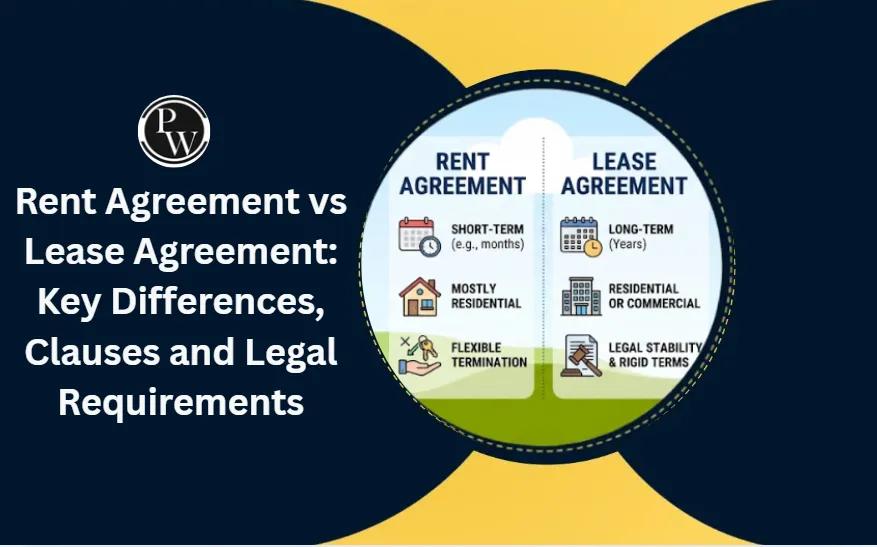
The two terms overlap a lot, and the title alone does not decide the legal position. The table below shows how they are used in practice.
Use it as a quick comparison, but remember that the actual terms of the document and the applicable law matter most.
|
Basis |
Rent agreement |
Lease agreement |
|
Common usage |
Often used for residential arrangements, especially shorter ones |
Commonly used for longer residential or commercial arrangements |
|
Legal meaning |
Not a separate statutory category; effect depends on its terms |
Lease is defined in Section 105 of the Transfer of Property Act, 1882 |
|
Duration |
Often drafted for a shorter period such as 11 months, but there is no universal rule |
May be for a fixed term, including more than one year, subject to formalities |
|
Registration |
Depends on the instrument, term and applicable law |
Compulsory in cases covered by Section 107 of the Transfer of Property Act and Section 17 of the Registration Act |
|
Stamp duty |
Depends on the state stamp law and the terms |
Depends on the state stamp law, term, rent, premium and other factors |
|
Typical use |
Residential occupation and shorter rentals |
Residential, commercial, industrial and other property |
|
Rights and duties |
Set by the agreement and tenancy law |
Set by the lease terms, the Transfer of Property Act and state law |
Do not assume that a rent agreement is always for 11 months and a lease agreement is always for more than one year. The title does not decide this.
What Are the Important Clauses in a Rent or Lease Agreement?
Both documents should record the duties of each party clearly. The exact clauses depend on the property, its use, the duration and the state law.
The table below lists the main clauses in a rent agreement or lease and why each one matters. Clear wording here prevents most later disputes. Drafters who want deeper practice can read what contract drafting is and why it matters.
|
Clause |
What to include |
Why it matters |
|
Details of parties |
Full names, addresses and identification details |
Shows who is entering the agreement |
|
Property description |
Address, unit, floor, area, parking and fixtures |
Identifies the premises |
|
Term and start date |
Start date, end date and duration |
Clarifies when the tenancy begins and ends |
|
Monthly rent |
Amount, due date and payment method |
Reduces payment disputes |
|
Security deposit |
Amount, permitted deductions and refund time |
Explains how the deposit is handled |
|
Rent revision |
Conditions, frequency and method of increase |
Avoids disagreement on increases |
|
Maintenance and repairs |
Who handles structural repairs, routine upkeep and damage |
Divides the repair duties |
|
Utilities and charges |
Electricity, water, gas and society charges |
Shows who pays each expense |
|
Permitted use |
Residential, commercial or other use |
Stops unauthorised use |
|
Entry and inspection |
Notice and reasonable conditions for the landlord’s entry |
Balances the landlord’s interest and the tenant’s privacy |
|
Subletting and assignment |
Whether allowed and on what terms |
Prevents unauthorised occupation |
|
Termination and notice |
Grounds, notice period and early exit terms |
Explains how the arrangement ends |
|
Renewal |
Procedure and revised rent |
Avoids doubt at the end of the term |
|
Handover and condition |
Inventory, condition report and keys |
Helps avoid disputes on exit |
|
Dispute resolution |
Applicable law and forum |
Shows how disputes will be handled |
|
Signatures and witnesses |
Signatures of parties and witnesses |
Records acceptance of the document |
No clause should conflict with the mandatory rules of the state tenancy law.
What Are the Legal Requirements for Rent and Lease Agreements in India?
Several laws apply to a tenancy document. The sections below follow the order in which a landlord, tenant or junior lawyer will meet them.
Transfer of Property Act, 1882
This is the main law on leases. Students who want a wider base can revise the Transfer of Property Act, 1882 as a whole.
-
Section 107: A lease from year to year, for a term of more than one year, or reserving yearly rent can generally be made only by a registered instrument. Other leases may be made by a registered instrument, or by an oral agreement with delivery of possession.
-
Section 108: It sets default rights and duties of lessor and lessee when the contract or local usage says nothing. The lessor must disclose certain material defects and put the lessee in possession. The lessee must pay rent and follow the lease terms.
-
Section 111: It explains how a lease ends, including expiry, surrender, forfeiture and other modes.
Section 108 has many specific rules. It does not mean that the landlord pays for all repairs or that the tenant pays for all repairs. The agreement and the law decide this, so any change from the default should be written down where the law allows.
Registration Requirements
Section 17(1)(d) of the Registration Act, 1908 makes registration compulsory for leases from year to year, for more than one year, or reserving yearly rent. Section 18(c) generally makes registration optional for leases not exceeding one year, subject to other laws.
Section 49 deals with the effect of leaving a compulsory document unregistered. For example, a lease for two years generally needs registration. A shorter one may be treated differently, but the state law and stamp rules must still be confirmed.
In Anthony v. K.C. Ittoop & Sons (2000) 6 SCC 394, the Supreme Court looked at the effect of an unregistered lease document that needed registration. It shows the limits on relying on such a document.
Stamp Duty and Notarisation
Stamp duty is not the same across India. It depends on the state, term, rent, premium, deposit and type of document, and e-stamping may be available in some states. A document with too little stamp duty may face problems as evidence until the duty and any penalty are dealt with.
Many people think notarisation and registration are the same. The table below shows how they differ, so keep it in mind when you advise clients.
|
Notarisation |
Registration |
|
A notary witnesses or authenticates certain documents and signatures |
The document is registered with the competent authority under the Registration Act |
|
It does not meet a compulsory registration requirement |
It meets the requirement where registration is compulsory |
|
It is not a substitute for registration |
It creates the legal record of the registered instrument |
State-Specific Tenancy Laws
Tenancy is largely governed by state law, so the law of the state where the property stands must be confirmed first. The Model Tenancy Act, 2021 is a model framework for states and Union Territories. It does not apply automatically across India.
Its provisions cover written agreements, security deposits, repairs, rent revision and a Rent Authority. For example, Sections 11, 15, 16, 17 and 21 deal with the deposit, repair duties, rent revision and the landlord’s entry. These apply only where a state adopts them. Do not apply one rule for deposits, notice, eviction or rent increases to the whole country.
How to Draft a Rent or Lease Agreement
A step-by-step method keeps the draft complete and lawful. Beginners can follow the same order each time.
-
Collect party details. Verify names, addresses and authority. If a representative acts for the landlord, confirm that authority.
-
Verify the property. Record the full address, description, permitted use and fixtures.
-
Decide the nature and term. Settle whether it is a lease or a licence, and fix the term and start date.
-
Confirm the money terms. Record rent, due dates, deposit, deductions, maintenance charges and rent revision.
-
Draft rights, duties and limits. Cover repairs, use, inspection, subletting, termination and renewal.
-
Review the law. Read the Transfer of Property Act, the Registration Act, the state tenancy law and the state stamp law.
-
Complete stamping and registration. Follow the current procedure of the competent authority in that state.
-
Review and sign. Look for missing details, clashing clauses and signatures, and give each party an executed copy.
Practice makes this routine easier. The PW Legal Drafting Certification Program covers property drafts such as lease deeds and rent agreements.
Want to develop practical legal drafting skills? Read how the PW Legal Drafting Certification Programme helps build practical legal skills and understand its relevance to legal learning and professional development.
What Common Mistakes Should You Avoid?
Most disputes come from small gaps in the draft. These are the errors seen most often.
-
Treating every rent agreement as an 11-month agreement, when no universal rule says so
-
Using a generic template that ignores the property and the state law
-
Describing the property poorly
-
Leaving security deposit terms unclear
-
Leaving out termination conditions
-
Ignoring stamp duty
-
Assuming notarisation is registration
-
Writing unclear repair and maintenance clauses
-
Ignoring state tenancy law
-
Not recording the condition of the property at handover
Drafting a lease needs an understanding of the parties’ aims, money terms, risks and legal steps. Learners can build these wider skills through the contract drafting program for beginners, which includes drafting practice and 10,000+ editable drafts.
Rent Agreement vs Leave and Licence Agreement
A leave and licence agreement is a different document and should not be mixed up with a rent agreement. Section 52 of the Indian Easements Act, 1882 defines a licence.
A licence is a right to do something on another’s property that would otherwise be unlawful, without creating an easement or an interest in the property. A lease transfers a right to enjoy the property.
In Associated Hotels of India Ltd. v. R.N. Kapoor (AIR 1959 SC 1262), the Supreme Court said the substance of the document and the real intention of the parties matter more than the title. Exclusive possession is an important sign of a lease, but the surrounding facts must also be weighed.
A rent agreement and a lease agreement are judged by their terms, duration and execution, and not by the name on top. A careful draft with correct stamping, registration where needed and the right state law keeps both sides safe.
Want to practise drafting rent agreements and lease deeds yourself? Explore the PW Legal Skills batches for live classes, drafting exercises and ready-to-edit legal drafts.