



NMAT Exam 2026: Dates, Registration, Syllabus, Pattern and Fees
 Anil Solonki3 Oct, 2026
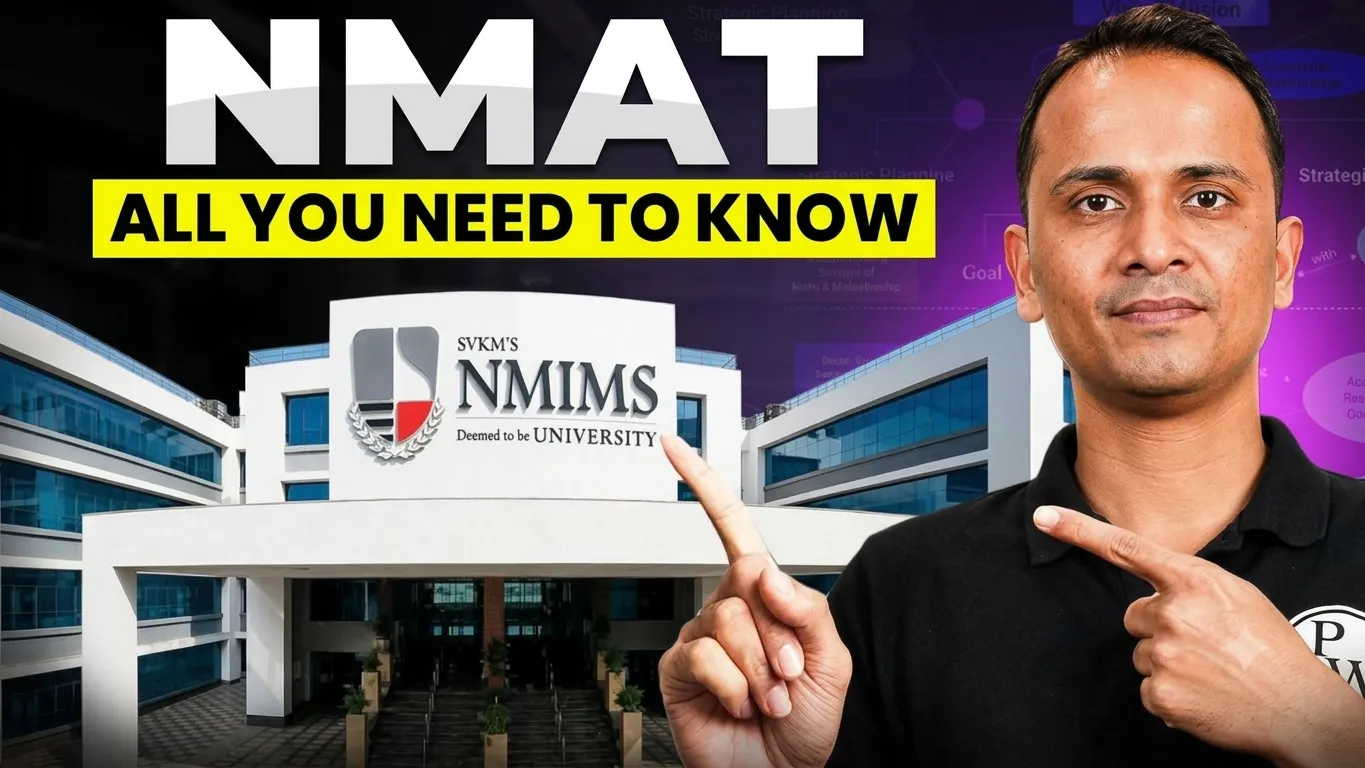
The NMAT Exam 2026 is a national-level MBA entrance examination conducted by the Graduate Management Admission Council (GMAC). It is accepted by several business schools in India and abroad for admission to MBA and other management programmes.
NMAT offers candidates flexibility in choosing their exam date, selecting the order of sections and taking multiple attempts within the testing cycle, subject to the examination rules. The exam evaluates candidates across three sections: Language Skills, Quantitative Skills and Logical Reasoning.
The NMAT 2026 registration window is open from 20 August to 10 October 2026, while the examination will be conducted from 2 November to 20 December 2026. Candidates planning to pursue an MBA in the 2027–29 admission cycle should check the eligibility requirements and application deadlines of their preferred business school
NMAT 2026 Highlights
Candidates can refer to the following table for an overview of the NMAT 2026 examination.
| Particulars | Details |
| Exam Name | NMAT by GMAC |
| Full Form | NMIMS Management Aptitude Test |
| Conducting Body | Graduate Management Admission Council (GMAC) |
| Exam Level | National-level entrance examination |
| Exam Frequency | Annual testing cycle |
| Exam Mode | Computer-based test and available delivery options as per location |
| Exam Duration | 120 minutes |
| Total Questions | 108 |
| Total Sections | 3 |
| Sections | Language Skills, Quantitative Skills and Logical Reasoning |
| Negative Marking | No negative marking |
| Registration Mode | Online |
| Registration Dates | 20 August to 10 October 2026 |
| NMAT Exam Date | 2 November to 20 December 2026 |
| Retake Attempts | Up to two retakes after the first attempt, subject to rules |
| Result | Unofficial score preview after the test; official score generally within 48 hours |
| Official Website | mba.com/exams/nmat |
NMAT 2026 Important Dates
GMAC has announced the schedule for the NMAT 2026 testing cycle. Candidates should track the registration deadline, exam scheduling dates and testing window to avoid missing important events.
NMAT 2026 Exam Schedule
| Events | Dates |
| NMAT 2026 Registration | 20 August 2026 |
| NMAT 2026 Registration Closes | 10 October 2026 |
| Exam Scheduling Begins | 20 August 2026 |
| Exam Scheduling Closes | 22 October 2026 |
| Exam Rescheduling Begins | 20 August 2026 |
| Exam Rescheduling Closes | 17 December 2026 |
| NMAT 2026 Exam Begins | 2 November 2026 |
| NMAT 2026 Exam Ends | 20 December 2026 |
| Retake Registration Begins | 3 November 2026 |
| Retake Registration Closes | 17 December 2026 |
| Retake Scheduling Closes | 17 December 2026 |
Candidates should book their preferred exam slot early because availability depends on the selected test centre, date and time.
Important: NMAT registration and applications to participating business schools are separate processes. Candidates must complete the application process for each institution according to its admission requirements and deadlines.
NMAT 2026 Eligibility Criteria
Candidates planning to take NMAT 2026 should review the admission requirements of the business schools where they intend to apply. GMAC conducts the examination, but individual institutions decide their own eligibility criteria for MBA and other programmes.
Educational Qualification
The general NMAT eligibility criteria expectations for many NMAT-accepting MBA programmes include:
- A bachelor's degree or equivalent qualification from a recognised university.
- A minimum aggregate score, commonly 50% for certain programmes.
- Final-year undergraduate students may apply where the target institution permits it.
- International or foreign degree holders may need to meet additional equivalence or documentation requirements.
These are general guidelines, not a universal eligibility rule for every NMAT-accepting institution.
Age Limit
There is no general age limit specified for taking the NMAT examination. However, candidates should check the admission criteria of their selected business schools for any programme-specific requirements.
Eligibility for Final-Year Students
Candidates appearing in the final year of their bachelor's degree may be eligible to take NMAT. Admission offers may be conditional on completing their graduation and submitting the required academic documents within the deadlines set by the institution.
NMAT 2026 Registration Process
The NMAT 2026 application process is conducted online through the official NMAT by GMAC portal. Candidates must create an account, complete their profile, pay the examination fee and schedule their test.
Steps to Register for NMAT 2026
Step 1: Visit the official website
Go to mba.com/exams/nmat and open the registration section.
Step 2: Create an NMAT account
Register using a valid email address and provide the required personal information. Verify your account using the instructions sent to your registered email address.
Step 3: Complete the candidate profile
Log in to the NMAT dashboard and fill in the required personal, academic and communication details. Ensure that your name and date of birth match your accepted photo identification.
Step 4: Upload your photograph
Upload a recent photograph that meets the official requirements and resembles your photo identification.
Step 5: Select business schools
Choose the business schools where you want your NMAT scores to be sent. The registration fee includes score reporting to the first five selected schools, subject to the current policy.
Step 6: Pay the registration fee
Pay the applicable NMAT registration fee using an available payment method.
Step 7: Schedule the exam
After successful registration, open the candidate dashboard and select the exam scheduling option. Choose an available date, time and delivery option according to your location.
Step 8: Download the admit card
Download your admit card from the candidate dashboard before the examination. Check the examination date, time, location and instructions carefully.
NMAT 2026 Application Fees
Candidates must pay the applicable fee for registration, retakes, rescheduling or additional score reports.
NMAT 2026 Fee Structure
| Fee Type | Amount |
| NMAT Registration Fee | ₹3,000 + applicable taxes |
| NMAT Retake Fee | ₹3,000 + applicable taxes |
| Exam Rescheduling Fee | ₹1,200 + applicable taxes |
| Additional Score Report | ₹400 + applicable taxes per report beyond the first five |
The registration fee includes score reporting to up to five selected business schools. Additional score reports require an extra payment.
Candidates should confirm the payable amount on the official payment page before completing the transaction.
NMAT 2026 Exam Pattern
The NMAT exam pattern consists of three sections: Language Skills, Quantitative Skills and Logical Reasoning. Candidates have 120 minutes to complete 108 questions.
The examination follows an adaptive format, and candidates can choose the order in which they attempt the sections. Each section has a separate time limit.
NMAT 2026 Section-Wise Exam Pattern
| Sections | Number of Questions | Time Limit |
| Language Skills | 36 | 28 minutes |
| Quantitative Skills | 36 | 52 minutes |
| Logical Reasoning | 36 | 40 minutes |
| Total | 108 | 120 minutes |
NMAT Marking Scheme
The NMAT examination uses a scaled scoring system. Candidates should understand the following scoring details:
- The overall score ranges from 36 to 360.
- Each section has its own scaled score.
- There is no negative marking for incorrect answers.
- All three sections have equal weightage in the examination structure.
- The examination is adaptive, and question difficulty can adjust based on the candidate's performance.
Candidates should avoid leaving questions unanswered because there is no negative marking. However, they must manage their time carefully because each section has a separate time limit.
NMAT 2026 Syllabus
The NMAT syllabus is divided into three major sections: Language Skills, Quantitative Skills and Logical Reasoning. Although GMAC provides an official exam structure, candidates should treat topic lists as preparation guidance rather than a guaranteed exhaustive list of every question type.
1. NMAT Language Skills Syllabus
The Language Skills section evaluates English comprehension, vocabulary, grammar and verbal reasoning.
Important topics include:
- Reading Comprehension
- Para Jumbles
- Sentence Correction
- Error Detection
- Fill in the Blanks
- Vocabulary
- Synonyms and Antonyms
- Analogies
- Sentence Completion
- Grammar and Usage
- Prepositions
- Idioms and Phrases
- Word Meaning
- Para Completion
Candidates should practise reading passages, identifying the main idea, understanding contextual vocabulary and improving grammatical accuracy.
2. NMAT Quantitative Skills Syllabus
The Quantitative Skills section evaluates mathematical aptitude, numerical reasoning and data interpretation.
Important topics include:
- Number Systems
- Arithmetic
- Percentages
- Profit and Loss
- Simple and Compound Interest
- Ratio and Proportion
- Averages
- Time, Speed and Distance
- Time and Work
- Mixtures and Alligation
- Algebra
- Linear Equations
- Quadratic Equations
- Geometry
- Mensuration
- Probability
- Permutations and Combinations
- Progressions
- Data Interpretation
- Data Sufficiency
Candidates should focus on calculation accuracy, selecting efficient methods and solving questions within the allotted time.
3. NMAT Logical Reasoning Syllabus
The Logical Reasoning section measures analytical thinking, problem-solving ability and the ability to interpret relationships between different elements.
Important topics include:
- Coding and Decoding
- Series
- Blood Relations
- Direction Sense
- Seating Arrangements
- Puzzles
- Syllogisms
- Statement and Conclusion
- Statement and Assumption
- Critical Reasoning
- Input-Output
- Venn Diagrams
- Analytical Reasoning
- Cause and Effect
- Decision Making
- Logical Sequences
Regular practice with timed reasoning sets can help candidates improve accuracy and develop effective problem-solving strategies.
NMAT 2026 Admit Card
Candidates can download their NMAT admit card through the official candidate dashboard after completing registration and scheduling.
How to Download the NMAT Admit Card
- Visit the official NMAT by GMAC website.
- Log in to the candidate dashboard.
- Open the exam scheduling or admit-card section.
- Find the relevant examination booking.
- Download the admit card and save a copy.
- Review the examination instructions before test day.
The admit card contains important examination details such as the candidate's information, scheduled test details and instructions. Candidates should carry the required identification documents and follow the rules applicable to their selected examination mode.
NMAT 2026 Result
NMAT provides an unofficial score preview after the examination. The official scorecard is generally made available within 48 hours, subject to any security review or examination-related issue.
How to Check the NMAT Result
Candidates can follow these steps to access their results:
- Visit mba.com/exams/nmat.
- Log in using the registered NMAT account.
- Open the candidate dashboard.
- Navigate to the scorecard or result section.
- View the available result details.
- Download and retain the official scorecard.
The scorecard provides the candidate's overall score and section-wise scores. Candidates should use their scores while completing the admission process for their selected business schools.
Colleges Accepting NMAT Scores
NMAT scores are accepted by several business schools for selected MBA and management programmes. Acceptance may vary by institution, programme and admission year.
Some institutions that have accepted NMAT scores include:
| Institution | Programme or Admission Note |
| Narsee Monjee Institute of Management Studies (NMIMS) | Selected management programmes |
| K J Somaiya Institute of Management | Selected MBA programmes |
| T. A. Pai Management Institute (TAPMI) | Selected management programmes |
| FLAME University | Selected MBA programmes |
| SDA Bocconi Asia Center | Selected management programmes |
| Indian School of Business (ISB) | Selected programmes, subject to current admission requirements |
| SPJIMR | Selected programmes, subject to current admission requirements |
Candidates must confirm whether their preferred programme accepts NMAT 2026 scores for the relevant admission cycle. The list of accepting institutions and their requirements can change.
NMAT 2026 Selection Process
The NMAT selection process varies across participating business schools. Taking the NMAT examination does not automatically guarantee admission to a management programme.
The typical admission process may include the following stages.
Stage 1: NMAT Examination
Candidates register for NMAT, schedule their examination and obtain a valid score.
Stage 2: Business School Applications
Candidates apply separately to their preferred institutions. They must complete the NMAT application form requirements and submit the required documents before the relevant deadlines.
Stage 3: Shortlisting
Business schools may shortlist applicants using NMAT scores and other admission criteria. The NMAT cutoff or shortlisting process differs by institution and programme.
Stage 4: Further Admission Rounds
Shortlisted candidates may be required to participate in additional admission activities, such as:
- Personal Interview
- Group Discussion
- Written Ability Test
- Case Discussion
- Other institution-specific evaluation rounds
Not every institution uses all these stages.
Stage 5: Final Selection
Institutions prepare their final admission decisions using their published selection criteria. These may include entrance examination scores, academic performance, interview performance, work experience and other relevant factors.
Candidates should check the official admission pages of their selected business schools for the latest process.
NMAT Preparation Tips for 2026
A structured preparation plan can help candidates cover the syllabus, improve accuracy and manage the sectional time limits.
- Understand the Exam Pattern: Start by reviewing the number of questions, sectional time limits, scoring system and adaptive format. This will help you plan your preparation and practise under realistic conditions.
- Prepare a Section-Wise Study Plan: Divide your preparation time among Language Skills, Quantitative Skills and Logical Reasoning. Give additional attention to topics where your accuracy or speed is comparatively weak.
- Practise with Mock Tests: Take full-length mock tests to understand the exam experience and evaluate your performance. Review incorrect answers and identify recurring mistakes after every test.
- Improve Time Management: Each section has a separate time limit. Practise solving questions efficiently and avoid spending too much time on a single difficult question.
- Strengthen Vocabulary and Reading Skills: Read editorials, articles and other English-language material regularly. Practise reading comprehension, vocabulary and grammar questions to build verbal ability.
- Focus on Quantitative Fundamentals: Revise arithmetic, algebra, number systems and data interpretation. Strengthen your fundamentals before moving on to complex questions.
- Practise Logical Reasoning Sets: Solve different types of puzzles, arrangements, critical reasoning questions and analytical reasoning sets. Focus on accuracy and a clear problem-solving approach.
- Analyse Your Mock-Test Performance: Review your section-wise scores, accuracy and time usage. Use this information to adjust your study plan and focus on topics that need improvement.
NMAT Exam 2026 FAQs
What is the NMAT 2026 exam date?
What is the last date to register for NMAT 2026?
How many attempts are allowed in NMAT 2026?
Is NMAT an online or offline examination?
Which colleges accept NMAT scores?












 Live & recorded classes available at easeDashboard for progress trackingMillions of practice questions at your fingertips