These questions test students' understanding of how matter is composed, how chemical reactions follow specific laws, and how to calculate quantities of substances. Mastery of these concepts is essential for grasping advanced chemistry topics, as they form the basis of understanding atomic interactions, chemical equations, and quantitative analysis in future studies.
Important Questions Class 9 Science Chapter 3 Atoms and Molecules
This section provides important questions and detailed answers from Atoms and Molecules Class 9 Science Chapter 3. These questions help reinforce your understanding of the chapter. They prepare you for various examination patterns. Practice these problems to improve your conceptual clarity and problem-solving skills.
-
Fill in the blanks:
(a) In a chemical reaction, the sum of the masses of the reactants and products remains unchanged. This is called .
(b) A group of atoms carrying a fixed charge on them is called .
(c) The formula unit mass of Ca3(PO4)2 is .
(d) Formula of sodium carbonate is , and that of ammonium sulphate is _.
Sol.
(a) In a chemical reaction, the sum of the masses of the reactants and products remains unchanged. This is called the Law of conservation of mass.
(b) A group of atoms carrying a fixed charge on them is called a polyatomic ion.
(c) The formula unit mass of Ca3(PO4)2 is 310 g.
(d) Formula of sodium carbonate is Na2CO3, and that of ammonium sulphate is (NH4)2SO4.
-
Write the formulae for the following and calculate the molecular mass for each of them.
(a) Caustic potash
(b) Baking powder
(c) Limestone
(d) Caustic soda
(e) Ethanol
(f) Common salt
Sol.
(a) The formulae of Caustic potash is KOH. The molecular mass of Caustic potash is 39 + 16 + 1 = 56 u.
(b) The formula of Baking powder is NaHCO3. The molecular mass of Baking powder is 23 + 1 + 12 + 3 × 16 = 84 u.
(c) The formula of Limestone is CaCO3. The molecular mass of Limestone is 40 + 12 + 3 × 16 = 100 u.
(d) The formula of Caustic soda is NaOH. The molecular mass of Caustic soda is 23 + 16 + 1 = 40 u.
(e) The formula of Ethanol is C2H5OH. The molecular mass of 12 × 2 + 5 × 1 + 16 + 1 = 46 u.
(f) The formula of Common salt is NaCl. The molecular mass of Common salt is 23 + 35.5 = 58.5 u.
-
What is an atomic mass unit'? How is it linked with relative atomic mass?
Sol. The atomic mass unit is defined as the 1/12 of the mass of carbon – 12 atom C – 12. The relative atomic mass of an element is the number of times one atom of the element is heavier than 1/12 times the mass of an atom of carbon –12.
-
Which are the six postulates of Dalton's atomic theory?
Sol.
(i) All matter is made of very tiny particles called atoms, which participate in chemical reactions.
(ii) Atoms are indivisible particles, which cannot be created or destroyed in a chemical reaction.
(iii) Atoms of a given element are identical in mass and chemical properties.
(iv) Atoms of different elements have different masses and chemical properties.
(v) Atoms combine in the ratio of small whole numbers to form compounds.
(vi) The relative number and kinds of atoms are constant in a given compound.
-
Define the law of constant proportion.
Sol. It states that 'In a pure chemical substance, the elements are always present in definite proportions by mass'.
-
Write atomicity of the following:
(i) Sulphur
(ii) Phosphorus
Sol.
(i) Polyatomic
(ii) Tetra atomic
-
Define atomic mass unit.
Sol. One atomic mass unit is a mass unit equal to th 1
⎛ ⎞ ⎜ ⎟ ⎝ ⎠
exactly one twelfth the mass of one atom 12
of carbon –12.
-
Which postulate of Dalton's atomic theory is the result of the law of conservation of mass?
Sol. Atoms are indivisible particles, which cannot be created or destroyed in a chemical reaction.
-
Which postulate of Dalton's atomic theory can explain the law of definite proportions?
Sol. Atoms combine in the ratio of small numbers to form compounds. In a compound, the relative number and kinds of atoms are constant.
-
What is meant by the term chemical formula?
Sol. The chemical formula of a compound is a symbolic representation of its composition and the actual number of atoms in one molecule of a pure substance, may be an atom or a compound.
-
Give two drawbacks of Dalton's atomic theory.
Sol. Drawbacks of Dalton's Atomic Theory:
(i) According to modern theory, atom is not the ultimate indivisible particle of matter. Today, we know that atoms are divisible, i.e., they are themselves made-up of particles (protons, electrons, neutrons, etc.).
(ii) In case of isotopes of an element, the assumption that the atoms of the same element have same mass does not hold good.
-
How would you differentiate between a molecule of element and a molecule of compound? Write one example of each type.
Sol. Molecule of an element is made-up of only one kind of atoms, e.g., O2, N2, F2, O3, P4, S8 etc. Molecule of a compound is made-up of two or more different kinds of atoms in a fixed ratio, e.g., H2O, CS2, H2S, NH3, CH4.
-
Hydrogen and oxygen combine in the ratio of 1 : 8 by mass to form water. What mass of oxygen gas would be required to react completely with 3 g of hydrogen gas?
Sol. 1 g of hydrogen reacts with oxygen = 8 g
3 g of hydrogen reacts with oxygen = 8 × 3 g = 24 g
-
When 3.0 g of carbon is burnt in 8.00 g of oxygen, 11.00 g of carbon dioxide is produced. What mass of carbon dioxide will be formed when 3.00 g of carbon is burnt in 50.00 g of oxygen? Which law of chemical combination will govern your answer?
Sol. 3 g of carbon produces carbon dioxide = 11 g. The remaining oxygen 50 g – 8 g = 42 g does not take part in the reaction. The law of definite proportion is governed by the above data.
-
Classify the following compounds diatomic, triatomic and polyatomic molecules: HCl, H2, H2O, NH3, CH3OH, PCl5
Sol.
Diatomic: HCl, H2
Tri atomic: H2O
Polyatomic: NH3, CH3OH, PCl5
-
In a reaction, 5.3 g of sodium carbonate reacted with 6 g of ethanoic acid. The products were 2.2 g of carbon dioxide, 0.9 g water and 8.2 g of sodium ethanoate. Show that these observations are in agreement with the law of conservation of mass, sodium carbonate + ethanoic acid → sodium ethanoate + carbon dioxide + water.
Sol. Mass of reactants before experiment = Mass of sodium carbonate + Mass of ethanoic acid = 5.3 g + 6g = 11.3 g
Mass of products after experiment = Mass of sodium ethanoate + Mass of carbon dioxide + Mass of water = 8.2 g + 2.2 g + 0.9 g = 11.3 g
The mass of reactants is equal to the mass of products, therefore, it proves law of conservation of mass.
-
State the law of conservation of mass. Is this law applicable to the chemical reactions? Elaborate your answer with the help of an example.
Sol. Law of conservation of mass states that mass can neither be created nor destroyed in a chemical reaction. Yes, this law is applicable to the chemical reactions. In all chemical reactions, there is only exchange of reactants taking place when products are formed. There is no loss or gain of mass. For example, in the following reaction, the total mass of the reactants is equal to the total mass of the products formed. AgNO3 + NaCl → AgCl + NaNO3
-
Define formula unit mass. Calculate formula unit mass of NaCI (Atomic mass of Na = 23 u, Cl = 35.5 u)
Sol. The formula unit mass is same as molecular mass which is equal to the sum of masses of atoms present in a formula unit. Formula unit mass of NaCI = (23 + 35.5) = 58.5 u.
-
Define atomicity.
Sol. The number of atoms present in one molecule of an element or a compound is known as its atomicity.
-
What are polyatomic ions? Give two examples.
Sol. A group of atoms having a charge is known as polyatomic ion. Examples: (NH4)+, (SO4)2-
-
Define the atomic mass unit.
Sol. The mass of 1/12 part of C-12 is equivalent to one atomic mass unit. Previous, it was denoted by symbol 'amu' but nowadays it is denoted by symbol 'u'.
-
Give the chemical name, chemical formulae for the following: Washing soda, blue vitriol, baking soda, green vitriol, oil of vitriol, soda ash, marble chips, lime water.
Sol.
|
Compound Name
|
Chemical Name
|
Chemical Formula
|
|
Washing soda
|
Sodium carbonate
|
Na2CO3·10H2O
|
|
Blue vitriol
|
Copper sulfate
|
CuSO4·5H2O
|
|
Baking soda
|
Sodium bicarbonate
|
NaHCO3
|
|
Green vitriol
|
Ferrous sulfate
|
FeSO4·7H2O
|
|
Oil of vitriol
|
Sulfuric acid
|
H2SO4
|
|
Soda ash
|
Anhydrous sodium carbonate
|
Na2CO3
|
|
Marble chips
|
Calcium carbonate
|
CaCO3
|
|
Lime water
|
Calcium hydroxide
|
Ca(OH)2
|
-
If the valency of an element X is 3, then write the chemical formula of its oxide.
Sol.
X O
3 2
Formula : X2O3
-
State two examples in each case and write their chemical formulae:
(a) Molecules having same kind of atoms only.
(b) Molecules having two different kinds of atoms.
(c) Molecules having three different kinds of atoms.
Sol.
(a) F2, Cl2, P4, S8
(b) Ammonia (NH3), Sulphur dioxide (SO2), Carbon disulphide (CS2).
(c) Calcium sulphate (CaSO4), Sodium nitrate (NaNO3).
-
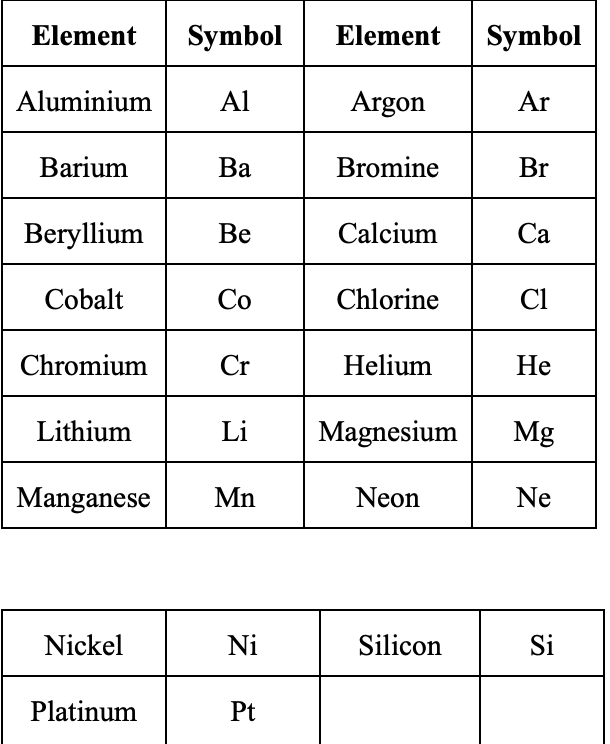
Write the symbols of the following elements: Aluminium, Argon, Barium, Bromine, Beryllium, Calcium, Cobalt, Chlorine, Chromium, Helium, Lithium, Magnesium, Manganese, Neon, Nickel, Silicon, and Platinum.
Sol.
-
Give symbol and valency of Potassium, Barium, Aluminium, Calcium, Cobalt, Fluorine, Lead, Zinc, Iodine, Sulphide.
Sol.
|
Name
|
Symbol
|
Valency
|
|
Potassium
|
K
|
1+
|
|
Barium
|
Ba
|
2+
|
|
Aluminium
|
Al
|
3+
|
|
Calcium
|
Ca
|
2+
|
|
Cobalt
|
Co
|
2+, 3+
|
|
Fluorine
|
F
|
1-
|
|
Lead
|
Pb
|
2+, 4+
|
|
Zinc
|
Zn
|
2+
|
|
Iodine
|
I
|
1-
|
|
Sulphide
|
S
|
2-
|
-
Write formula for the following:
(a) Zinc sulphate,
(b) Methane,
(c) Ammonium carbonate.
Sol.
(a) Zinc sulphate
Zn SO4
+2 –2
Thus, Zn2(SO4)2 and finally = ZnSO4
(b) Methane
C H
+4 1
Thus, finally = CH4
(c) Ammonium carbonate
Nh4 CO3
1 –2
Thus, finally = (NH4)2CO3
-
The formula of chloride of a metal M is MCl3, then the formula of the phosphate of metal M will be
(A) MPO4
(B) M2PO4
(C) M3PO4
(D) M2(PO4)3
Sol. MPO4
-
Match the columns by choosing the correct option.
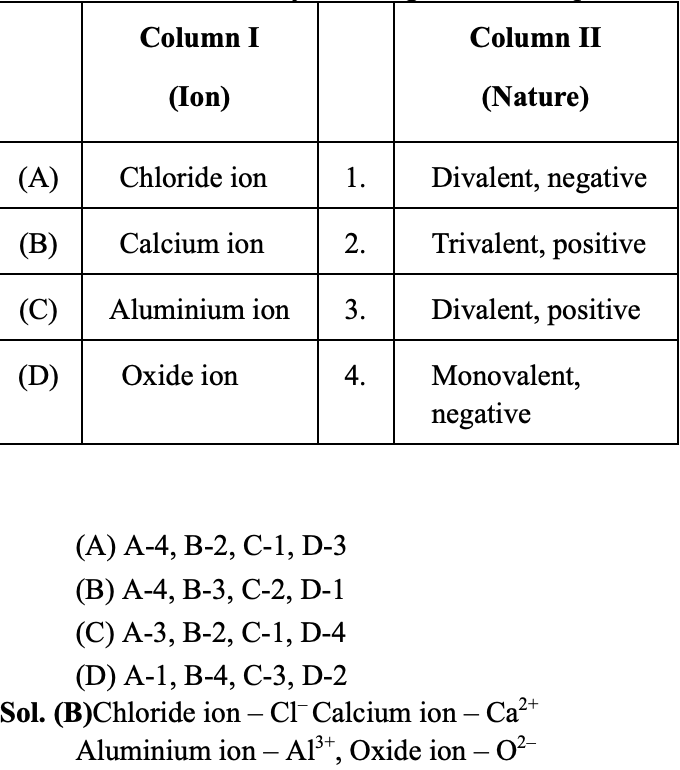
30. Some elements and ions with their valencies are enlisted in the given table:
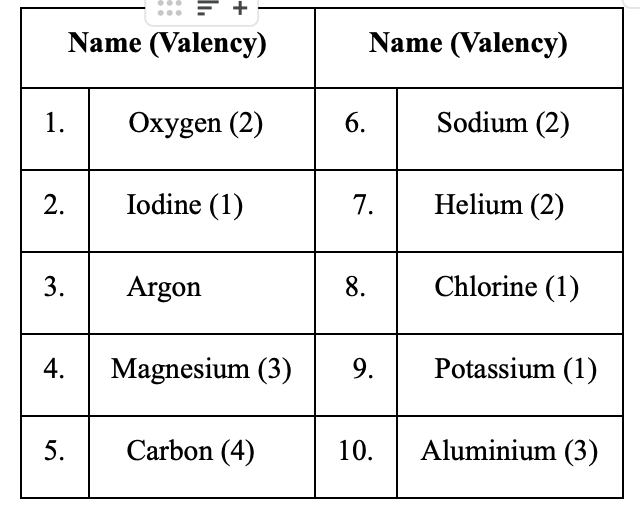
Select the incorrect match.
(A) 4, 5, 7 and 9
(B) 4, 6 and 7
(C) 1, 8, 9 and 10
(D) 2, 3, 5 and 9
Sol. 4, 6 and 7
31. Choices for the correct combination from List-I and List-II are given as options (a), (b), (c) and (d) out of which one is correct.
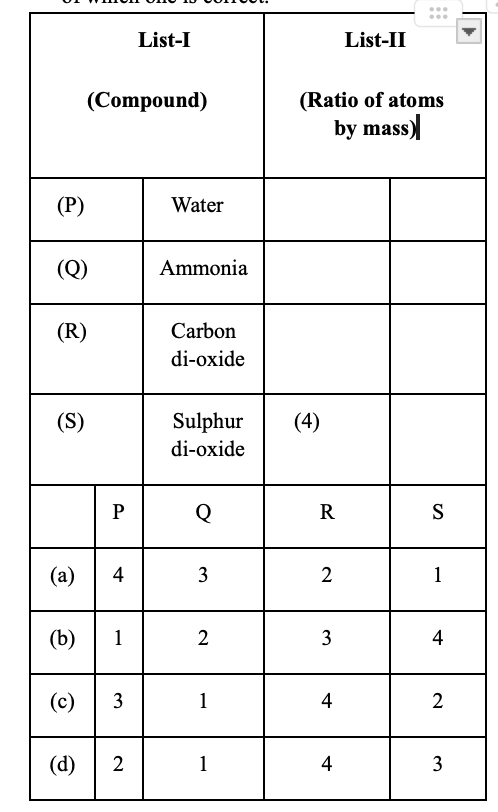
Sol. (D) H2O = 1:8
NH3 = 14:3
CO2 = 3:8
SO2 = 1:1
32. Assertion: The atomic mass of aluminium is 27
Reason: An atom of aluminium is 27 times heavier than the mass of a carbon-12 atom.
(A) Both (A) and (R) are true and reason (R) is the correct explanation of the assertion (A).
(B) Both (A) and (R) are true, but reason (R) is not the correct explanation of the assertion (A).
(C) (A) is true, but (R) is false.
(D) (A) is false, but (R) is true.
Sol.(A)Both assertion (A) and reason (R) are true and reason (R) is the correct explanation of assertion (A).
33. Assertion: When 10 g of CaCO3 is decomposed, 5.6 g of residue is left and 4.4 g of CO2 escapes.
Reason: The law of conservation of mass is followed.
(A) Both (A) and (R) are true and reason (R) is the correct explanation of the assertion (A).
(B) Both (A) and (R) are true, but reason (R) is not the correct explanation of the assertion (A).
(C) (A) is true, but (R) is false.
(D) (A) is false, but (R) is true.
Sol. (A)Both assertion (A) and reason (R) are true and reason (R) is the correct explanation of assertion (A).
Benefits of Solving Important Questions Class 9 Science Chapter 3
Solving important questions from Chapter 3 "Atoms and Molecules" in Class 9 Science offers several key benefits:
Enhanced Conceptual Clarity : By practicing questions on atomic theory, chemical laws, and molecular mass, students develop a deeper understanding of the core concepts, helping them grasp the basics of chemistry more effectively.
Application of Theoretical Knowledge : Important questions test the practical application of theoretical concepts like the Law of Conservation of Mass, the Law of Constant Proportion, and Dalton’s Atomic Theory. Solving them reinforces learning through real-world chemical problems.
Improved Problem-Solving Skills : Questions based on atomic mass, molecular formulas, and the mole concept encourage analytical thinking and enhance problem-solving abilities. This sharpens mathematical skills crucial for future chemistry calculations.
Better Exam Preparation : These questions are designed to reflect typical exam patterns, enabling students to familiarize themselves with the format, marking scheme, and important areas that are likely to be covered in exams. It helps reduce anxiety by giving them a feel of what to expect.
Stronger Foundation for Higher Studies : Understanding atoms and molecules is fundamental for advanced chemistry. Solving detailed questions ensures that students build a strong foundation, preparing them for more complex topics in higher grades.
Explore More Chapters