Development of Nervous System, Types Of Development
The nervous system develops from the ectoderm following an inductive signal from the mesoderm. The initial mesodermal cells condense to form the notochord, which elongates under the primitive streak along the anterior—posterior axis of the developing embryo. Read to know more.
 Nivedita Dar14 Aug, 2026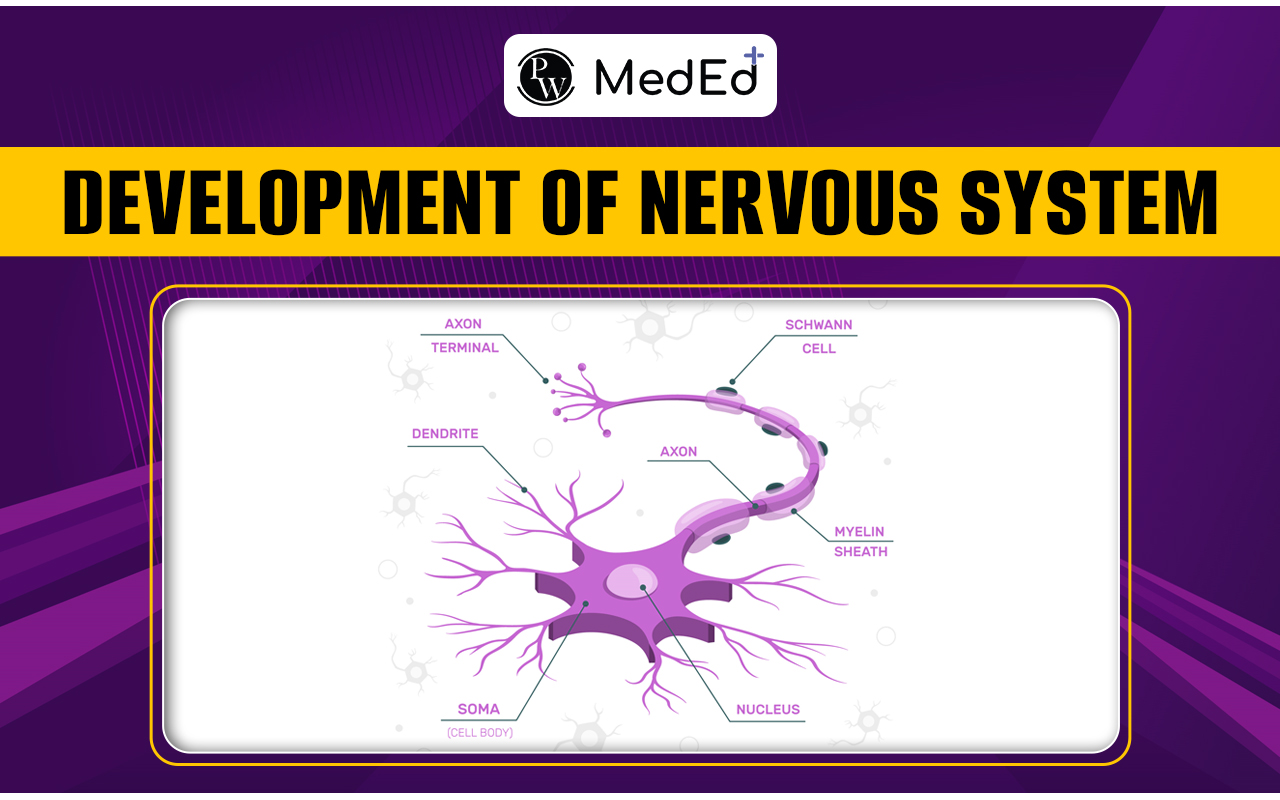
Development of Nervous System - The complex origin of the command center of the body.
Visit - MedEd App
Read More - Scabies
Embryological Development of the Nervous System
Embryological development is an intricate process, with the formation of the human nervous system being one of the most vital components. The development of our bodies defines our physical existence, but the development of the brain makes us who we are, giving us the ability to think, see, feel, and form our personalities. The nervous system has multiple elements, each of which has different responsibilities when well-formed and developed. The central nervous system (CNS) is composed of the brain and spinal cord. The brain interprets information received by the spinal cord and generates its own signals and instructions for the body to carry out. The spinal cord transmits information from the brain to the body and vice versa.Early Development
In the early stages of embryogenesis, three iconic layers of tissue develop within the embryo: the endoderm, mesoderm, and ectoderm. A section of ectoderm leads to the development of the neural plate, which begins to differentiate under the influence of the nearby notochord as this solid, cord-like structure secretes many factors and paraxial mesoderm around the third week. The edges of the neural plate then elevate to form the neural folds. In a process called neurulation, the neural folds curve upward and fuse to form the neural tube, which will become the central nervous system. The neural plate also forms the neural crest, cells of which will later migrate to different parts of the body and become most of the cells in the peripheral nervous system (PNS) and autonomic nervous system (ANS).Visit - MedEd App
Neural Tube Formation
Neurulation begins in the fourth week of development (around day 22-23). The neural folds fuse first in the cervical region and continue to fuse in both cranial (head) and caudal (tail) directions until only the very ends of the tube remain open and connected with the amniotic cavity. These openings are called neuropores, with the opening at the cranial end of the embryo being the rostral neuropore, and the opening at the caudal end being the caudal neuropore. The rostral neuropore closes around day 25, and the caudal neuropore closes approximately two days later.Development of the Central Nervous System
The neural tube becomes vascularized around the time that the neuropores close. Regions of the neural tube begin to thicken, forming the brain and spinal cord, and the opening within the tube begins to form the ventricles and central spinal canal. Read More - Pelvis and PerineumDevelopment of the Spinal Cord
The caudal part of the neural tube (i.e., the neural tube after the fourth pair of somites) becomes the spinal cord. As the walls of the neural tube thicken, the neural canal becomes smaller and smaller until only a very thin central canal remains. The neuroepithelium surrounding this canal transitions from pseudostratified columnar ependymal epithelium (the cell layer surrounding the ventricles, constituting the ventricular zone) to instead form neurons and macroglia (including astrocytes and oligodendrocytes) within the spinal cord. The formation of neurons from neuroepithelial cells occurs when neuroepithelial cells in the ventricular zone differentiate into primordial neurons called neuroblasts. It is in this layer that neurons will eventually form the gray matter of the spinal cord.Development of Nervous System FAQs
Why can folate deficiency lead to neural tube defects?
Folate deficiency can lead to neural tube defects because folate is essential for DNA synthesis, repair, and methylation. A deficiency can disrupt these processes, leading to incomplete closure of the neural tube, resulting in conditions such as spina bifida and anencephaly.
What is anencephaly?
Anencephaly is a severe neural tube defect where a significant portion of the brain, skull, and scalp fail to develop. It results from the rostral end of the neural tube failing to close, leading to the absence of major portions of the brain and skull.
What is holoprosencephaly?
Holoprosencephaly is a congenital brain malformation resulting from incomplete division of the embryonic forebrain (prosencephalon) into two hemispheres. It can lead to facial deformities and severe neurological impairments.
What is spina bifida?
Spina bifida is a type of neural tube defect where the backbone and membranes around the spinal cord don’t close properly. It can vary in severity, from mild forms like spina bifida occulta to severe forms like myelomeningocele, which involves the spinal cord protruding through the back.

🔥 Trending Blogs



Join 15 Million students on the app today!
 Live & recorded classes available at easeDashboard for progress trackingMillions of practice questions at your fingertips


Free Learning Resources
PW Books
Notes (Class 10-12)
PW Study Materials
Notes (Class 6-9)
Ncert Solutions
Govt Exams
Our Other Websites
Class 6th to 12th Online Courses
Govt Job Exams Courses
UPSC Coaching
Defence Exam Coaching
Gate Exam Coaching
Other Exams
Know about Physics Wallah
Physics Wallah is an Indian edtech platform that provides accessible & comprehensive learning experiences to students from Class 6th to postgraduate level. We also provide extensive NCERT solutions, sample paper, NEET, JEE Mains, BITSAT previous year papers & more such resources to students. Physics Wallah also caters to over 3.5 million registered students and over 78 lakh+ Youtube subscribers with 4.8 rating on its app.
We Stand Out because
We provide students with intensive courses with India’s qualified & experienced faculties & mentors. PW strives to make the learning experience comprehensive and accessible for students of all sections of society. We believe in empowering every single student who couldn't dream of a good career in engineering and medical field earlier.
Our Key Focus Areas
Physics Wallah's main focus is to make the learning experience as economical as possible for all students. With our affordable courses like Lakshya, Udaan and Arjuna and many others, we have been able to provide a platform for lakhs of aspirants. From providing Chemistry, Maths, Physics formula to giving e-books of eminent authors like RD Sharma, RS Aggarwal and Lakhmir Singh, PW focuses on every single student's need for preparation.
What Makes Us Different
Physics Wallah strives to develop a comprehensive pedagogical structure for students, where they get a state-of-the-art learning experience with study material and resources. Apart from catering students preparing for JEE Mains and NEET, PW also provides study material for each state board like Uttar Pradesh, Bihar, and others
Copyright © 2026 Physicswallah Limited All rights reserved.