






Venous Blood Supply to Heart, Anatomy and Circulation of the Heart
All the venous blood from the heart arrives at the coronary sinus which is located in the atrioventricular groove. The coronary sinus is the biggest cardiac vein, and it empties directly into the right atrium at the conjunction of the coronary and the interventricular grooves.
 Nivedita Dar8 Oct, 2024
Share
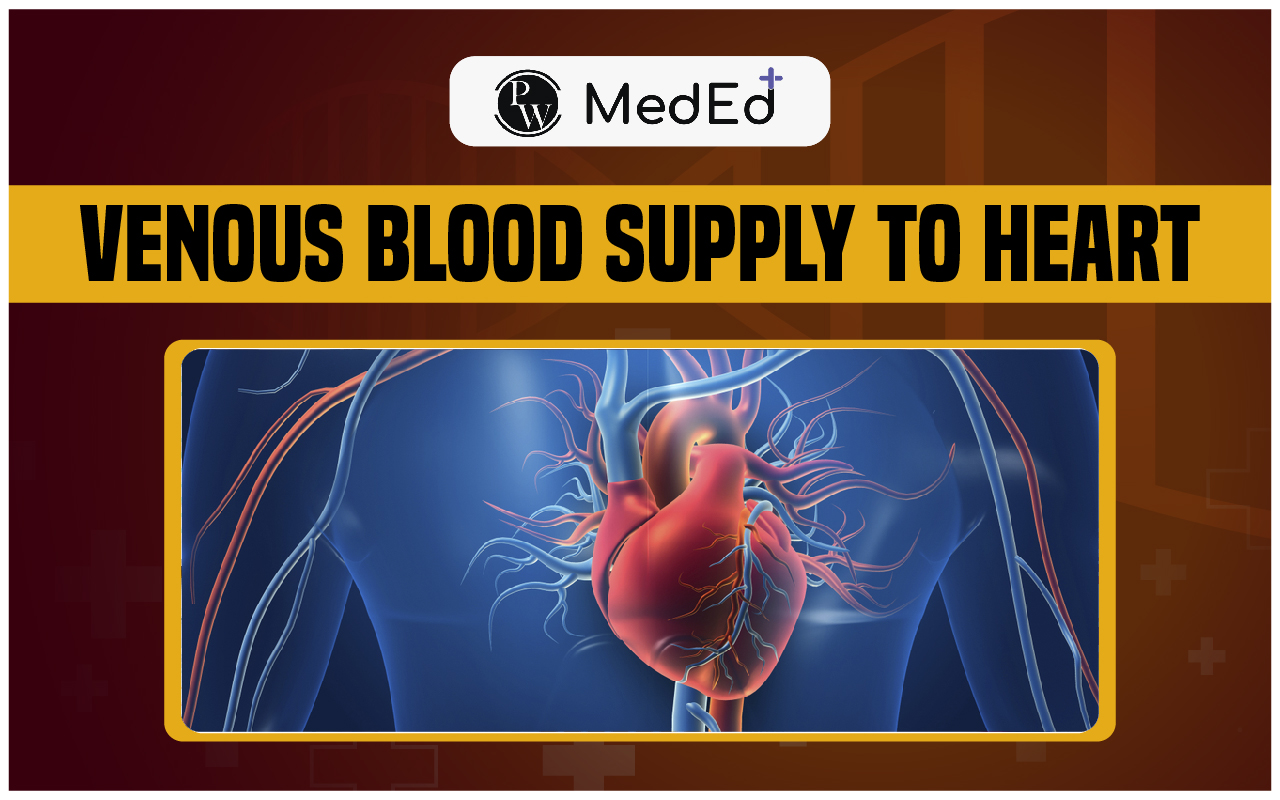
Venous drainage of Heart: Drainage of venous blood of the heart vasculature - Your heart is an amazing organ. It continuously pumps oxygen and nutrient-rich blood throughout your body to sustain life. As the heart beats, it pumps blood through a system of blood vessels, called the circulatory system. The vessels are elastic tubes that carry blood to every part of the body.
Visit - MedEd App
Read More - Pharyngeal Arches
Structure of Heart
On the inside, the heart is a four-chambered, hollow organ. It is divided into the left and right side by a wall called the septum. The right and left sides of the heart are further divided into two top chambers called the atria, which receive blood from the veins, and two bottom chambers called ventricles, which pump blood into the arteries. Veins are blood vessels that take blood back to the heart; this blood lacks oxygen (oxygen-poor) and is rich in waste products that are to be excreted or removed from the body. Veins become larger and larger as they get closer to the heart. The superior vena cava is the large vein that brings blood from the head and arms to the heart, and the inferior vena cava brings blood from the abdomen and legs into the heart.Read More - Radiodiagnosis
Venous drainage of heart
The venous drainage of the heart is mostly through the coronary sinus – a large dilated sac like structure containing venous blood located on the posterior aspect of the heart. The cardiac veins drain into the coronary sinus, which in turn, empties into the right atrium. There are also smaller cardiac veins which pass directly into the right atrium. The main tributaries of the coronary sinus are: Great cardiac vein (anterior interventricular vein) – the largest tributary of the coronary sinus. It originates at the apex of the heart and ascends in the anterior interventricular groove. It then curves to the left and continues onto the posterior surface of the heart. Here, it gradually enlarges to form the coronary sinus. Small cardiac vein – located on the anterior surface of the heart, in a groove between the right atrium and right ventricle. It travels within this groove onto the posterior surface of the heart, where it empties intoxication the coronary sinus. Middle cardiac vein (posterior interventricular vein) – begins at the apex of the heart and ascends in the posterior interventricular groove to empty into the coronary sinus. Posterior cardiac vein – located on the posterior surface of the left ventricle. It lies to the left of the middle cardiac vein and empties into the coronary sinus. Clinical Significance of Coronary Sinus - Due to its special anatomic relation, the coronary sinus provides a vital role in cardiac resynchronization therapy ( synchronization of all the four chambers for effective filling after a arrhythmia). A biventricular pacemaker is a device commonly used to treat a delay in ventricular contractions in those with advanced heart failure. To pace the right ventricle one lead of the pacemaker is placed in the anterior cardiac vein, while the left lead is commonly placed in the coronary sinus to pace the left ventricle.Venous Blood Supply to Heart FAQs
What is Myocardial Infarction?
Myocardial infarction (MI), commonly known as a heart attack, occurs when blood flow to a part of the heart muscle is blocked for an extended period. This blockage is typically due to a blood clot that forms in a coronary artery due to atherosclerosis (plaque buildup).
What is Atherosclerosis of Coronary Vasculature?
Atherosclerosis of the coronary vasculature refers to the buildup of fatty deposits, cholesterol, and other substances (plaque) on the inner walls of the coronary arteries. These arteries supply blood to the heart muscle. Over time, this plaque can harden and narrow the arteries, reducing blood flow to the heart.
What is Oxygen Content in the Coronary Sinus of the Heart?
The oxygen content in the coronary sinus is typically lower than in arterial blood because the heart muscle extracts a significant amount of oxygen as it works. The oxygen content in the coronary sinus is an important measure in assessing the oxygen demand and consumption of the heart muscle.
What is the Name of the Valve in the Coronary Sinus?
The valve of the coronary sinus is called the Thebesian valve. This small, flap-like valve is located at the orifice where the coronary sinus empties into the right atrium. Its function is not entirely clear, but it is thought to prevent the backflow of blood from the right atrium into the coronary sinus during atrial contraction.


Talk to a counsellorHave doubts? Our support team will be happy to assist you!


Check out these Related Articles





Join 15 Million students on the app today!
 Live & recorded classes available at easeDashboard for progress trackingMillions of practice questions at your fingertips


Free Learning Resources
PW Books
Notes (Class 10-12)
PW Study Materials
Notes (Class 6-9)
Ncert Solutions
Govt Exams
Class 6th to 12th Online Courses
Govt Job Exams Courses
UPSC Coaching
Defence Exam Coaching
Gate Exam Coaching
Other Exams
Know about Physics Wallah
Physics Wallah is an Indian edtech platform that provides accessible & comprehensive learning experiences to students from Class 6th to postgraduate level. We also provide extensive NCERT solutions, sample paper, NEET, JEE Mains, BITSAT previous year papers & more such resources to students. Physics Wallah also caters to over 3.5 million registered students and over 78 lakh+ Youtube subscribers with 4.8 rating on its app.
We Stand Out because
We provide students with intensive courses with India’s qualified & experienced faculties & mentors. PW strives to make the learning experience comprehensive and accessible for students of all sections of society. We believe in empowering every single student who couldn't dream of a good career in engineering and medical field earlier.
Our Key Focus Areas
Physics Wallah's main focus is to make the learning experience as economical as possible for all students. With our affordable courses like Lakshya, Udaan and Arjuna and many others, we have been able to provide a platform for lakhs of aspirants. From providing Chemistry, Maths, Physics formula to giving e-books of eminent authors like RD Sharma, RS Aggarwal and Lakhmir Singh, PW focuses on every single student's need for preparation.
What Makes Us Different
Physics Wallah strives to develop a comprehensive pedagogical structure for students, where they get a state-of-the-art learning experience with study material and resources. Apart from catering students preparing for JEE Mains and NEET, PW also provides study material for each state board like Uttar Pradesh, Bihar, and others
Copyright © 2026 Physicswallah Limited All rights reserved.