A College Degree Is No Longer Enough: How AI Is Changing Graduate Employability
 Avisha Das4 Nov, 2026

India has nearly 155 million people in the 18-23 age group, creating one of the world's largest higher education markets. But the bigger question is not just how many students enter college; it is how well their education prepares them for the changing world of work.
Makreo Research's India Higher Education Market 2026 highlights how AI adoption, skill-centred programmes, online education and industry engagement are changing the sector. As colleges expand beyond traditional classroom learning, graduate readiness is increasingly linked to practical skills, digital capabilities and the ability to apply what students learn.
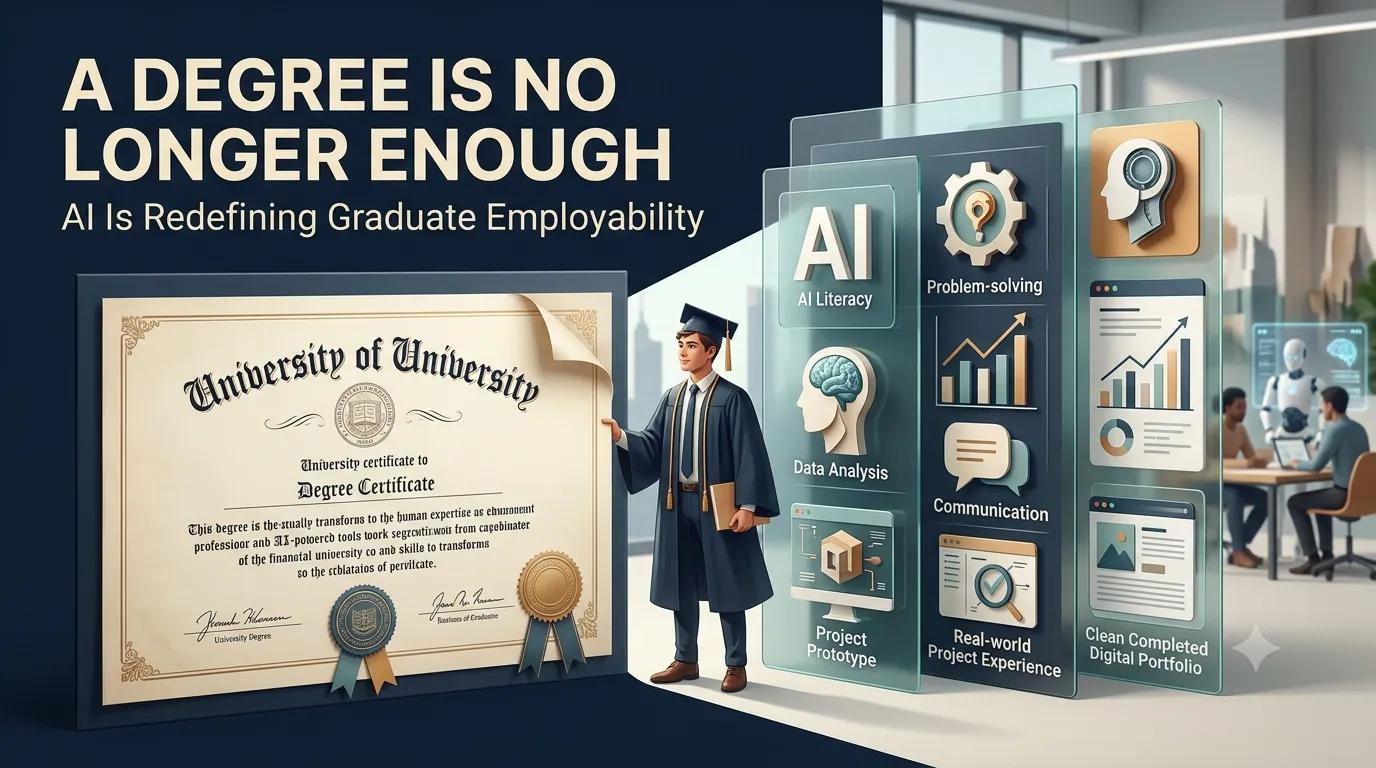
THE BIG TAKEAWAY: A college degree remains an important qualification, but the learning experience behind it matters just as much. AI awareness, practical exposure, industry engagement and recognised credentials are becoming important parts of graduate preparation.
Is a College Degree Still Enough to Prepare You for the Workplace?
A qualification gives you an academic foundation, but the skills and experience you gain during your education also matter.
India's higher education market is growing at a 10% CAGR, supported by its large student population, expanding institutional capacity and policy-led reforms under NEP 2020. As more institutions and programme formats enter the market, students have a wider range of educational choices.
However, the value of a programme is not determined by the degree title alone. Makreo Research identifies several factors that influence how students and employers evaluate educational quality:
-
Practical learning: Opportunities to apply academic concepts to real tasks and projects.
-
Industry engagement: Connections between programmes and professional environments.
-
Faculty quality: The depth of teaching and academic expertise.
-
Placement outcomes: How effectively institutions support students' transition into employment.
-
Research and international exposure: Opportunities to develop academic and professional perspectives.
Two students may hold similar qualifications but have different learning experiences depending on the projects, industry exposure and academic opportunities available to them.
This makes it important to evaluate what a programme helps you learn and apply, rather than focusing only on the qualification you receive.
Key takeaway: A degree establishes your academic background, while practical learning, relevant skills and professional exposure add to your preparation for work.
Build skills relevant to emerging technology applications with PW's IIT Patna AI & ML Certification Programme, which includes hands-on projects using Python, TensorFlow and PyTorch.
AI Is Changing the Classroom. Is It Changing What You Need to Learn Too?
AI is becoming part of higher education delivery, curriculum development and student support.
Makreo Research identifies AI-led learning, hybrid models and skill-centred programmes as important education trends in 2026. Universities and EdTech platforms are exploring applications such as:
-
Personalised learning paths
-
Adaptive assessments
-
Job-linked microcredentials
-
Language localisation
-
Analytics-driven student support
AI is also entering higher education through government initiatives and institutional programmes. Some developments highlighted in the market overview include:
-
A Rs. 100 crore Centre of Excellence in AI for Education.
-
The YUVA AI for All initiative, targeting 10 lakh learners.
-
Coursera's collaboration with 18 Indian universities, including IITs and IIMs, which recorded 2.6 million generative AI enrolments by August 2025.
These developments indicate that AI is becoming part of how students learn and how institutions design educational programmes.
For students, this makes exposure to AI and digital technologies increasingly relevant. However, AI adoption alone does not guarantee better learning. Institutions also need to assess whether these tools improve completion rates, placement readiness, faculty productivity and student engagement.
Key takeaway: Understanding AI and its applications can complement your academic knowledge, but the real value lies in how effectively you learn and apply these capabilities.
Explore how AI can be applied to marketing workflows, customer engagement and campaign execution through PW's IIT Jammu Generative AI in Digital Marketing Programme.
Beyond the Syllabus: Why Practical Learning and Industry Exposure Matter
Employability-led curricula are bringing greater attention to what students can do with the knowledge they gain.
Academic learning provides the foundation, but practical exposure helps students understand how concepts work in professional settings. Makreo Research highlights industry integration, internships, applied research, assessments and placement support as important considerations in the changing higher education market.
When comparing programmes, look at the opportunities they offer beyond classroom instruction.
|
What to evaluate |
What it can offer |
|
Practical projects |
Opportunities to apply academic concepts |
|
Industry engagement |
Exposure to professional environments |
|
Internships |
Experience with workplace activities |
|
Applied assessments |
Opportunities to demonstrate what you have learned |
|
Placement support |
Assistance with the transition into employment |
|
Faculty and research |
Academic depth and opportunities for further learning |
Skill-centred programmes and job-linked microcredentials are also gaining attention. These can complement formal education by helping learners develop knowledge in specific areas.
For example, students interested in manufacturing and operations can explore how AI supports automation and industrial processes, while those interested in finance can look at applications such as risk analytics and fraud detection.
Key takeaway: Practical projects, internships and industry engagement can help connect your academic knowledge with its professional applications.
Explore AI applications in manufacturing, operations and supply chains through PW's Advanced Certificate Programme in AI-Driven Supply Chain and Industry 4.0.
Online Degrees and Foreign Campuses: How Is India Redefining Access to Higher Education?
Students now have more ways to access higher education, including recognised online qualifications and international university programmes within India.
Online education is moving beyond its role as an alternative to campus-based learning. Makreo Research reports that enrolments in UGC-governed online programmes reached 9.5 million, marking a 45% single-year increase.
This growth is particularly relevant for working professionals and students in Tier-2 and Tier-3 cities, where access to physical campus infrastructure may be limited. UGC-recognised online degrees have also improved confidence in online qualifications.
Foreign university campuses are creating another option. As of April 2026, three foreign universities were fully operational in India:
-
Deakin University: GIFT City, Gujarat.
-
University of Wollongong: GIFT City, Gujarat.
-
University of Southampton: Gurugram, Haryana.
Other international institutions have also received UGC approval or Letters of Intent to establish campuses in India.
These developments allow students to explore international qualifications without necessarily moving overseas. They also increase the range of programmes and delivery formats available within the country.
However, the institution and learning format are only part of the decision. Students should also check:
-
Whether the programme has the required UGC approval or recognition.
-
Whether the qualification has the relevant degree equivalence.
-
What practical learning and assessment opportunities are available.
-
Whether the programme offers industry exposure and placement support.
-
How the fees compare with the learning opportunities provided.
Key takeaway: Online degrees and foreign university campuses are expanding access, but recognition, academic quality and student outcomes remain important when choosing a programme.
If you are interested in applying AI to financial services, explore PW's IIT Roorkee AI-Driven FinTech Programme (PGCPF), covering areas such as fraud analytics, credit scoring and risk analytics.
What Should You Check Before Choosing a College or Degree Programme?
The growing range of educational options makes it important to evaluate the complete learning experience, not just the institution's name or qualification.
Makreo Research highlights recognition, curriculum, faculty quality, industry integration, placement outcomes and affordability as important factors in the higher education market.
You can use these points when comparing colleges and programmes:
-
Check recognition: Confirm the institution's approval status and the validity of the qualification.
-
Review the curriculum: Look for relevant subjects, interdisciplinary learning and opportunities to develop digital or AI-related skills.
-
Examine practical exposure: Check whether the programme includes projects, internships, assessments or applied research.
-
Understand industry connections: Explore the institution's employer partnerships and professional engagement.
-
Review student outcomes: Look at placement support, alumni outcomes and available career progression pathways.
-
Compare delivery and affordability: Consider whether campus-based, online or hybrid learning suits your requirements.
Transparency is equally important. Institutions need to communicate their approval status, fees, placement support, degree equivalence and progression pathways clearly.
Key Takeaways
-
A degree is one part of graduate preparation: Practical learning, industry engagement and placement outcomes also matter.
-
AI is influencing higher education: Personalised learning, adaptive assessments and AI-focused curricula are gaining attention.
-
Online education is expanding: UGC-governed online programme enrolments reached 9.5 million, with a 45% single-year increase.
-
International options are growing: Foreign university campuses are expanding access to global qualifications within India.
-
Programme quality matters: Recognition, faculty, practical exposure, industry connections and student outcomes should inform education decisions.
India's higher education landscape is moving beyond the traditional choice of a college and a degree. Online programmes, foreign university campuses, AI-led learning and industry-linked curricula are expanding what students can access and how they prepare for professional opportunities.
A college qualification remains important, but the learning experience behind it matters too. As you evaluate your education options, look for programmes that combine recognised qualifications with relevant skills, practical exposure and clear student outcomes.