MBA Graduates Outpace BTech in Employability: 2026 Report Reveals a 72.76% Employability Rate


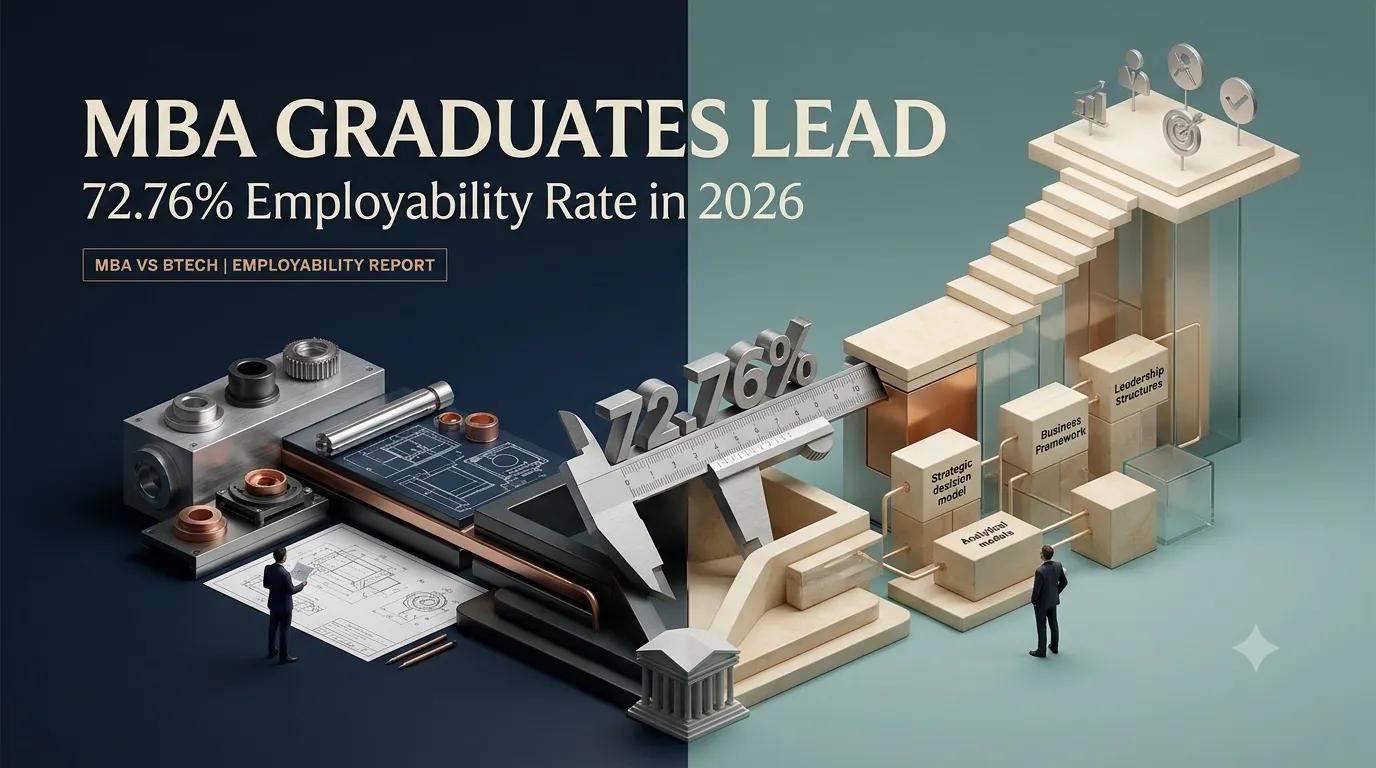
According to the India Skills Report 2026, MBA graduates are more employable than engineers. MBA graduates scored 72.76 percent, ahead of B.E./B.Tech graduates at 70.15 percent, a gap of 2.61 points by our calculation. But neither group is celebrating: MBA employability fell from 78 percent last year, and B.E./B.Tech slipped from 71.5 percent.
The decline sits against a rising national picture. India's overall employability improved to 56.35 percent in 2026 from 54.81 percent in 2025. So why did the two most employable degree groups slip while the country as a whole improved?
The report offers some answers, and they say as much about what employers want as about the degrees themselves.
How Do Degrees Compare on Employability?
Employability varies across qualifications, with MBA and B.E./B.Tech graduates recording the highest scores among the categories listed. However, the year-on-year changes tell a more varied story: some fields have improved, while others have seen a decline.
The comparison below shows how different qualifications performed in 2026 and how their scores changed from the previous year.
|
Qualification |
Employability 2026 |
Previous year |
|---|---|---|
|
MBA |
72.76% |
78% |
|
B.E./B.Tech |
70.15% |
71.5% |
|
MCA |
68.25% |
Slightly higher |
|
Commerce |
62.81% |
55% |
|
Science |
61% |
58% |
|
Pharmacy |
58% |
56% |
|
Arts |
55.55% |
Small improvement |
|
ITI |
45.95% |
41% |
|
Polytechnic |
32.92% |
Improved |
India's overall employability rose to 56.35 percent in 2026 from 54.81 percent in 2025.
Why Did MBA Employability Fall From 78 Percent?
The report points to a shift in what managerial readiness means.
The report reads the MBA drop as an industry shift toward applied, cross-domain managerial expertise, and as a sign that candidates need more advanced managerial skills. It describes engineering's slip from 71.5 percent as stability in technical domains despite rising demands for specialisation.
The fall is large for a headline group. At 72.76 percent against 78 percent a year earlier, MBA employability dropped by more than five points, while still staying the highest among the degree groups listed.
Which Engineering Branches Hold Up the Average?
The 70.15 percent B.E./B.Tech figure hides a wide range. Among engineering specialisations, the report found:
-
Computer Science: 80 percent
-
Information Technology: 78 percent
-
Instrumentation Engineering: 77 percent
-
Electronics and Communication: 75 percent
-
Mechanical Engineering: 63 percent
The report's own conclusion is that tech-focused specialisations continue to dominate.
Computer Science graduates lead engineering at 80 percent employability, higher than the MBA average of 72.76 percent.
The stronger scores in Computer Science, IT and related fields point to the continued relevance of technology-focused knowledge in the job market. For graduates and aspiring developers looking to build practical application development skills, the PW Skills Full Stack Development with AI Programme covers web development concepts alongside AI-powered tools.
What Are Employers Looking For?
Technical skills and workplace skills, with AI shaping recruitment.
The report identifies AI, data analytics, cloud computing and cybersecurity as the most in-demand skills across sectors. It also flags a widening need for communication, problem-solving, digital literacy and adaptability as AI-led and remote work models expand.
Hiring itself is changing. 70 percent of IT organisations and 50 percent of BFSI organisations report full or partial AI adoption in recruitment. Hiring intent is also rising: organisations project that 40 percent of planned FY 2026-27 positions will be new roles, up from 29 percent last year. In the IT sector, freshers make up 35 percent of new hires.
70 percent of IT organisations and 50 percent of BFSI organisations report full or partial AI adoption in recruitment.
Tip: Whatever your degree, pair it with one in-demand technical skill and the workplace skills employers list, such as communication and problem-solving.
Want to develop practical data analysis skills for a changing job market? Explore the PW Skills Data Analytics with AI Course to learn how data tools and AI can support business analysis and decision-making.
What Does the Employability Score Actually Measure?
The India Skills Report uses the ETS Wheebox Global Employability Test to assess job readiness. A candidate is considered employable if they score above 60% in the assessment, which evaluates educational and technical knowledge alongside communication, critical thinking, adaptability and other workplace skills.
The 2026 report's assessment covered more than 700,000 candidates across 28 states and 9 Union Territories, with participation from over 1,000 employers. This provides a broad view of how candidates perform against the test's job-readiness benchmark.
However, an employability score is not the same as an employment or placement rate. It indicates whether candidates meet the assessment's benchmark, not whether they have secured jobs or what salaries they earn.
Key Takeaways
-
MBA graduates scored 72.76 percent on employability, ahead of B.E./B.Tech graduates at 70.15 percent.
-
MBA employability fell from 78 percent, and B.E./B.Tech fell from 71.5 percent.
-
India's overall employability rose to 56.35 percent from 54.81 percent.
-
Computer Science (80 percent) and IT (78 percent) lead engineering, while Mechanical Engineering sits at 63 percent.
-
AI, data analytics, cloud computing and cybersecurity are the most in-demand skills, alongside communication and problem-solving.
-
Employability in the report means scoring above 60 percent on the Global Employability Test.
So, Do MBA Graduates Really Outpace BTech Graduates?
On this report's measure, yes, by 2.61 percentage points on average. But the lead is narrower than it looks. Both groups recorded lower employability scores than last year, with MBA seeing a sharper decline. The engineering average also hides considerable variation across specialisations.
The findings suggest that a degree alone does not determine job readiness. Employability also depends on the relevance of a graduate's technical knowledge, practical capabilities and workplace skills. This is reflected in the differences across engineering branches and the growing importance of skills such as AI, data analytics and problem-solving.
Ultimately, the report highlights the importance of combining academic qualifications with skills that match changing workplace requirements.