







Area of Rhombus Formula: Definition, Derivation and Solved Examples
 Anchal Singh15 Sept, 2023
Area of Rhombus Formula stands as a distinctive variation of a parallelogram, characterized by the presence of two sets of opposite sides that exhibit congruence. This implies that all sides of a rhombus are of equal length. This often leads students to grapple with differentiating between a square and a rhombus. The primary disparity between the two lies in the nature of their internal angles; specifically, all the internal angles of a square are right angles, whereas those of a rhombus do not possess such a characteristic. In the forthcoming discussion, you will acquire a comprehensive understanding of how to determine the area of a rhombus, employing various parameters including diagonals, side and height, and side and internal angle. Each scenario will be elucidated through solved examples to facilitate your comprehension.
What Is The Area Of A Rhombus?
The area of a rhombus formula refers to the space enclosed by this two-dimensional geometric shape. A rhombus itself is a quadrilateral positioned within a two-dimensional (2D) plane, distinguished by its four sides, all of which share the same length and congruency.Area Of Rhombus Formula
The formula to calculate the area (A) of a rhombus depends on the information you have about the rhombus. Here are the three common methods for finding the area of a rhombus: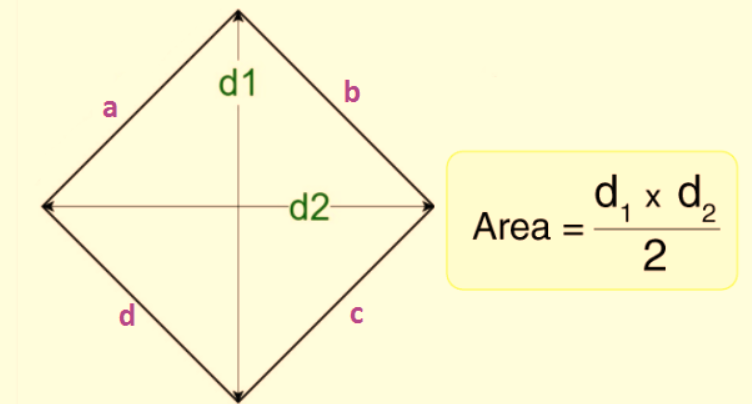 Using Diagonals (D1 and D2):
If you know the lengths of both diagonals (D1 and D2) of the rhombus, you can use the following formula:
A = (D1 * D2) / 2
Using Side Length (s) and Height (h):
If you know the length of one side (s) of the rhombus and the height (h), you can use the formula:
A = s * h
The height (h) is the perpendicular distance between two parallel sides of the rhombus.
Using Diagonals (D1 and D2):
If you know the lengths of both diagonals (D1 and D2) of the rhombus, you can use the following formula:
A = (D1 * D2) / 2
Using Side Length (s) and Height (h):
If you know the length of one side (s) of the rhombus and the height (h), you can use the formula:
A = s * h
The height (h) is the perpendicular distance between two parallel sides of the rhombus.
Also Check - Line and Angles Formula
Using Side Length (s) and Internal Angle (θ): If you know the length of one side (s) of the rhombus and the measure of one internal angle (θ) in degrees, you can use the formula: A = s^2 * (sin(θ)) Here, you need to ensure that θ is in degrees, and you'll use the sine function. Each of these methods allows you to calculate the area of a rhombus, depending on the given information about the rhombus. Choose the appropriate formula based on the data you have.Derivation for Rhombus Area Formula
To derive the formula for the area of a rhombus, we can break it down into two right triangles. Let's consider a rhombus with side length 's' and diagonals 'D1' and 'D2':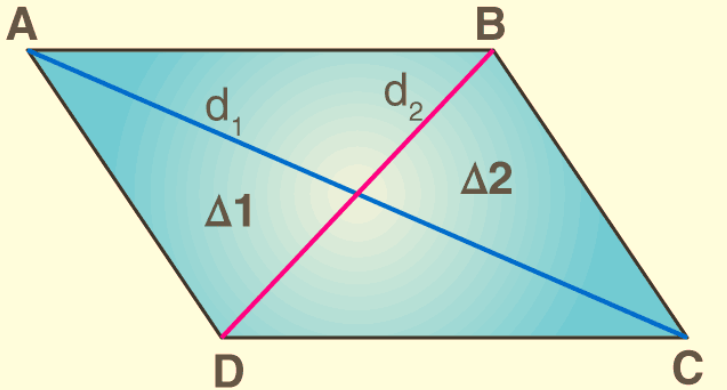 Draw the rhombus with one diagonal (D1) dividing it into two congruent right triangles.
Each right triangle has a base equal to half of one diagonal (D1/2) and a height equal to the side length (s) of the rhombus.
Use the formula for the area of a triangle:
Area of a triangle = (1/2) * base * height
For one of the right triangles:
Area of one right triangle = (1/2) * (D1/2) * s
Now, calculate the total area of the rhombus by considering both right triangles:
Total area of rhombus = 2 * Area of one right triangle
Total area of rhombus = 2 * [(1/2) * (D1/2) * s]
Simplify the expression:
Total area of rhombus = (D1/2) * s
Since 'D1' is one of the diagonals of the rhombus, and we know that 'D1' is equal to 'D2' (both diagonals are congruent in a rhombus), we can substitute 'D2' for 'D1':
Total area of rhombus = (D2/2) * s
Finally, you can write the area of the rhombus formula as:
Area (A) = (D1 * s) / 2
or
Area (A) = (D2 * s) / 2
Both of these formulas represent the area of a rhombus. You can choose the one that suits the given information about the rhombus, whether you know the lengths of the diagonals (D1 and D2) or the side length (s) and a diagonal.
Draw the rhombus with one diagonal (D1) dividing it into two congruent right triangles.
Each right triangle has a base equal to half of one diagonal (D1/2) and a height equal to the side length (s) of the rhombus.
Use the formula for the area of a triangle:
Area of a triangle = (1/2) * base * height
For one of the right triangles:
Area of one right triangle = (1/2) * (D1/2) * s
Now, calculate the total area of the rhombus by considering both right triangles:
Total area of rhombus = 2 * Area of one right triangle
Total area of rhombus = 2 * [(1/2) * (D1/2) * s]
Simplify the expression:
Total area of rhombus = (D1/2) * s
Since 'D1' is one of the diagonals of the rhombus, and we know that 'D1' is equal to 'D2' (both diagonals are congruent in a rhombus), we can substitute 'D2' for 'D1':
Total area of rhombus = (D2/2) * s
Finally, you can write the area of the rhombus formula as:
Area (A) = (D1 * s) / 2
or
Area (A) = (D2 * s) / 2
Both of these formulas represent the area of a rhombus. You can choose the one that suits the given information about the rhombus, whether you know the lengths of the diagonals (D1 and D2) or the side length (s) and a diagonal.
Also Check - Perimeter and Area Formula
How To Calculate Area Of Rhombus?
Below, we will explore three distinct methods for determining the area of a rhombus, accompanied by illustrative examples: Method 1: Utilizing Diagonals Method 2: Employing Base and Height Method 3: Leveraging Trigonometry (specifically, involving a side length and an angle measure)Also Check - Probability Formula
Area Of Rhombus Using Diagonals: Method 1
Let's examine how to determine the area of a rhombus, such as ABCD, with two diagonals, AC and BD, using the following steps: Step 1: Measure the length of diagonal 1, denoted as d1. This measurement is the distance between points A and C. It's essential to note that the diagonals of a rhombus intersect at the center, forming four right triangles. Step 2: Measure the length of diagonal 2, referred to as d2, which represents the distance between points B and D. Step 3: Multiply the lengths of both diagonals, d1 and d2. Step 4: Divide the result obtained in step 3 by 2. The outcome of this calculation will yield the area of the rhombus ABCD. To illustrate this method further, let's explore it with an example.Also Check - Linear Inequalities Formula
Example 1: Determining the Area of a Rhombus with Diagonals Measuring 6 cm and 8 cm. Solution: Given: Diagonal 1, d1 = 6 cm Diagonal 2, d2 = 8 cm To compute the area of the rhombus, employ the formula: Area (A) = (d1 × d2) / 2 = (6 × 8) / 2 = 48 / 2 = 24 cm² Therefore, the area of the rhombus is 24 square centimeters (cm²).Area Of Rhombus Using Base And Height: Method 2
Step 1: Determine both the base and height of the rhombus. The base corresponds to one of the rhombus's sides, while the height signifies the altitude, which is the perpendicular measurement from the selected base to the opposite side. Step 2: Proceed to multiply the base by the calculated height. To illustrate this process, let's explore an example: Example 2: Determine the area of a rhombus with a base measuring 10 cm and a height of 7 cm. Solution: Given: Base, b = 10 cm, Height, h = 7 cm To calculate the area (A), apply the formula: Area (A) = b × h = 10 × 7 cm² A = 70 cm² Hence, the area of the rhombus is 70 square centimeters (cm²).Area Of Rhombus Using Trigonometry: Method 3
This technique is employed to compute the area of a rhombus when provided with one of its internal angles and the length of one of its sides. Step 1: Begin by squaring the length of any of the sides. Step 2: Follow this by multiplying the squared side length by the sine of the specified internal angle. To grasp a practical application of this approach, let's explore an example demonstrating how to determine the area of a rhombus using the side length and an angle. Example 3: Compute the area of a rhombus with a side length of 2 cm and one of its angles (angle A) measuring 30 degrees. Solution: Given: Side length (s) = 2 cm , Angle A = 30 degrees Square of side = 2 × 2 = 4 To determine the area (A), apply the formula: Area, A = s^2 × sin(30°) A = 4 × 1/2 A = 2 cm² Thus, the area of the rhombus is 2 square centimeters (cm²) when the side length is 2 cm, and angle A is 30 degrees.Solved Problem On Area Of Rhombus Formula
Problem: Calculate the area of a rhombus with diagonals measuring 10 cm and 12 cm. Solution: Given: Diagonal 1 (D1) = 10 cm Diagonal 2 (D2) = 12 cm Method 1: Using Diagonals Use the formula for the area of a rhombus using diagonals: Area (A) = (D1 * D2) / 2 Plug in the values: Area (A) = (10 cm * 12 cm) / 2 Calculate the area: Area (A) = (120 cm²) / 2 Simplify: Area (A) = 60 cm² So, the area of the rhombus is 60 square centimeters (cm²) when the diagonals are 10 cm and 12 cm long.Area of Rhombus Formula
What Constitutes a Rhombus?
What Represents the Formula for Calculating the Area of a Rhombus?
How Can You Determine the Area of a Rhombus Given the Side Length and Height?
What Constitutes the Formula for Calculating the Perimeter of a Rhombus?













 Live & recorded classes available at easeDashboard for progress trackingMillions of practice questions at your fingertips

