What are Secondary Activities
Industries of Class 8
Secondary activities or manufacturing are those activities which change raw materials into products of more value to people. Changing of pulp of wood into paper and paper into note book represents the two stages of manufacturing process.
The finished has more value and utility than the raw material that it is made from.Industry refers to an economic activity that is concerned with production of goods, extraction of- minerals or the provision of services. Thus we have iron and steel industry (production of goods), coal mining industry (extraction of coal) and tourism industry (service provider).
Classification of Industries
- ON THE BASIS OF RAW MATERIALS:
- Agro based industries use plant and animal based products as their raw materials. Food processing, vegetable oil, cotton textile, dairy products and leather industries are examples of agro-based industries.
- Mineral based industries are primary industries that use mineral ores as their raw materials. The products of these industries feed other industries. Iron made from iron ore is the product of mineral based industry. This is used as raw material for the manufacture of a number of other products, such as heavy machinery, building materials and railway coaches.
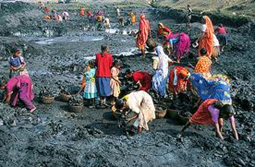
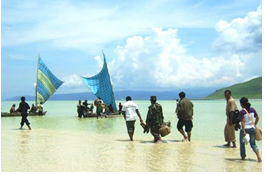
- Marine based industries use products from the sea and oceans as raw materials. Industries processing sea food or manufacturing fish oil are some examples.
- Forest based industries utilise forest produce as raw materials. The industries associated with forests are pulp and paper, pharmaceuticals, furniture and buildings.

- INDUSTRIES ON THE BASIS OF SIZE:
This classification refers to the amount of capital invested, number of people employed and the volume of production.
- Small scale industries
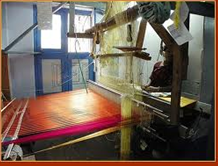
Cottage or household industries are a type of small scale industry where the products are manufactured by hand, by the artisans. Basket weaving, pottery and other handicrafts are examples of cottage industry. Small scale industries use lesser amount of capital and technology as compared to large scale industries. Silk weaving and food processing industries are small scale industries. Micro & Small Scale Enterprises plays a vital role in employment generation
- Large Scale industries
Produce large volumes of products. Investment of capital is higher and the technology used is superior. Production of automobiles and heavy machinery are large scale industries.
- INDUSTRIES ON THE BASIS OF OWNERSHIP:
Industries can be classified into private sector; state owned or public sector, Joint sector and cooperative
- Private sector industries : Are owned and operated by individuals or a group of individuals.
- Public sector industries : Are owned and operated by the government, such as Hindustan Aeronautics Limited and Steel Authority of India Limited.
- Joint sector industries : Are owned and operated by the state and individuals or a group of individuals. Maruti Udyog Limited is an example of joint sector industry.
- Co-operative sector industries: Are owned and operated by the producers or suppliers of raw materials, workers or both. Anand Milk Union Limited and Sudha Dairy are success stories of a co-operative venture.
Factors that effect Location on Industries
Some regions are industrially more advanced than others because they have conditions favourable for the growth of industries. Some important factors that influence the locations of industries are : -
- Raw materials : Industries that use heavy and bulky raw materials like coal and steel prefer location near sources of raw materials, as the transportation of such materials over long distances is difficult and expensive. Industries using perishable raw materials are also usually located near sources of raw materials, as perishable materials have to reach the factories quickly.
- Power : An uninterrupted supply of power is essential for running machines. Hence, regions rich in power resources are ideal locations for industries.
- Labour : For industries that require plenty of labour, densely populated areas are ideal locations, as labour is cheap and abundant in such areas.
- Water : industries need water for cooling machinery, for draining out wastes and for various other purposes. most industries are located near sources of water.
- Topography and Climate : Fiat topography and moderate climate are ideal far most industries. Hence, plains have the highest concentration of industries.
- Market : Industries producing perishable or fragile goods are usually located near their respective markets so that the products can reach the markets with minimum delay or damage.
- Transport facilities : An efficient transport network helps raw materials to reach factories and finished good to reach markets. Thus, regions that are well connected by transport routes are ideal sites for industries. Coastal locations with shipping facilities are particularly suitable for industries using imported raw material or producing goods for export.
- Capital : Every industry needs capital for purchasing machines. power and raw materials, and also for paying wages and meeting transportation costs. Areas where money is locally available and people are willing to invest in industries are, therefore, ideal locations for industries.
- Government Policy : Sometimes, the government makes a particular location attractive to industries by providing land, tax concessions and various facilities.