







ICSE Class 10 Maths Selina Solutions Chapter 9 Matrices
 Ananya Gupta24 Jul, 2024
ICSE Class 10 Maths Selina Solutions Chapter 9 – Matrices provides a clear and structured guide to understanding the fundamental concepts of matrices. Here, we have provided ICSE Class 10 Maths Selina Solutions Chapter 9 to help students prepare effectively for their examinations.
This chapter covers important topics such as types of matrices, matrix addition and subtraction, multiplication of matrices, and real-life applications. The step-by-step solutions are easy to follow and help students understand even complex operations confidently. Since the ICSE Board exams have started from 17 February, revising this chapter thoroughly can help students strengthen their foundation in algebra and score well.
ICSE Class 10 Maths Selina Solutions Chapter 9 Matrices Overview
ICSE Class 10 Maths Selina Solutions Chapter 9 Matrices PDF
ICSE Class 10 Maths Selina Solutions for Chapter 9 Matrices are available in a PDF format. This comprehensive solutions covers various matrix concepts and operations in detail. Students can easily download the PDF from the link provided below, allowing them to study and revise the chapter effectively at their own pace.ICSE Class 10 Maths Selina Solutions Chapter 9 Matrices PDF
ICSE Class 10 Maths Selina Solutions Chapter 9 Matrices
Below we have provided ICSE Class 10 Maths Selina Solutions Chapter 9 for the ease of the students –ICSE Class 10 Maths Selina Solutions Chapter 9 Matrices Page No: 120
1. State, whether the following statements are true or false. If false, give a reason.
(i) If A and B are two matrices of orders 3 x 2 and 2 x 3 respectively; then their sum A + B is possible.
(ii) The matrices A 2 x 3 and B 2 x 3 are conformable for subtraction.
(iii) Transpose of a 2 x 1 matrix is a 2 x 1 matrix.
(iv) Transpose of a square matrix is a square matrix.
(v) A column matrix has many columns and one row.
Solution:
(i) False. The sum of matrices A + B is possible only when the order of both the matrices A and B are same. (ii) True (iii) False Transpose of a 2 x 1 matrix is a 1 x 2 matrix. (iv) True (v) False A column matrix has only one column and many rows. 2. Given:  , find x, y and z.
Solution:
If two matrices are said to be equal, then their corresponding elements are also equal. Therefore, x = 3, y + 2 = 1 so, y = -1 z – 1 = 2 so, z = 33. Solve for a, b and c if
(i) 
(ii) 
Solution:
If two matrices are said to be equal, then their corresponding elements are also equal. Then, (i) a + 5 = 2 ⇒ a = -3 -4 = b + 4 ⇒ b = -8 2 = c – 1 ⇒ c = 3 (ii) a = 3 a – b = -1 ⇒ b = a + 1 = 4 b + c = 2 ⇒ c = 2 – b = 2 – 4 = -24. If A = [8 -3] and B = [4 -5]; find:
(i) A + B (ii) B – A
Solution:
(i) A + B = [8 -3] + [4 -5] = [8+4 -3-5] = [12 -8] (ii) B – A = [4 -5] – [8 -3] = [4-8 -5-(-3)] = [-4 -2] 5. If A=  , B =
, B =  and C =
  ; find:
(i) B + C (ii) A – C
(iii) A + B – C (iv) A – B +C
Solution :
(i)B + C = (ii)A – C =
  (iii)
(iii) 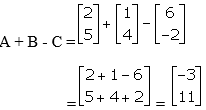 (iv)
(iv) 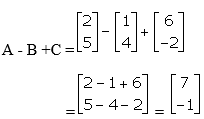
Exercise 9(B) Page No: 120
1. Evaluate:
(i) 3[5 -2]
Solution:
3[5 -2] = [3×5 3x-2] = [15 -6] (ii) 
Solution:
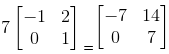
(iii) 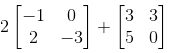
Solution:

(iv) 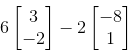
Solution:

2. Find x and y if:
(i) 3[4 x] + 2[y -3] = [10 0]
Solution:
Taking the L.H.S, we have 3[4 x] + 2[y -3] = [12 3x] + [2y -6] = [(12 + 2y) (3x – 6)] Now, equating with R.H.S we get [(12 + 2y) (3x – 6)] = [10 0] 12 + 2y = 10 and 3x – 6 = 0 2y = -2 and 3x = 6 y = -1 and x = 2 (ii) 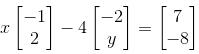
Solution:
We have,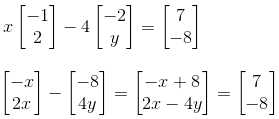 So, equating the matrices we get -x + 8 = 7 and 2x – 4y = -8 x = 1 and 2(1) – 4y = -8 2 – 4y = -8 4y = 10 y = 5/2
3.

(i) 2A – 3B + C (ii) A + 2C – B
Solution:
(i) 2A – 3B + C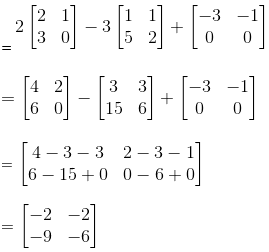 (ii) A + 2C – B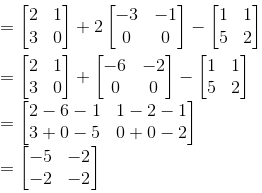
4. 
Solution:
Given,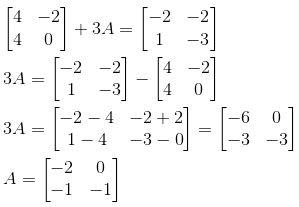
5. 
(i) find the matrix 2A + B.
(ii) find a matrix C such that:
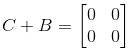
Solution:
(i) 2A + B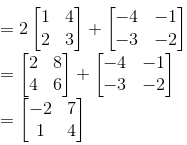 (ii)
(ii) 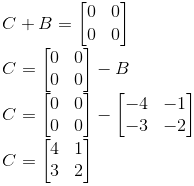
ICSE Class 10 Maths Selina Solutions Chapter 9 Matrices Page No: 129
1. Evaluate: if possible:
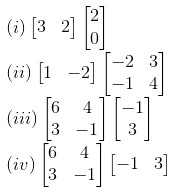
If not possible, give reason.
Solution:
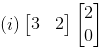 = [6 + 0] = [6]
 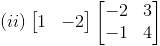 = [-2+2 3-8] = [0 -5]
 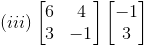 =
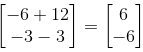
= 
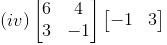 The multiplication of these matrices is not possible as the rule for the number of columns in the first is not equal to the number of rows in the second matrix.
2. If 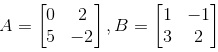 and I is a unit matrix of order 2×2, find:
(i) AB (ii) BA (iii) AI
(iv) IB (v) A 2 (iv) B 2 A
Solution:
(i) AB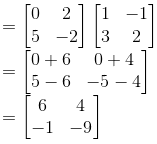 (ii) BA
 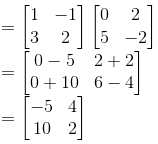 (iii) AI
 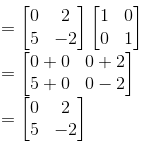 (iv) IB
 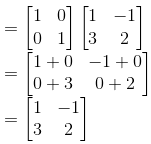 (v) A 2
 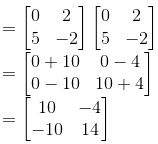 (vi) B 2
 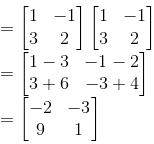 B 2 A
B 2 A 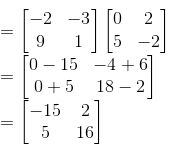
3. If 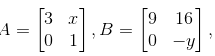 find x and y when x and y when A 2 = B.
Solution:
A 2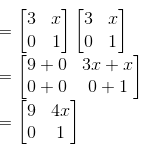 A 2 = B
 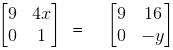 On comparing corresponding elements, we have 4x = 16 x = 4 And, 1 = -y y = -1
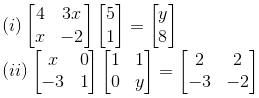
4. Find x and y, if:
Solution:
(i)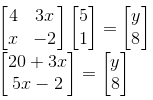 On comparing the corresponding terms, we have 5x – 2 = 8 5x = 10 x = 2 And, 20 + 3x = y 20 + 3(2) = y 20 + 6 = y y = 26
 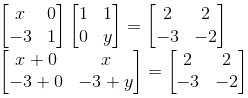 (ii) On comparing the corresponding terms, we have x = 2 And, -3 + y = -2 y = 3 – 2 = 1
5. 
(i) (AB) C (ii) A (BC)
Solution:
(i) (AB)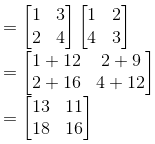 (AB) C
  (ii) BC
  A (BC)
  Therefore, its seen that (AB) C = A (BC)
6. 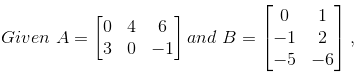 is the following possible:
(i) AB (ii) BA (iii) A 2
Solution:
(i) AB (ii) BA
  (iii) A 2 = A x A, is not possible since the number of columns of matrix A is not equal to its number of rows.
7.  Find A 2 + AC – 5B.
Solution:
A 2 AC
AC  5B
5B 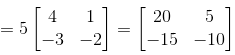 A 2 + AC – 5B =
8. If  and I is a unit matrix of the same order as that of M; show that:
M 2 = 2M + 3I
Solution:
M 2 2M + 3I
  Thus, M 2 = 2M + 3I
9.  and BA = M 2 , find the values of a and b.
Solution:
BA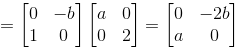 M 2
M 2  So, BA =M 2
 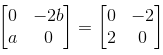 On comparing the corresponding elements, we have -2b = -2 b = 1 And, a = 2
10. 
(i) A – B (ii) A 2 (iii) AB (iv) A 2 – AB + 2B
Solution:
(i) A – B (ii) A 2
  (iii) AB
  (iv) A 2 – AB + 2B =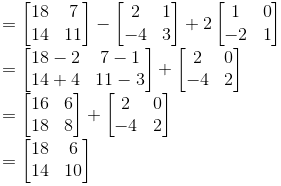
11. 
(i) (A + B) 2 (ii) A 2 + B 2
(iii) Is (A + B) 2 = A 2 + B 2 ?
Solution:
(i) (A + B) So, (A + B) 2 = (A + B)(A + B) =
 (ii) A 2
  B 2
B 2  A 2 + B 2 Thus, its seen that (A + B) 2 ≠ A 2 + B 2+
12. Find the matrix A, if B =  and B 2 = B + ½A.
Solution:
B 2 B 2 = B + ½A ½A = B 2 – B A = 2(B 2 – B)
13. If 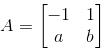 and A 2 = I, find a and b.
Solution:
 A 2 And, given A 2 = I So on comparing the corresponding terms, we have 1 + a = 1 Thus, a = 0 And, -1 + b = 0 Thus, b = 1
14. If  then show that:
(i) A(B + C) = AB + AC
(ii) (B – A)C = BC – AC.
Solution:
(i) A(B + C) AB + AC
 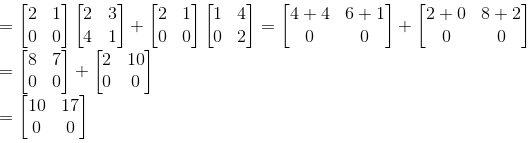 Thus, A(B + C) = AB + AC (ii) (B – A)C
  BC – AC
 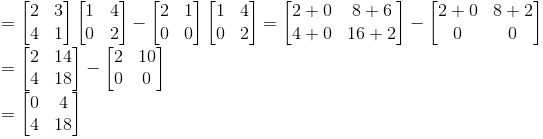 Thus, (B – A)C = BC – AC
15. If  simplify: A 2 + BC.
Solution:
A 2 + BC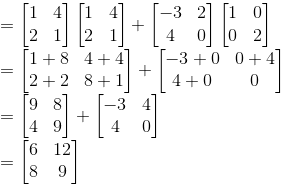
ICSE Class 10 Maths Selina Solutions Chapter 9 Matrices Page No: 131
1. Find x and y, if:
Solution:
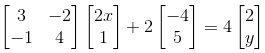
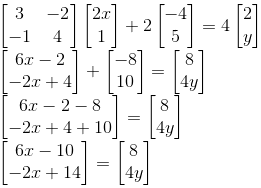 On comparing the corresponding terms, we have 6x – 10 = 8 and -2x + 14 = 4y 6x = 18 and y = (14 – 2x)/4 x = 3 and y = (14 – 2(3))/4 y = (14 – 6)/ 4 y = 8/4 = 2 Thus, x = 3 and y = 2
2. Find x and y, if:

Solution:
 On comparing the corresponding terms, we have 3x + 18 = 15 and 12x + 77 = 10y 3x = -3 and y = (12x + 77)/10 x = -1 and y = (12(-1) + 77)/10 y = 65/10 = 6.5 Thus, x = -1 and y = 6.5
3. If;  ; find x and y, if:
(i) x, y ∈ W (whole numbers)
(ii) x, y ∈ Z (integers)
Solution:
From the question, we have x 2 + y 2 = 25 and -2x 2 + y 2 = -2 (i) x, y ∈ W (whole numbers) It can be observed that the above two equations are satisfied when x = 3 and y = 4. (ii) x, y ∈ Z (integers) It can be observed that the above two equations are satisfied when x = ± 3 and y = ± 4. 4. 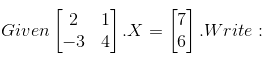
(i) The order of the matrix X.
(ii) The matrix X.
Solution:
(i) Let the order of the matrix be a x b. Then, we know that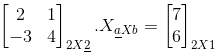 Thus, for multiplication of matrices to be possible a = 2 And, form noticing the order of the resultant matrix b = 1 (ii)
 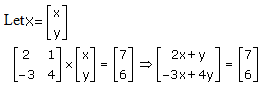 On comparing the corresponding terms, we have 2x + y = 7 and -3x + 4y = 6 Solving the above two equations, we have x = 2 and y = 3 Thus, the matrix X is
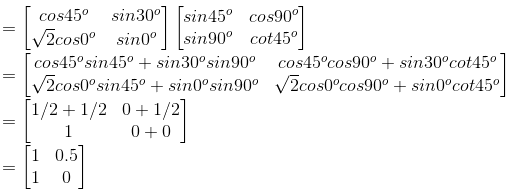
5. Evaluate:

Solution:
6. 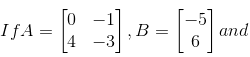 3A x M = 2B; find matrix M.
Solution:
Given, 3A x M = 2B And let the order of the matric of M be (a x b) Now, it’s clearly seen that a = 2 and b = 1 So, the order of the matrix M is (2 x 1)
 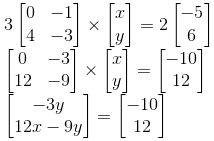 Now, on comparing with corresponding elements we have -3y = -10 and 12x – 9y = 12 y = 10/3 and 12x – 9(10/3) = 12 12x – 30 = 12 12x = 42 x = 42/12 = 7/2 Therefore, Matrix M =
7. 
find the values of a, b and c.
Solution:
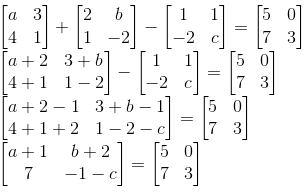 On comparing the corresponding elements, we have a + 1 = 5 ⇒ a = 4 b + 2 = 0 ⇒ b = -2 -1 – c = 3 ⇒ c = -4
8. 
(i) A (BA) (ii) (AB) B.
Solution:
(i) A (BA)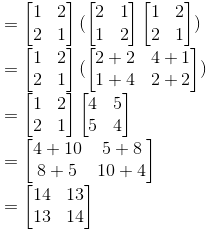 (ii) (AB) B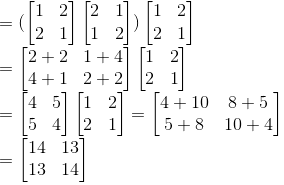
9. Find x and y, if: 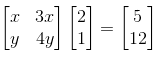
Solution:
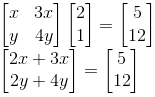 Thus, on comparing the corresponding terms, we have 2x + 3x = 5 and 2y + 4y = 12 5x = 5 and 6y = 12 x = 1 and y = 2
10. If matrix  find the matrix ‘X’ and matrix ‘Y’.
Solution:
 Now,
Now, 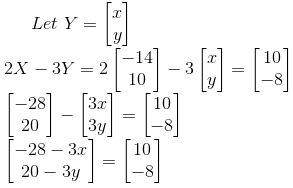 On comparing with the corresponding terms, we have -28 – 3x = 10 3x = -38 x = -38/3 And, 20 – 3y = -8 3y = 28 y = 28/3 Therefore,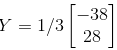
11. Given  find the matrix X such that:
A + X = 2B + C
Solution :
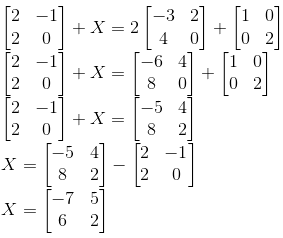
12. Find the value of x, given that A 2 = B,
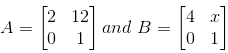
Solution:
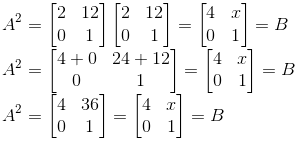 Thus, on comparing the terms we get x = 36.
Last Minute Preparation Tips for ICSE Class 10 Maths Selina Solutions Chapter 9
With the ICSE Board exams already started from 17 February, this is the right time to focus on quick and smart revision. Matrices is a scoring chapter if concepts and operations are practiced properly.
1. Revise Types of Matrices
Quickly go through different types such as row matrix, column matrix, square matrix, diagonal matrix, and identity matrix. Clear understanding helps in solving theory-based questions.
2. Practice Matrix Operations
Revise addition, subtraction, and multiplication of matrices. Pay special attention to the condition for multiplication (number of columns = number of rows).
3. Remember Important Properties
Go through key properties of matrix operations once again. This helps in solving conceptual and reasoning-based questions quickly.
4. Avoid Calculation Mistakes
Be careful while multiplying matrices. Most errors occur during row and column multiplication, so double-check each step.
5. Follow Proper Steps in Answers
Write matrices neatly and clearly. Proper presentation ensures full marks and avoids confusion.
6. Solve Board-Level Questions
Practice a few previous year or textbook questions. This improves speed and confidence before the exam.
7. Recheck Final Answers
After solving, verify your calculations once. Small arithmetic errors can reduce marks in otherwise simple questions.
ICSE Class 10 Maths Selina Solutions Chapter 9 FAQs
What is a matrix?
What is the order of a matrix?
What is the determinant of a matrix?
What are matrix operations?










 Live & recorded classes available at easeDashboard for progress trackingMillions of practice questions at your fingertips

