







Important Questions Class 12 Biology Chapter 1 play a crucial role in board exam preparation, especially for students aiming to score high in Biology. With the CBSE Board Class 12 Biology examination scheduled for 27 March, focused and last-minute revision of high-weightage chapters has become extremely important for students.
Chapter 1, Sexual Reproduction in Flowering Plants, is concept-heavy and frequently tested in CBSE and state board examinations. Here are compiled important questions Class 12 Biology chapter 1 in a structured and exam-relevant manner, helping students revise concepts, understand answer presentation, and practice MCQs, descriptive, and short-answer questions effectively.
Class 12 Biology Chapter 1 Sexual Reproduction in Flowering Plants
Class 12 Biology Chapter 1 explains the complete process of sexual reproduction in flowering plants, starting from the structure of flowers and formation of male and female gametophytes to pollination, fertilisation, and seed development.
The chapter highlights unique features of angiosperms such as double fertilisation, embryo sac formation, and endosperm development.
It also covers important concepts like types of pollination, development of embryo and fruit, apomixis, and polyembryony, which are frequently asked in CBSE Board Class 12 examinations.
Important Questions Class 12 Biology Chapter 1
This section presents Focused on sexual reproduction in flowering plants class 12 important questions covering MCQs, descriptive, and short questions. These questions are exam-oriented and help Class 12 students revise key concepts, terminology, and answer-writing format effectively for board exams.
1. The hilum in a typical angiospermic ovule represents the junction between:-
(1) Integuments and the embryo sac.
(2) Embryo sac and the nucellus
(3) Body of the ovule and the funicle
(4) Nucellus and the fumicle
Ans. (3) Body of the ovule and the funicle
2. The term used for the embryo entering into the state of inactivity as the seed mature is:-
(1) Quiescent
(2) Parthenogenesis
(3) Parthenocarpy
(4) Dormancy
Ans. (4)Dormancy
3. An undifferentiated sheath covering the root cap of a monocotyledonous embryo is:
(1) Scutellum
(2) Coleorhiza
(3) Coleoptile
(4) Epiblast
Ans. (2)Coleorhiza
4. What kind of structures is formed at the end of microsporogenesis and megasporogenesis?
Ans. Microsporogenesis results into formation of four haploid pollen grains arranged generally in a tetrahedral tetrad while Megasporogenesis forms four megaspores arranged in linear tetrad.
5. Name the type of cross pollination in Vallisneria & Bougainvillea.
Ans. (i) Vallisneria - Hydrophily
(ii) Bougainvillea - Entomophily
6. Describe the structure of a pollen grain.
Ans. The pollen grain is normally spherical with two wall layers.
-
the outer layer is exine composed of highly resistant organic substance called sporopollenin which is absent at the aperture region called germ pore.
-
the inner layer is the in tine which is composed of cellulose and pectin.
-
a mature pollen grain has a vegetative cell and a generative cell
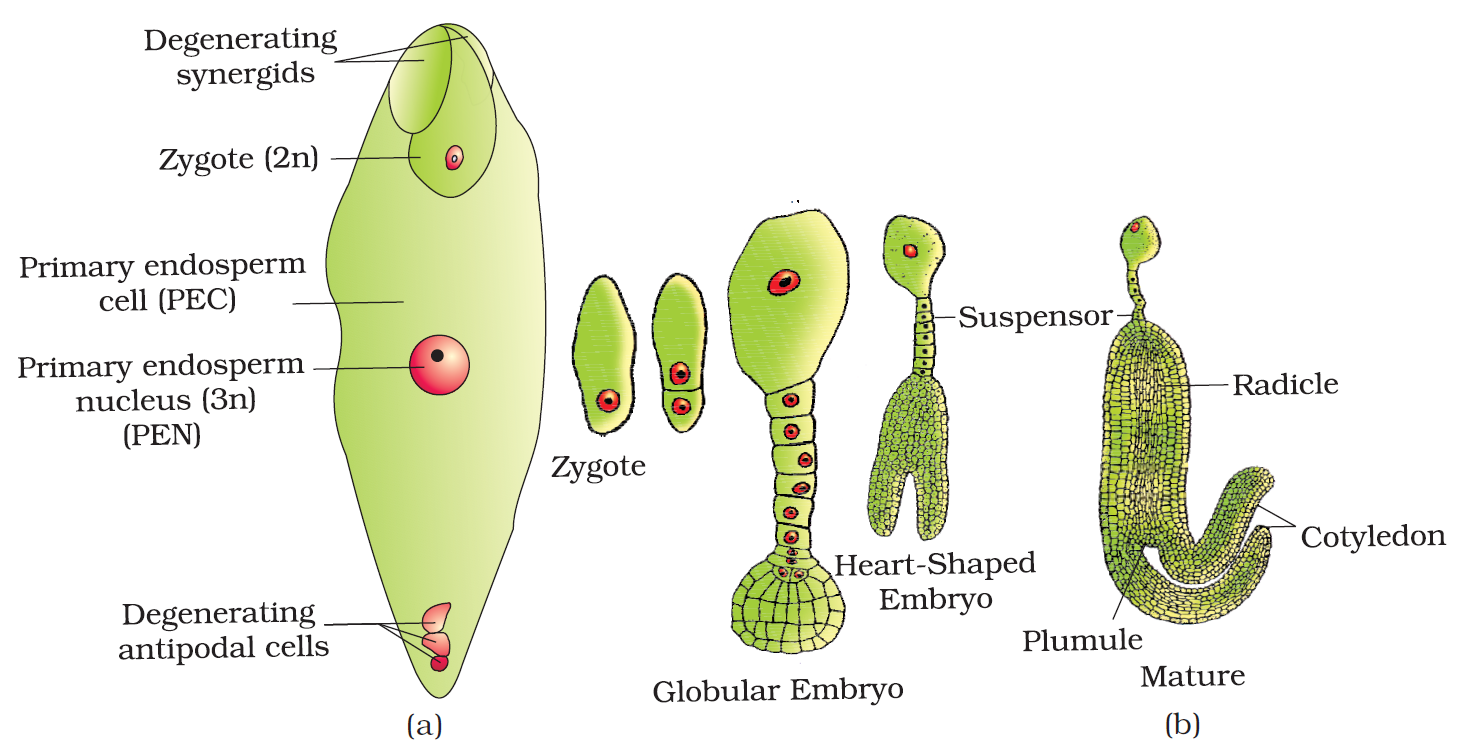
7. Explain the development of embryo in a dicotyledonous plant with neatly labelled diagrams.
Ans. The embryo develops at the micropylar end where the zygote is located. The zygote starts developing only after certain amount of endosperm is formed to assure nutrition to the embryo. The zygote divides mitotically to form various stages including pro- embryo, globular, heart shaped and finally the mature embryo
8. Differentiate between geitonogamy and xenogamy.
Ans.
|
Geitonogamy |
Xenogamy |
||
|
1. |
Transfer of pollen grains from the another to stigma of another flower of the same plant |
1. |
Transfer of Pollen grains from another to stigma of different plant. |
|
2. |
Does not provide opportunity for gametic recombination. |
2. |
Provide opportunity for gametic recombination. |
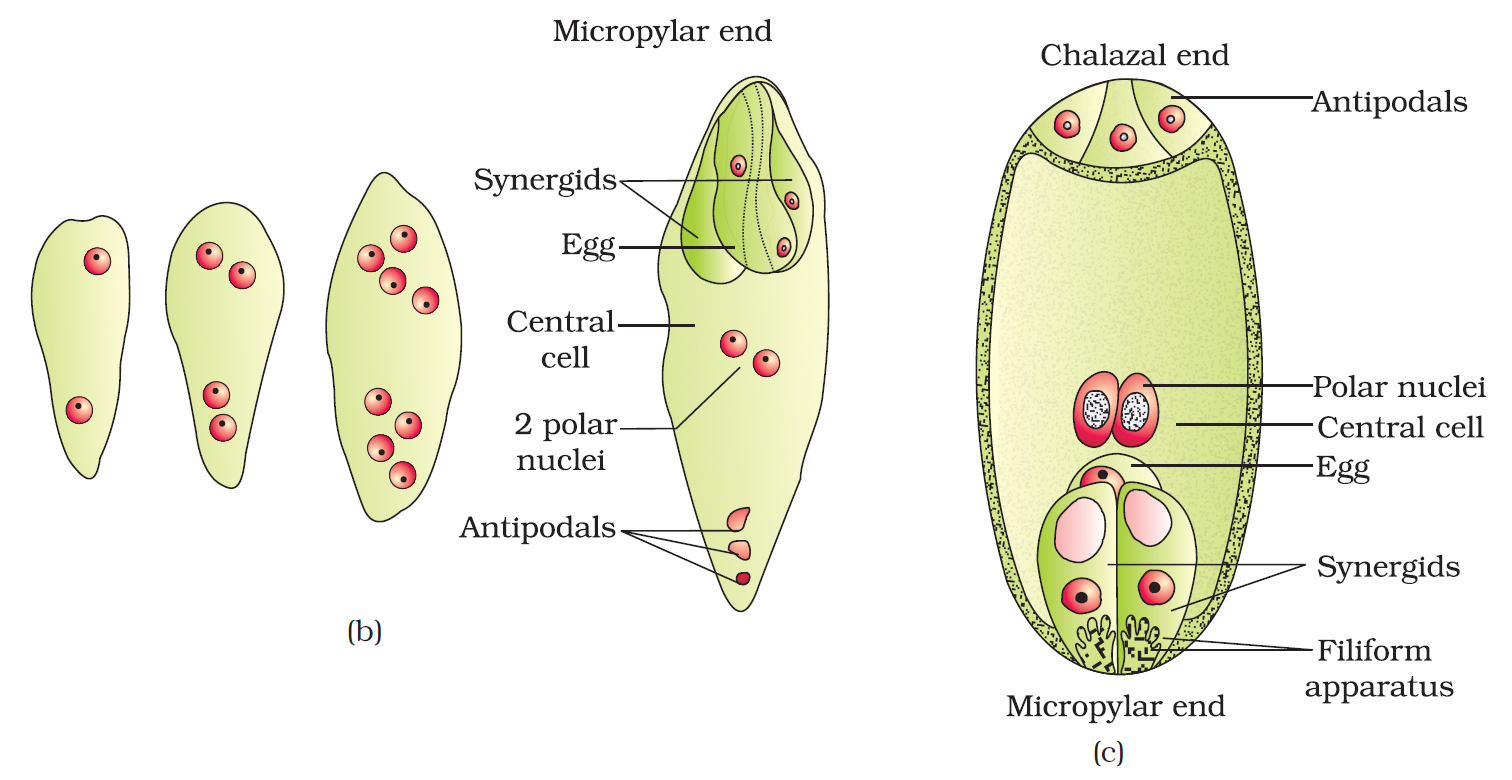
9. Explain the formation of an embryo sac with diagrams.
Ans. - The functional megaspore grows in size.
- The nucleus divides mitotically to form two nuclei which move to opposite poles.
- Each nucleus at the poles undergoes two mitotic divisions to form four nuclei in each pole or a total of 8 nuclei.
- two nuclei from each pole move to the centre to form the polar nuclei.
- the other nuclei, three at each pole get surrounded by bit of cytoplasm to form cells.
- the female gametophyte or the embryo sac thus has 7 cells and eight nuclei.
10. (i) Explain the structure of a maize grain with the help of a diagram
(ii) Why cannot we use the term maize seeds for maize grains?
Ans. (i) In grass family (eg. Maize) fruit is single seeded where pericarp & seed coat are fused together to form the husk. Just below husk, there is a layer of cells called aleurone layer, with stores proteins. There is a large endosperm that stores starch. The embryo lies on one side of endosperm & consists of a single cotyledon called scutellum & embryonal axis. The region of embryonal axis that points down ward from point of attachment of cotyledons is radicle & is covered by protective sheath called coleorhiza. The region of embryonal axis that points upward from point of attachment of cotyledon is plumule, it is covered by foliaceous sheath called coleoptite
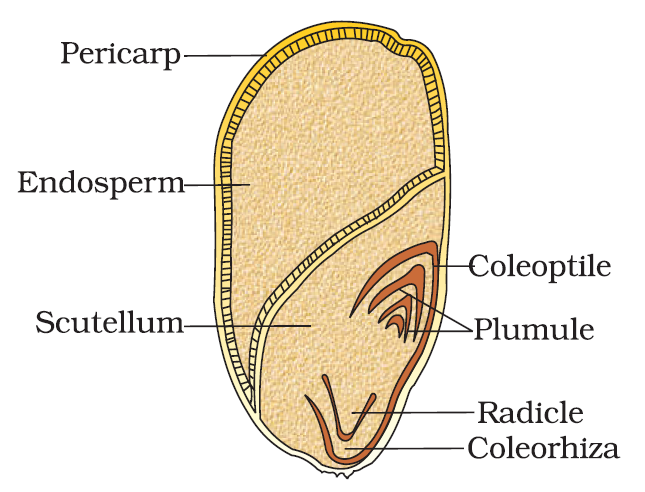
(ii) We cannot use the term seeds for maize grain because seed is not completely developed from embryo but retains a part of endosperm.
CBSE Class 12 Biology Exam Preparation Tips for Chapter 1
To master the important questions Class 12 Biology chapter 1, students should follow these strategies:
-
Revise the NCERT line by line
-
Practice previous year questions
-
Learn definitions word-to-word
-
Practice MCQs daily
-
Focus on diagrams and keywords.
Consistent revision ensures confidence while answering questions on sexual reproduction in flowering plants in exams.
Important questions in Class 12 Biology chapter 1 form the foundation for scoring well in Biology board exams. With a balanced focus on theory, MCQs, diagrams, and short notes, students can confidently attempt all types of questions from sexual reproduction in flowering plants.
Systematic preparation using these important questions in the Class 12 Biology chapter 1 will help students achieve accuracy, clarity, and higher marks.