

With the CBSE Board Class 12 examinations set to begin soon and the Biology exam scheduled for 27 March, focused revision has become more important than ever for students. Among all chapters, Human Reproduction holds high exam relevance and is known for its repeated questions and diagram-based answers.
Therefore, revising important questions Class 12 Biology chapter 2 at this stage can significantly improve confidence and scoring potential. This chapter not only carries substantial weightage but also tests conceptual clarity, making it crucial for last-minute and final-phase preparation.
Human Reproduction Class 12 Biology Chapter 2
Class 12 Biology Chapter 2 Human Reproduction explains the structure and functions of male and female reproductive systems, formation of gametes through spermatogenesis and oogenesis, and hormonal regulation of reproduction. It covers the menstrual cycle, fertilisation, implantation, pregnancy, parturition, and lactation.
The chapter highlights the role of hormones like FSH, LH, estrogen, progesterone, and oxytocin. It is an important scoring chapter in CBSE exams due to repeated theory, diagram-based questions, and MCQs.
Important Questions Answers Class 12 Biology Chapter 2
Human Reproduction carries significant weightage in board exams, making it crucial for students to practice Human Reproduction class 12 important questions regularly. Below are exam-relevant questions framed according to the CBSE pattern:
1. Given below are structural details of a human mammary gland :
(i) The glandular tissue in the breast has 15-20 clusters of cells called alveoli.
(ii) The milk is stored in the lumen of alveoli.
(iii) The alveoli join to form the mammary ducts.
(iv) Mammary ampulla is connected to lactiferous ducts.
Choose the option that gives the correct detail of human mammary gland.
(1) (i) and (ii)
(2) (ii) and (iii)
(3) (ii) and (iv)
(4) (i) and (iii)
Ans. (3) (ii) and (iv)
2. Breast-feeding the baby acts as a natural contraceptive for the mother because it prevents:
(i) Ovulation
(ii) Menstruation
(iii) Insemination
(iv) Fertilisation
(1) (ii) and (iv)
(2) (i) and (iii)
(3) (i) and (iv)
(4) (i) and (ii)
Ans. (4) (i) and (ii)
3. During human embryonic development the external genital organs are well developed in the foetus by the end of -
(1) 6 weeks of pregnancy
(2) 12 weeks of pregnancy
(3) 18 weeks of pregnancy
(4) 24 weeks of pregnancy
Ans. (2) 12 weeks of pregnancy
4. What are the major components of seminal plasma?
Ans. The major components of seminal plasma are :
Secretions of the accessory sex glands of males - prostate gland, seminal vesicles, bulbourethral glands. Mainly composed of - calcium, fructose, and other enzymes
5. Write two major functions each of testis and ovary.
Ans. (1) Functions of the Testis :
-
They produce male gametes (sperm) by the process of called spermatogenesis.
-
The leydig cells of the seminiferous tubules secrete the male sex hormone called testosterone.
(2) Functions of the ovary :
-
They produce female gametes (ovum) by the process of oogenesis.
-
The growing Graafian follicles secrete the female sex hormone called estrogen.
6. What are the major functions of male accessory ducts and glands?
Ans. The major functions of the male accessory ducts and glands are as follows:
Male accessory ducts
(a) Vasa efferentia : Conducts sperms from the rete testis to the epididymis.
(b) Rete testis : Stores sperms that are produced by seminiferous tubules.
(c) Epididymis : Physiological maturation of sperms, storage and nourishment.
(d) Vas deferens : Conducts sperms from epididymis to the urethra.
Male accessory glands
(a) Seminal vesicles : Activates and provides energy to facilitate sperm motility after ejaculation.
(b) Prostate gland : Nourishes and activates sperms, enhances sperm motility.
(c) Cowper’s gland : It enhances mobility \& survival potentiality of sperms in the genital tract of female reproductive system and neutralizes the activity of acidic female vaginal secretions.
7. Medically it is advised to all young mothers that breast feeding is the best for their newborn babies. Do you agree? Give reasons in support of your answer.
Ans. Yes, The milk produced during the initial few days of lactation is called colostrum.
The colostrum contains several antibodies (IgA) absolutely essential to develop resistance for the new-born babies. Breast-feeding during the initial period of infant growth is recommended by doctors for bringing up a healthy baby.
8. In our society the women are often blamed for giving birth to daughters. Can you explain why this is not correct?
Ans. This is not correct to blame women for giving birth to daughter.
-
The male sperm contain either X or Y chromosome whereas the female egg contain only X chromosome.
-
At the time of fertilization, sperm with Y chromosome combine with egg containing X chromosome formed which would be male.
-
Thus scientifically sex of the baby is determined by the father and not by the mother as blamed in our society.
9. A fully developed foetus initiates its delivery from the mother’s womb. Justify the statement.
Ans. ● The signals for parturition originate from the fully developed foetus and the placenta which induce mild uterine contractions called foetal ejection reflex.
● This triggers the release of oxytocin from the maternal pituitary.
● Oxytocin acts on the uterine muscle and causes stronger uterine contractions, which in turn stimulates further secretion of oxytocin.
● The stimulatory reflex between the uterine contraction and oxytocin secretion continues resulting in stronger and stronger contractions.
● Parturition is induced by a complex neuroendocrine mechanism involving cortisol, oestrogens and oxytocin.
● This leads to expulsion of the baby out of the uterus through the birth canal - parturition.
10. The following figure shows a foetus within the uterus. On the basis of the given figure, answer the questions that follow:
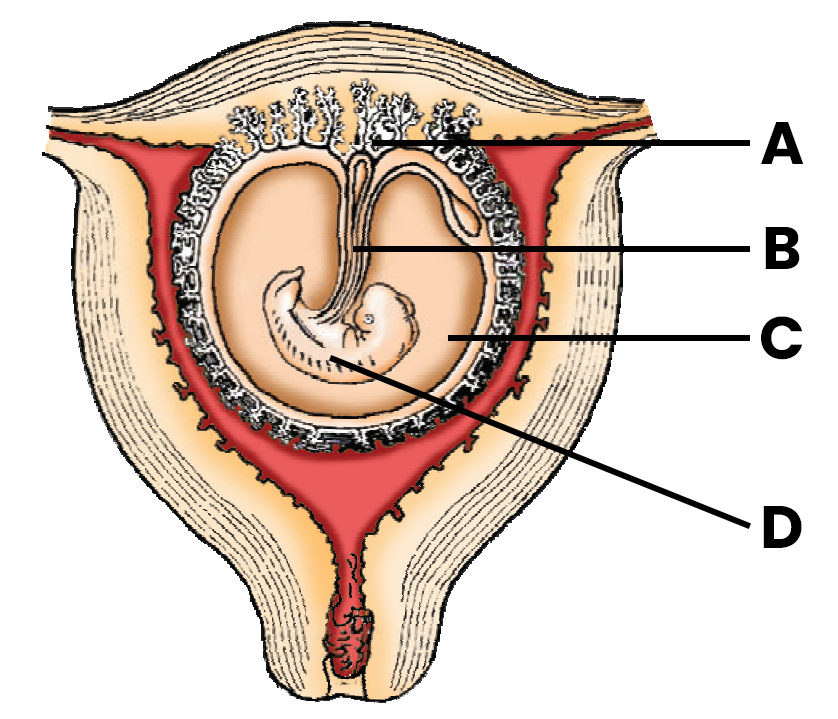
(a) In the above figure, choose and name the correct part (A, B, C or D) that act as a temporary endocrine gland and substantiate your answer. Why is it also called the functional junction?
(b) Mention the role of B in the development of the embryo.
(c) Name the fluid surrounding the developing embryo. How is it misused for sex-determination?
Ans. (a) Part labelled A -Placenta. It acts as an endocrine tissue as it produces several hormones like human chorionic gonadotropin (hCG), human placental lactogen (hPL), estrogens, progestogens, etc. It is also called the functional junction because it facilitates the supply of oxygen and nutrients to the embryo and removes carbon dioxide and excretory/waste materials produced by the embryo.
(b) The placenta is connected to the embryo through an umbilical cord which helps in the transport of substances to the embryo.
(c) Amniotic fluid; a foetal sex determination test is based on the chromosomal pattern of the cells in the amniotic fluid surrounding the developing embryo.
CBSE Class 12 Biology Exam Preparation Tips for Chapter 2
These focused tips will help you revise Human Reproduction effectively by strengthening diagrams, hormonal concepts, definitions, and exam-oriented question practice.
-
Master Diagrams: Practice labeling the male and female reproductive systems, the structure of the sperm, and the fetus within the uterus. Diagrams are often high-scoring areas.
-
Understand Hormonal Control: Pay close attention to the role of hormones like LH, FSH, GnRH, oxytocin, and hCG in various reproductive stages.
-
Focus on Definitions: Be clear on terms like spermatogenesis, oogenesis, ovulation, and implantation.
-
Connect Concepts: Understand how the placenta acts as a temporary endocrine gland, producing hormones like hCG and hPL during pregnancy.
-
Solve 12th Previous Year Papers: Regularly solving Class 12th Previous Year Papers from past exams will build your confidence and improve time management.
Important Questions Class 12 Biology Chapter 2 FAQs
Are the important questions in Class 12 Biology chapter 2 enough for board exam preparation?
Which topics from Human Reproduction are most important for exams?
Are MCQs important for the Human Reproduction chapter?
Should diagrams be practised for Chapter 2 Biology?