






Important Questions for Class 12 Physics Chapter 1 focus on Electric Charges and Fields. It is a basic and a high weightage chapter in electrostatics.
PW Question & Concept Bank Class 12 Physics offers chapterwise theory, competency-based questions, numericals, and board exam-focused preparation.
The chapter covers key topics such as Coulomb’s Law, electric field intensity, electric flux, Gauss’s Law, electric dipole, and field due to different charge distributions. Electric Charges And Fields Class 12 Question Answers are given here for effective preparation.
PW Class 12 Board Catalyst Physics Handwritten Notes by Rajwant Sir includes concise theory, formulas, numericals, and quick revision support.

Electric Charges And Fields Class 12 Important Questions
The chapter Electric Charges and Fields requires both conceptual understanding and strong mathematical application. Students must thoroughly practice Electric Charges And Fields Class 12 Important Questions, especially numericals based on Coulomb’s Law, electric field due to point charges, and derivations involving Gauss’s Law.
Below are the Electric Charges And Fields Class 12 Solutions as well with the questions for complete preparation:
1. When a body is connected to the earth, then electrons from the earth, flow into the body. It means that the body is [Delhi 2021]
(A) unchanged
(B) an insulator
(C) positively charged
(D) negatively charged
Sol. When a positively charged body is connected to the earth, then electrons from the earth flow into the body. Thus (C) is correct option.
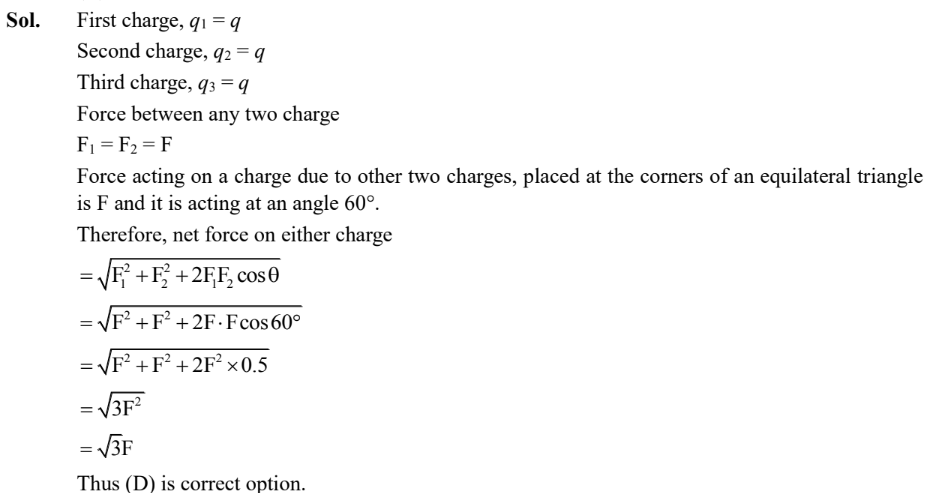
2. Three charges, each equal to +q, are placed at the corners of an equilateral triangle. If the force between any two charges is F, then net force on either charge will be [SQP 2004]
(A) 2F
(B) 3F
(C) 2F
(D) 3F
Sol. (D)
3. 
Sol. 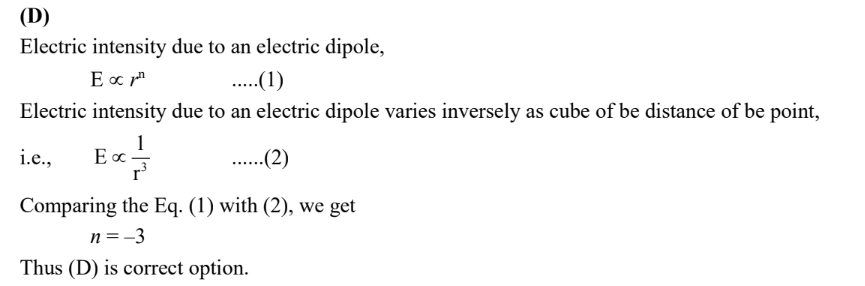
4. A comb after passing through dry hair attracts small pieces of paper. What happens if the hair is wet or if it is a rainy day? [SQP 2016]
Sol. A dry comb when passed through hair gets charged due to friction and because of this it induces an opposite charge on the paper. The electrostatic force of attraction between the comb and the paper is much greater than the weight of paper therefore it is lifted. On a wet day, the hair is wet, the friction is quite less and hence, comb does not get charged.
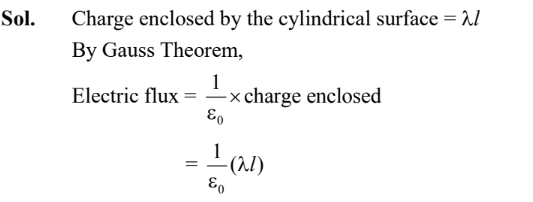
5. A thin straight infinitely long conducting wire having charge density is enclosed by a cylindrical surface of radius r and length l, its axis coinciding with the length of the wires. Find the expression for the electric flux through the surface of the cylinder. [SQP 2011]
6. What is the nature of electrostatic force between two-point electric charges q1 and q2 if
1. q1 + q2 > 0?
2. q1 + q2 < 0? [SQP 2010, Delhi 2001]
Sol. 1. If both q1 and q2 are positive, the electrostatic force between these will be repulsive. However, if one of these charges is positive and is greater than the other negative charge, the electrostatic force between them will be attractive. Thus, the nature of force between them can be repulsive or attractive.
2. If both q1 and q2 are –ve, the force between these will be repulsive. However, if one of them is –ve and it is greater than the second +ve charge, the force between them will be attractive. Thus, the nature of force between them can be repulsive or attractive.
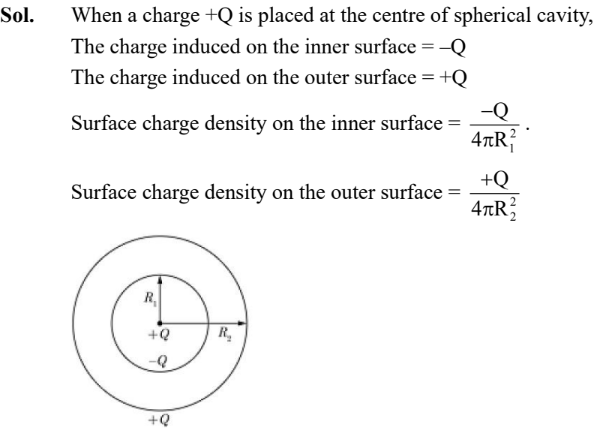
7. A metallic spherical shell has an inner radius R1 and outer radius R2. A charge Q is placed at the centre of the spherical cavity. What will be surface charge density on
1. The inner surface
2. The outer surface? [Comp 2006]
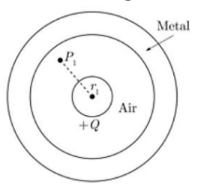
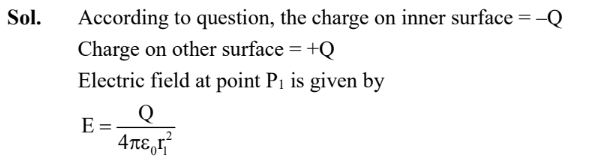
8. A small metal sphere carrying a charge +Q is located at the centre of a spherical cavity in a large uncharged metallic spherical shell. Write the charges on the inner and outer surfaces of the shell. Write the expression for the electric field at the point P1. [Foreign 2015]
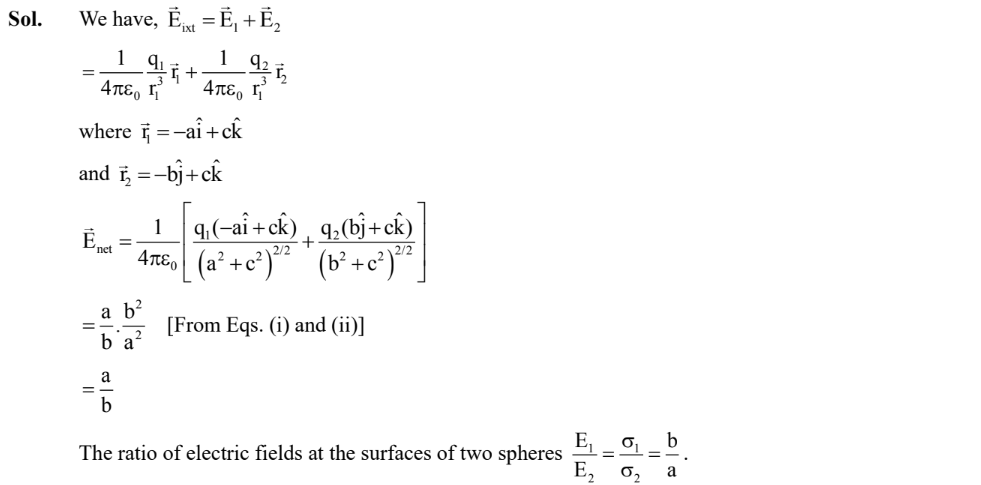
9. Two-point charges q1 and q2 are located at points (a, 0,0) and (0, b, 0) respectively. Find the electric field due to both these charges at the point (0,0, c)? [OD 2012]
10. The electric field components due to a charge inside the cube of side 0.1 m are as shown:
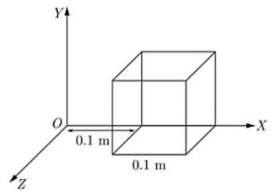
Ex = ax, where a = 500 N/C-m
Ey = 0, E2 = 0
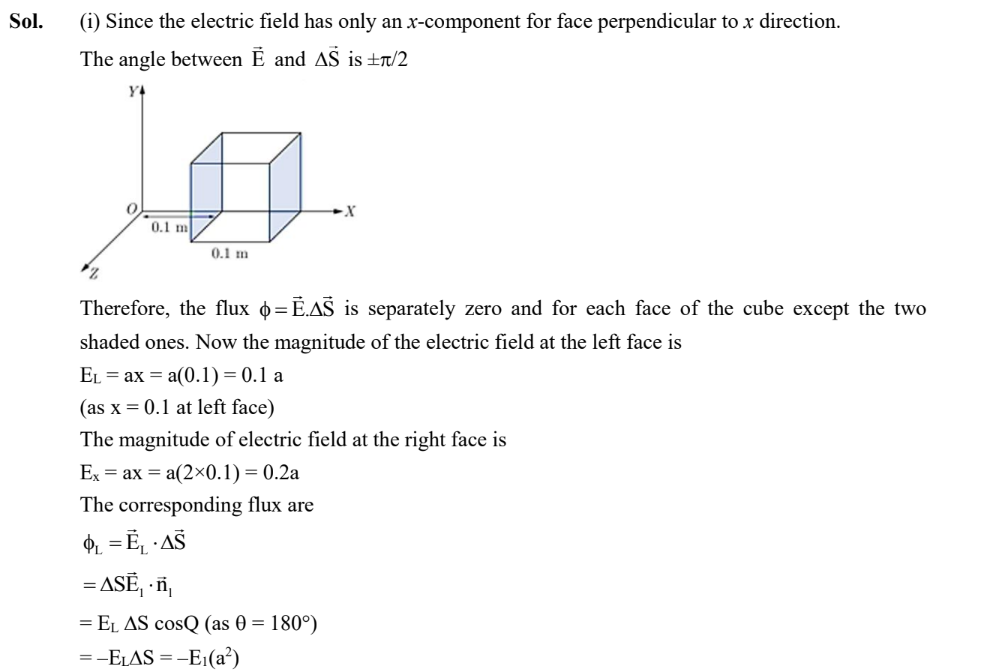
Calculate (i) the flux through the cube and (ii) the charge inside the cube. [OD 2018, Comp 2006]
Important Numericals from Electric Charges And Fields
Numerical-based questions are scoring if practiced properly. Students should revise:
-
Force between two charges using Coulomb’s Law.
-
Electric field intensity at a point due to multiple charges.
-
Problems involving dipole moment.
-
Applications of Gauss’s Law.
Regular practice of Electric Charges And Fields Class 12 Solutions improves speed and reduces calculation errors.
Last-Minute Revision Tips for Physics Board Exam
With the Physics board exam on February 15, 2026, follow these strategies:
-
Revise all formulas daily (Coulomb’s constant, dipole moment, electric flux).
-
Practice derivations at least twice before the exam.
-
Solve previous year board questions from Chapter 1.
-
Focus on stepwise solutions in numericals.
-
Avoid new topics and revise only Electric Charges And Fields Class 12 Question Answers.
-
Time yourself while solving numericals to simulate exam conditions.
Important Questions for Class 12 Physics Chapter 1 FAQs
What are the most important topics in Electric Charges And Fields Class 12?
Are numericals important from Electric Charges And Fields in the board exam?
How can I prepare Electric Charges And Fields Class 12 Important Questions quickly?
Are derivations asked from Chapter 1 in 12th Physics board exam?
Is Electric Charges And Fields a scoring chapter?





Get Free Counselling Today
and Clear up all your Doubts
 Live & recorded classes available at easeDashboard for progress trackingLakhs of practice questions

