
NCERT Solutions for Class 9 Science Chapter 11 Sound give detailed explanations of how sound is produced, how it travels, and how humans perceive it.
These Sound Class 9 questions and answers help students understand the important concepts such as frequency, amplitude, speed of sound, echo, and SONAR.
Sound Class 9 Questions and answers are helpful for students appearing for Class 9 exams.
Chapter 11 Sound is an essential part of the Class 9 Science syllabus. It explains the physics behind how sound is produced, the nature of waves, and how sound travels through different media.
The NCERT Solutions for Class 9 Science Chapter 11 Sound gives clear explanations of the questions using clear diagrams, definitions, and applications. The solutions are based on the NCERT curriculum for effective Class 9 exam preparation.
Sound Class 9 Questions and Answers
Sound Class 9 Questions and Answers cover all important concepts from Chapter 11 of the NCERT Science textbook in a well structured manner.
The questions and answers are based on the latest CBSE syllabus and are useful for conceptual clarity. Below are the Sound Class 9 Questions and Answers:
NCERT Solutions for Class 9 Science Chapter 11
Below we have provided Sound Class 9 Questions and Answers to help students prepare well for the exams:
Page- 129
1. How does the sound produced by a vibrating object in a medium reach your ear?
Solution:
When something vibrates, the medium's surrounding particles must also vibrate. Next to vibrating particles, other particles are compelled to vibrate as well. As a result, sound waves generated by vibrating objects propagate across a medium, passing through particles before reaching your ears.
2. Explain how sound is produced by your school bell.
Solution:
The school bell vibrates when struck with a hammer, moving forward and backward and causing compression and rarefaction. This is how the school bell sounds.
3. Why are sound waves called mechanical waves?
Solution:
For sound waves to interact with the particles in them, they need a medium to propagate through. Sound waves are hence referred to as mechanical waves.
4. Suppose you and your friend are on the moon. Will you be able to hear any sound produced by your friend?
Solution:
No. For sound waves to travel, they need a medium. I will not be able to hear my friend's sound since there is no atmosphere on the moon and sound cannot pass through a vacuum.
Page: 132
5. Which wave property determines (a) loudness, and (b) pitch?
Solution:
(a) Amplitude: There is a direct correlation between a sound's amplitude and loudness. The sound is louder when the amplitude is larger. (b) Frequency: There is a direct correlation between a sound's pitch and frequency. A high pitch corresponds to a high frequency of sound.
6. Guess which sound has a higher pitch: guitar or car horn?
Solution:
A sound's frequency and pitch are exactly proportionate. As a result, the guitar's pitch is higher than a car horn's.
7. What are the wavelength, frequency, period, and amplitude of a sound wave?
Solution:
(a) Wavelength: The separation between two successive compressions or rarefactions is known as the wavelength. The meter (m) is the wavelength unit in the SI. (b) Frequency - The number of oscillations per second is the definition of frequency. The hertz (Hz) is the SI unit of frequency. (c) Amplitude - The highest point a sound wave's trough or crest can reach is known as its amplitude. (d) Period: This is the amount of time needed to produce a single full cycle of a sound wave.
8. How are the wavelength and frequency of a sound wave related to its speed?
Solution:
Wavelength, speed, and frequency are related in the following way: Speed = Wavelength x Frequency v = λ ν
9. Calculate the wavelength of a sound wave whose frequency is 220 Hz and speed is 440 m/s in a given medium.
Solution:
Given that, Frequency of sound wave = 220 Hz Speed of sound wave = 440 m/s Calculate wavelength. We know that Speed = Wavelength × Frequency v = λ ν 440 = Wavelength × 220 Wavelength = 440/220 Wavelength = 2 Therefore, the wavelength of the sound wave = 2 meters
10. A person is listening to a tone of 500 Hz, sitting at a distance of 450 m from the source of the sound. What is the time interval between successive compressions from the source?
Solution:
The time interval between successive compressions from the source is equal to the period, and the period is reciprocal to the frequency. Therefore, it can be calculated as follows: T= 1/F T= 1/500 T = 0.002 s
Page 133
11. Distinguish between loudness and intensity of sound.
Solution:
The intensity of a sound wave is the quantity of sound energy that travels across a space in a second. The definition of loudness is its amplitude.
12. In which of the three media, air, water, or iron, does sound travel the fastest at a particular temperature?
Solution:
Sound travels faster in solids when compared to any other medium. Therefore, at a particular temperature, sound travels fastest in iron and slowest in gas.
Page 134
13. An echo is heard in 3 s. What is the distance of the reflecting surface from the source, given that the speed of sound is 342 ms -1 ?
Solution:
Speed of sound (v) = 342 ms -1 Echo returns in time (t) = 3 s Distance travelled by sound = v × t = 342 × 3 = 1026 m In the given interval of time, sound must travel a distance that is twice the distance between the reflecting surface and the source. Therefore, the distance of the reflecting surface from the source =1026/2 = 513 m
Page: 165
14. Why are the ceilings of concert halls curved?
Solution:
The ceilings of concert halls are curved to spread sound uniformly in all directions after reflecting from the walls.
Page: 136
15. What is the audible range of the average human ear?
Solution:
20 Hz to 20,000 Hz. Any sound less than 20 Hz or greater than 20,000 Hz frequency is not audible to human ears.
16. What is the range of frequencies associated with (a) Infrasound? (b) Ultrasound?
Solution:
(a) 20 Hz (b) 20,000 Hz
Exercise Questions Page: 138
1. What is sound, and how is it produced?
Solution:
Vibrations result in sound production. A body's vibrations cause the medium's nearby particles to vibrate as well. This disrupts the medium, which makes its way to the ear in the form of waves. As a result, sound is generated.
2. Describe, with the help of a diagram, how compressions and rarefactions are produced in the air near a source of the sound.
Solution:
The school bell vibrates when struck with a hammer, moving forward and backward and causing compression and rarefaction. Its forward motion generates tremendous pressure in its immediate vicinity. Compression refers to this area of intense pressure. Its retrograde motion produces a zone of low pressure around it. We refer to this area as rarefaction.
3. Why is a sound wave called a longitudinal wave?
Solution:
A longitudinal wave is defined as the vibration of the medium that moves either parallel to or in the direction of the wave. The medium's particle direction vibrates in a direction parallel to the disturbance's propagation direction. As a result, a longitudinal wave is what is known as a sound wave.
4. Which characteristics of the sound help you to identify your friend by his voice while sitting with others in a dark room?
Solution:
A trait that aids in recognizing a specific person's voice is sound quality. Even though the pitch and loudness of two people are the same, their characteristics will change.
5. Flash and thunder are produced simultaneously. But thunder is heard a few seconds after the flash is seen. Why?
Solution:
The speed of light is 3 × 10⁸ m/s, while the speed of sound is 344 m/s. About light, the speed of light is lower. This explains why thunder travels slower to Earth than light, even though light travels quicker. Therefore, every time we hear thunder, lightning is visible beforehand.
6. A person has a hearing range from 20 Hz to 20 kHz. What are the typical wavelengths of sound waves in air corresponding to these two frequencies? Take the speed of sound in air as 344 m s −1 .
Solution:
For sound waves, Speed = Wavelength × frequency v = λ × v Speed of sound wave in air = 344 m/s (a) For v = 20 Hz λ 1 = v/v 1 = 344/20 = 17.2 m (b) For v 2 = 20,000 Hz λ 2 = v/v 2 = 344/20,000 = 0.0172 m Therefore, for human beings, the hearing wavelength is in the range of 0.0172 m to 17.2 m.
7. Two children are at opposite ends of an aluminum rod. One strikes the end of the rod with a stone. Find the ratio of times taken by the sound wave in the air and in aluminum to reach the second child.
Solution:
Consider the length of the aluminum rod = d Speed of sound wave at 25° C, V Al = 6420 ms-1 The time taken to reach the other end is, T Al = d/ (V Al) = d/6420 Speed of sound in air, V air = 346 ms-1 Time taken by sound to each other end is, T air = d/ (V air) = d/346 Therefore, the ratio of time taken by sound in aluminum and air is, T air / t Al = 6420 / 346 = 18.55
8. The frequency of a source of sound is 100 Hz. How many times does it vibrate in a minute?
Solution:
Frequency = (Number of oscillations) / Total time Number of oscillations = Frequency × Total time Given, Frequency of sound = 100 Hz Total time = 1 min (1 min = 60 s) Number of oscillations or vibrations = 100 × 60 = 6000 The source vibrates 6000 times in a minute and produces a frequency of 100 Hz.
9. Does sound follow the same laws of reflection as light does? Explain.
Solution:
Indeed. Similar to light, sound is governed by the principles of reflection. At the point of incidence, the incident and reflected sound waves form an equal angle with the surface normal. Furthermore, all three components of the sound wave—the incident, the reflected, and the normal to the point of incidence—lie in the same plane.
10. When a sound is reflected from a distant object, an echo is produced. Let the distance between the reflecting surface and the source of sound production remain the same. Do you hear an echo sound on a hotter day?
Solution:
When there is a minimum of 0.1 seconds of delay between the original sound and the reflected sound, an echo is audible. In a medium with increasing temperature, sound travels faster. An echo is only detectable if there is a time difference of more than 0.1 seconds between the reflected and original sounds. On a hotter day, this time difference will decrease.
11. Give two practical applications of the reflection of sound waves.
Solution:
(i) Reflection of sound is used to measure the speed and distance of underwater objects. This method is called SONAR. (ii) Working of a stethoscope – The sound of a patient’s heartbeat reaches the doctor’s ear through multiple reflections of sound.
12. A stone is dropped from the top of a tower 500 m high into a pond of water at the base of the tower. When is the splash heard at the top? Given, g = 10 m s −2 and speed of sound = 340 m s −1 .
Solution:
Height (s) of tower = 500 m Velocity (v) of sound = 340 m s −1 Acceleration (g) due to gravity = 10 m s −1 Initial velocity (u) of the stone = 0 Time (t 1 ) taken by the stone to fall to the tower base: As per the second equation of motion, s= ut 1 + (½) g (t 1 ) 2 500 = 0 x t 1 + (½) 10 (t 1 ) 2 (t 1 ) 2 = 100 t 1 = 10 s Time (t 2 ) taken by sound to reach the top from the tower base = 500/340 = 1.47 s t = t 1 + t 2 t = 10 + 1.47 t = 11.47 s
13. A sound wave travels at a speed of 339 m s -1 . If its wavelength is 1.5 cm, what is the frequency of the wave? Will it be audible?
Solution:
Speed (v) of sound = 339 m s −1 Wavelength (λ) of sound = 1.5 cm = 0.015 m Speed of sound = Wavelength × Frequency v = v = λ X v v = v / λ = 339 / 0.015 = 22600 Hz The frequency of audible sound for human beings lies between the ranges of 20 Hz to 20,000 Hz. The frequency of the given sound is more than 20,000 Hz; therefore, it is not audible.
14. What is reverberation? How can it be reduced?
Solution:
Reverberation is the constant, multiple sound reflections in a large, confined environment. It can be decreased by using sound-absorbing materials, including loose woolen and fiber boards, to cover the walls and ceilings of enclosed places.
15. What is the loudness of sound? What factors does it depend on?
Solution:
High volumes have a lot of energy. The relationship between loudness and vibration amplitude is direct. It is directly proportional to the square of the sound waves' amplitude.
16. How is ultrasound used for cleaning?
Solution:
After placing dirty objects in a cleaning solution, the solution is subjected to ultrasonic sound waves. The dirt is helped to separate off the objects by the high frequency of the ultrasonic waves. This is one application of ultrasonic cleaning technology.
17. Explain how defects in a metal block can be detected using ultrasound.
Solution:
Ultrasound waves cannot go through faulty metal blocks and be reflected. This method is applied to the identification of flaws in metal blocks. As illustrated in the picture, assemble the apparatus so that detectors are positioned on one end of a metal block and ultrasound is passed through the other. The metal block's damaged portion cannot be identified by the detector because ultrasonic waves cannot flow through it. In this manner, ultrasonography can be used to identify flaws in metal blocks.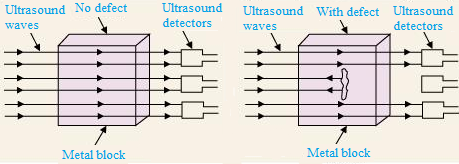
How to Prepare Class 9 Chapter 11 Sound Effectively?
Preparing this chapter becomes easy if you follow a structured method:
-
Before solving numerical problems, ensure that you clearly understand amplitude, frequency, wavelength, and time period.
-
Draw Diagrams such as Wave diagrams, vibration setups, and SONAR illustrations help you visualize the chapter and retain information.
-
Practice Numerical Questions Daily like the Speed of sound, echo-based questions, and time-period calculations strengthen numerical confidence.
-
Learn Real-Life Applications like musical instruments, stethoscope functioning, SONAR, and echoes to improve conceptual clarity.
-
The Sound Class 9 Questions and Answers provided make it easy to check mistakes and refine your understanding.
|
NCERT Solutions for Class 9 Science Chapter-wise Links |
|---|
NCERT Solutions for Class 9 Science Chapter 11 Sound FAQs
What is sound according to Class 9 Science?
Can sound travel in vacuum?
What is the speed of sound in air?
What is an echo?
Why are NCERT Solutions for Class 9 Science Chapter 11 important?