







NCERT Solutions for Class 11 Maths Chapter 5 Exercise 5.1
 Yashasvi Tyagi27 Jan, 2025
NCERT Solutions for Class 11 Maths Chapter 5 Exercise 5.1: The NCERT (National Council of Educational Research and Training) provides a well-structured curriculum that helps guide students through their academic journey. Class 11 Maths Chapter 5 is Linear Inequalities , is divided into multiple exercises, including Exercise 5.1, Exercise 5.2, Exercise 5.3, and a Miscellaneous Exercise.
These exercises are designed to provide practice and enhance students' understanding of the topics. By solving the problems in Exercise 5.1, students can strengthen their grasp of the concepts. Students can refer to the NCERT Solutions for Class 11 Maths Chapter 5, Exercise 5.1 below for detailed solutions and explanations.NCERT Solutions for Class 11 Maths Chapter 5 Exercise 5.1 Overview
NCERT Solutions for Class 11 Maths Chapter 5 Exercise 5.1 provides an insightful introduction to Linear Inequalities. This exercise focuses on teaching students the fundamental methods for solving linear inequalities, with clear examples and detailed explanations. It is designed to help students understand how to apply algebraic techniques to solve inequality problems effectively. In the broader context, NCERT Solutions for Class 11 Maths Chapter 5 covers the concept of inequalities that involve expressions with non-equal values. The chapter thoroughly explains the key principles of Linear Inequalities, supported by practical examples. This helps students understand the topic deeply and equips them with the skills to apply linear inequalities in real-world situations.About the Linear Inequalities in Class 11 Maths Exercise 5.1
Linear inequalities are an extension of the linear equations you studied previously. In earlier classes, you explored linear equations in one and two variables, solving and proving various solutions. Class 11 Maths Chapter 5 introduces linear inequalities, describing them as relationships between two unequal quantities. These inequalities use symbols such as < (less than) and > (greater than), as well as ≥ (greater than or equal to), to represent different conditions.NCERT Solutions for Class 11 Maths Chapter 5 Exercise 5.1 PDF
NCERT Solutions for Class 11 Maths Chapter 5 Exercise 5.1 PDF is a valuable resource for students studying Linear Inequalities. This PDF provides detailed solutions and step-by-step explanations for all the problems in Exercise 5.1. It helps students understand the methods used to solve linear inequalities and reinforces their learning through clear examples. NCERT Solutions for Class 11 Maths Chapter 5 Exercise 5.1 PDF format allows easy access, making it convenient for students to refer to the solutions anytime for revision and practice. Using this resource, students can strengthen their problem-solving skills and gain a deeper understanding of the topic, which is essential for their academic success. Students can check the direct link provided below to download NCERT Solutions for Class 11 Maths Chapter 5 Exercise 5.1 PDF:Download NCERT Solutions for Class 11 Maths Chapter 5 Exercise 5.1 PDF
NCERT Solutions for Class 11 Maths Chapter 5 Exercise 5.1 Linear Inequalities
The following are the NCERT Solutions for Class 11 Maths Chapter 5 Exercise 5.1:1. Solve 24x < 100, when
(i) x is a natural number.
(ii) x is an integer.
Solution:
(i) Given that 24x < 100 Now, we have to divide the inequality by 24, and we get x < 25/6 When x is a natural integer, then It is clear that the only natural number less than 25/6 are 1, 2, 3, and 4. Thus, 1, 2, 3, and 4 will be the solution of the given inequality when x is a natural number. Hence, {1, 2, 3, 4} is the solution set. (ii) Given that 24x < 100 Now, we have to divide the inequality by 24, and we get x < 25/6 When x is an integer, then It is clear that the integer number less than 25/6 are…-1, 0, 1, 2, 3, 4. Thus, the solution of 24 x < 100 is…,-1, 0, 1, 2, 3, 4, when x is an integer. Hence, {…, -1, 0, 1, 2, 3, 4} is the solution set.2. Solve – 12x > 30, when
(i) x is a natural number.
(ii) x is an integer.
Solution:
(i) Given that – 12x > 30 Now by dividing the inequality by -12 on both sides, we get x < -5/2 When x is a natural integer, then It is clear that there is no natural number less than -2/5 because -5/2 is a negative number, and natural numbers are positive numbers. Therefore, there would be no solution to the given inequality when x is a natural number. (ii) Given that – 12x > 30 Now by dividing the inequality by -12 on both sides, we get x < -5/2 When x is an integer, then It is clear that the integer number less than -5/2 are…, -5, -4, – 3 Thus, the solution of – 12x > 30 is …,-5, -4, -3, when x is an integer. Therefore, the solution set is {…, -5, -4, -3}.3. Solve 5x – 3 < 7, when
(i) x is an integer
(ii) x is a real number
Solution:
(i) Given that, 5x – 3 < 7 Now by adding 3 on both sides, we get 5x – 3 + 3 < 7 + 3 Above inequality becomes 5x < 10 Again, by dividing both sides by 5, we get 5x/5 < 10/5 x < 2 When x is an integer, then It is clear that the integer numbers less than 2 are…, -2, -1, 0, 1. Thus, the solution of 5x – 3 < 7 is …,-2, -1, 0, 1, when x is an integer. Therefore, the solution set is {…, -2, -1, 0, 1} (ii) Given that, 5x – 3 < 7 Now by adding 3 on both sides, we get 5x – 3 + 3 < 7 + 3 Above inequality becomes 5x < 10 Again, by dividing both sides by 5, we get, 5x/5 < 10/5 x < 2 When x is a real number, then It is clear that the solutions of 5x – 3 < 7 will be given by x < 2, which states that all the real numbers are less than 2. Hence, the solution set is x ∈ (-∞, 2).4. Solve 3x + 8 >2, when
(i) x is an integer.
(ii) x is a real number.
Solution:
(i) Given that 3x + 8 > 2 Now, by subtracting 8 from both sides, we get 3x + 8 – 8 > 2 – 8 The above inequality becomes, 3x > – 6 Again, by dividing both sides by 3, we get 3x/3 > -6/3 Hence x > -2 When x is an integer, then It is clear that the integer number greater than -2 are -1, 0, 1, 2,… Thus, the solution of 3x + 8 > 2 is -1, 0, 1, 2,… when x is an integer. Hence, the solution set is {-1, 0, 1, 2,…} (ii) Given that, 3x + 8 > 2 Now, by subtracting 8 from both sides, we get 3x + 8 – 8 > 2 – 8 The above inequality becomes, 3x > – 6 Again, by dividing both sides by 3, we get 3x/3 > -6/3 Hence x > -2 When x is a real number. It is clear that the solutions of 3x + 8 >2 will be given by x > -2, which states that all the real numbers are greater than -2. Therefore, the solution set is x ∈ (-2, ∞).Solve the inequalities in Exercises 5 to 16 for real x.
5. 4x + 3 < 5x + 7
Solution:
Given that, 4x + 3 < 5x + 7 Now by subtracting 7 from both sides, we get 4x + 3 – 7 < 5x + 7 – 7 The above inequality becomes, 4x – 4 < 5x Again, by subtracting 4x from both sides, 4x – 4 – 4x < 5x – 4x x > – 4 ∴ The solutions of the given inequality are defined by all the real numbers greater than -4. Hence, the required solution set is (-4, ∞).6. 3x – 7 > 5x – 1
Solution:
Given that, 3x – 7 > 5x – 1 Now by adding 7 to both sides, we get 3x – 7 +7 > 5x – 1 + 7 3x > 5x + 6 Again, by subtracting 5x from both sides, 3x – 5x > 5x + 6 – 5x -2x > 6 Dividing both sides by -2 to simplify, we get -2x/-2 < 6/-2 x < -3 ∴ The solutions of the given inequality are defined by all the real numbers less than -3. Hence, the required solution set is (-∞, -3).7. 3(x – 1) ≤ 2 (x – 3)
Solution:
Given that, 3(x – 1) ≤ 2 (x – 3) By multiplying the above, inequality can be written as 3x – 3 ≤ 2x – 6 Now, by adding 3 to both sides, we get 3x – 3+ 3 ≤ 2x – 6+ 3 3x ≤ 2x – 3 Again, by subtracting 2x from both sides, 3x – 2x ≤ 2x – 3 – 2x x ≤ -3 Therefore, the solutions of the given inequality are defined by all the real numbers less than or equal to -3. Hence, the required solution set is (-∞, -3].8. 3 (2 – x) ≥ 2 (1 – x)
Solution:
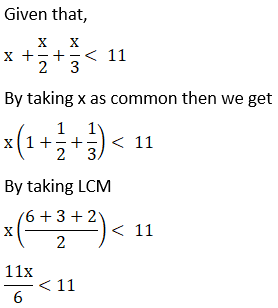
Given that, 3 (2 – x) ≥ 2 (1 – x) By multiplying, we get 6 – 3x ≥ 2 – 2x Now, by adding 2x to both sides, 6 – 3x + 2x ≥ 2 – 2x + 2x 6 – x ≥ 2 Again, by subtracting 6 from both sides, we get 6 – x – 6 ≥ 2 – 6 – x ≥ – 4 Multiplying inequality by a negative sign, we get x ≤ 4 ∴ The solutions of the given inequality are defined by all the real numbers greater than or equal to 4. Hence, the required solution set is (-∞, 4].9. x + x/2 + x/3 < 11
Solution:
 x < 6
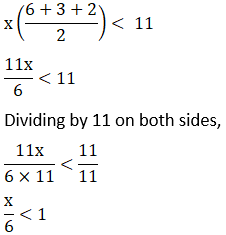
The solutions of the given inequality are defined by all the real numbers less than 6.
Hence, the solution set is (-∞, 6).
x < 6
The solutions of the given inequality are defined by all the real numbers less than 6.
Hence, the solution set is (-∞, 6).
10. x/3 > x/2 + 1
Solution:
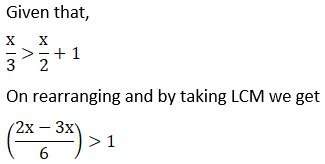 – x/6 > 1
– x > 6
x < – 6
∴ The solutions of the given inequality are defined by all the real numbers less than – 6.
Hence, the required solution set is (-∞, -6).
– x/6 > 1
– x > 6
x < – 6
∴ The solutions of the given inequality are defined by all the real numbers less than – 6.
Hence, the required solution set is (-∞, -6).
11. 3(x – 2)/5 ≤ 5 (2 – x)/3
Solution:
Given that,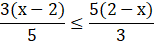 Now by cross-multiplying the denominators, we get
9(x- 2) ≤ 25 (2 – x)
9x – 18 ≤ 50 – 25x
Now adding 25x on both sides,
9x – 18 + 25x ≤ 50 – 25x + 25x
34x – 18 ≤ 50
Adding 25x on both sides,
34x – 18 + 18 ≤ 50 + 18
34x ≤ 68
Dividing both sides by 34,
34x/34 ≤ 68/34
x ≤ 2
The solutions of the given inequality are defined by all the real numbers less than or equal to 2.
Hence, the required solution set is (-∞, 2].
Now by cross-multiplying the denominators, we get
9(x- 2) ≤ 25 (2 – x)
9x – 18 ≤ 50 – 25x
Now adding 25x on both sides,
9x – 18 + 25x ≤ 50 – 25x + 25x
34x – 18 ≤ 50
Adding 25x on both sides,
34x – 18 + 18 ≤ 50 + 18
34x ≤ 68
Dividing both sides by 34,
34x/34 ≤ 68/34
x ≤ 2
The solutions of the given inequality are defined by all the real numbers less than or equal to 2.
Hence, the required solution set is (-∞, 2].
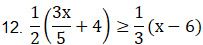
Solution:
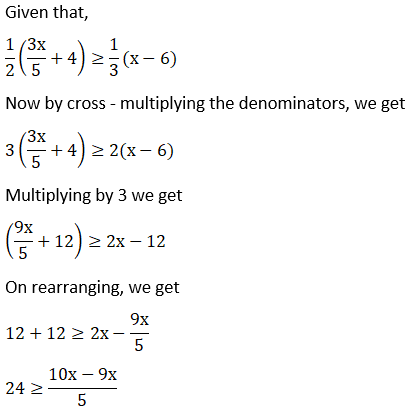
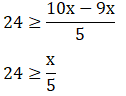 120 ≥ x
∴ The solutions of the given inequality are defined by all the real numbers less than or equal to 120.
Thus, (-∞, 120] is the required solution set.
120 ≥ x
∴ The solutions of the given inequality are defined by all the real numbers less than or equal to 120.
Thus, (-∞, 120] is the required solution set.
13. 2 (2x + 3) – 10 < 6 (x – 2)
Solution:
Given that, 2 (2x + 3) – 10 < 6 (x – 2) By multiplying, we get 4x + 6 – 10 < 6x – 12 On simplifying, we get 4x – 4 < 6x – 12 4x – 6x < -12 + 4 -2x < -8 Dividing by 2, we get; -x < -4 Multiply by “-1” and change the sign. x > 4 ∴ The solutions of the given inequality are defined by all the real numbers greater than 4. Hence, the required solution set is (4, ∞).14. 37 – (3x + 5) ≥ 9x – 8 (x – 3)
Solution:
Given that, 37 – (3x + 5) ≥ 9x – 8 (x – 3) On simplifying, we get = 37 – 3x – 5 ≥ 9x – 8x + 24 = 32 – 3x ≥ x + 24 On rearranging = 32 – 24 ≥ x + 3x = 8 ≥ 4x = 2 ≥ x All the real numbers of x which are less than or equal to 2 are the solutions to the given inequality Hence, (-∞, 2] will be the solution for the given inequality.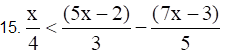
Solution:
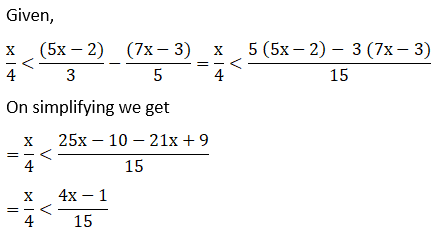 = 15x < 4 (4x – 1)
= 15x < 16x – 4
= 4 < x
All the real numbers of x which are greater than 4 are the solutions of the given inequality.
Hence, (4, ∞) will be the solution for the given inequality.
= 15x < 4 (4x – 1)
= 15x < 16x – 4
= 4 < x
All the real numbers of x which are greater than 4 are the solutions of the given inequality.
Hence, (4, ∞) will be the solution for the given inequality.
Solution:
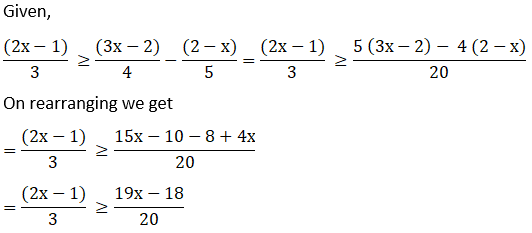
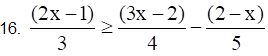
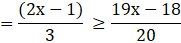 = 20 (2x – 1) ≥ 3 (19x – 18)
= 40x – 20 ≥ 57x – 54
= – 20 + 54 ≥ 57x – 40x
= 34 ≥ 17x
= 2 ≥ x
∴ All the real numbers of x, which are less than or equal to 2, are the solutions to the given inequality.
Hence, (-∞, 2] will be the solution for the given inequality.
= 20 (2x – 1) ≥ 3 (19x – 18)
= 40x – 20 ≥ 57x – 54
= – 20 + 54 ≥ 57x – 40x
= 34 ≥ 17x
= 2 ≥ x
∴ All the real numbers of x, which are less than or equal to 2, are the solutions to the given inequality.
Hence, (-∞, 2] will be the solution for the given inequality.
Solve the inequalities in Exercises 17 to 20 and show the graph of the solution in each case on a number line.
17. 3x – 2 < 2x + 1
Solution:
Given, 3x – 2 < 2x + 1 Solving the given inequality, we get 3x – 2 < 2x + 1 = 3x – 2x < 1 + 2 = x < 3 Now, the graphical representation of the solution is as follows:
18. 5x – 3 ≥ 3x – 5
Solution:
We have, 5x – 3 ≥ 3x – 5 Solving the given inequality, we get 5x – 3 ≥ 3x – 5 On rearranging, we get = 5x – 3x ≥ -5 + 3 On simplifying = 2x ≥ -2 Now, by dividing 2 on both sides, we get = x ≥ -1 The graphical representation of the solution is as follows:
19. 3 (1 – x) < 2 (x + 4)
Solution:
Given, 3 (1 – x) < 2 (x + 4) Solving the given inequality, we get 3 (1 – x) < 2 (x + 4) On multiplying, we get = 3 – 3x < 2x + 8 On rearranging, we get = 3 – 8 < 2x + 3x = – 5 < 5x Now, by dividing 5 on both sides, we get -5/5 < 5x/5 = – 1 < x Now, the graphical representation of the solution is as follows:

Solution:
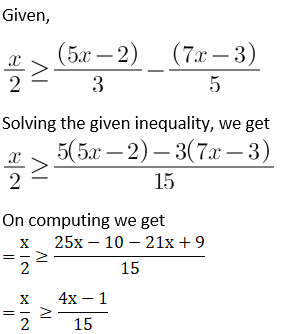
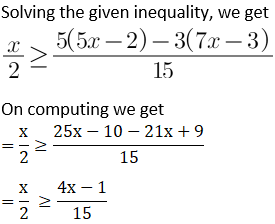 On computing, we get
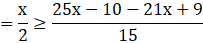
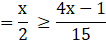 = 15x ≥ 2 (4x – 1)
= 15x ≥ 8x -2
= 15x -8x ≥ 8x -2 -8x
= 7x ≥ -2
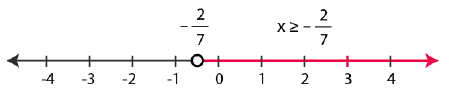
= x ≥ -2/7
Now, the graphical representation of the solution is as follows:
= 15x ≥ 2 (4x – 1)
= 15x ≥ 8x -2
= 15x -8x ≥ 8x -2 -8x
= 7x ≥ -2
= x ≥ -2/7
Now, the graphical representation of the solution is as follows:
21. Ravi obtained 70 and 75 marks in the first two unit tests. Find the minimum marks he should get in the third test to have an average of at least 60 marks.
Solution:
Let us assume x be the marks obtained by Ravi in his third unit test According to the question, the entire students should have an average of at least 60 marks (70 + 75 + x)/3 ≥ 60 = 145 + x ≥ 180 = x ≥ 180 – 145 = x ≥ 35 Hence, all the students must obtain 35 marks in order to have an average of at least 60 marks.22. To receive a Grade ‘A’ in a course, one must obtain an average of 90 marks or more in five examinations (each of 100 marks). If Sunita’s marks in the first four examinations are 87, 92, 94 and 95, find the minimum marks that Sunita must obtain in the fifth examination to get a Grade ‘A’ in the course.
Solution:
Let us assume Sunita scored x marks in her fifth examination Now, according to the question, in order to receive a Grade ‘A’ in the course, she must have to obtain an average of 90 marks or more in her five examinations (87 + 92 + 94 + 95 + x)/5 ≥ 90 = (368 + x)/5 ≥ 90 = 368 + x ≥ 450 = x ≥ 450 – 368 = x ≥ 82 Hence, she must have to obtain 82 or more marks in her fifth examination to get a Grade ‘A’ in the course.23. Find all pairs of consecutive odd positive integers, both of which are smaller than 10, such that their sum is more than 11.
Solution:
Let us assume x be the smaller of the two consecutive odd positive integers ∴ Other integer is = x + 2 It is also given in the question that both the integers are smaller than 10 ∴ x + 2 < 10 x < 8 … (i) Also, it is given in the question that the sum of two integers is more than 11 ∴ x + (x + 2) > 11 2x + 2 > 11 x > 9/2 x > 4.5 … (ii) Thus, from (i) and (ii), we have x as an odd integer, which can take values 5 and 7. Hence, possible pairs are (5, 7) and (7, 9)24. Find all pairs of consecutive even positive integers, both of which are larger than 5, such that their sum is less than 23.Solution:
Let us assume x be the smaller of the two consecutive even positive integers ∴ Other integer = x + 2 It is also given in the question that both the integers are larger than 5 ∴ x > 5 ….(i) Also, it is given in the question that the sum of two integers is less than 23. ∴ x + (x + 2) < 23 2x + 2 < 23 x < 21/2 x < 10.5 …. (ii) Thus, from (i) and (ii), we have x as an even number, which can take values 6, 8 and 10. Hence, possible pairs are (6, 8), (8, 10) and (10, 12).25. The longest side of a triangle is 3 times the shortest side, and the third side is 2 cm shorter than the longest side. If the perimeter of the triangle is at least 61 cm, find the minimum length of the shortest side.
Solution:
Let us assume the length of the shortest side of the triangle to be x cm ∴ According to the question, the length of the longest side = 3x cm And, length of third side = (3x – 2) cm As the least perimeter of the triangle = 61 cm Thus, x + 3x + (3x – 2) cm ≥ 61 cm = 7x – 2 ≥ 61 = 7x ≥ 63 Now divide by 7, and we get = 7x/7 ≥ 63/7 = x ≥ 9 Hence, the minimum length of the shortest side will be 9 cm.26. A man wants to cut three lengths from a single piece of board of length 91cm. The second length is to be 3cm longer than the shortest, and the third length is to be twice as long as the shortest. What are the possible lengths of the shortest board if the third piece is to be at least 5cm longer than the second?
Solution:
Let us assume the length of the shortest piece to be x cm ∴ According to the question, the length of the second piece = (x + 3) cm And, the length of the third piece = 2x cm As all three lengths are to be cut from a single piece of the board having a length of 91 cm ∴ x + (x + 3) + 2x ≤ 91 cm = 4x + 3 ≤ 91 = 4x ≤ 88 = 4x/4 ≤ 88/4 = x ≤ 22 … (i) Also, it is given in the question that the third piece is at least 5 cm longer than the second piece ∴ 2x ≥ (x+3) + 5 2x ≥ x + 8 x ≥ 8 … (ii) Thus, from equations (i) and (ii), we have: 8 ≤ x ≤ 22 Hence, it is clear that the length of the shortest board is greater than or equal to 8 cm and less than or equal to 22 cm.Benefits of NCERT Solutions for Class 11 Maths Chapter 5 Exercise 5.1
NCERT Solutions for Class 11 Maths Chapter 5 Exercise 5.1 offer various benefits for students:- Understanding Concepts : These solutions provide detailed explanations, helping students grasp the foundational principles of Linear Inequalities, which are crucial for further studies in mathematics.
- Exam Preparation : The solutions are fully aligned with the NCERT syllabus, making them an essential tool for effective exam preparation, ensuring students are well-prepared for their CBSE exams.
- Step-by-Step Guidance : Solutions break down complex problems into manageable steps, simplifying the process and making it easier for students to understand and apply the concepts.
- Concept Reinforcement : The solutions help reinforce key concepts such as factorization and solving linear inequalities, strengthening students' understanding.
- Exam-Oriented : The NCERT Solutions are specifically designed to align with the CBSE exam pattern, giving students the confidence to face exams with a clear understanding of the topics.
- Time Efficiency : With well-organized solutions, students can save time and focus on practicing problems rather than searching for answers, making their study sessions more productive.
NCERT Solutions for Class 11 Maths Chapter 5 Exercise 5.1 FAQs
How can I use NCERT Solutions for Class 11 Maths Chapter 5?
What is the importance of solving Exercise 5.1 in Linear Inequalities?
How can NCERT Solutions for Chapter 5 help in exam preparation?
Can I access NCERT Solutions for Class 11 Maths Chapter 5 Exercise 5.1 anytime?







 Live & recorded classes available at easeDashboard for progress trackingMillions of practice questions at your fingertips

