







Lucknow Pact, History, Significance, Nature, Provisions, Result
Lucknow Pact 1916 is an agreement between the Indian National Congress (INC) and the All India Muslim League signed in December 1916. Check history, significance, nature, provisions, result.
 Parul Rishi21 Mar, 2024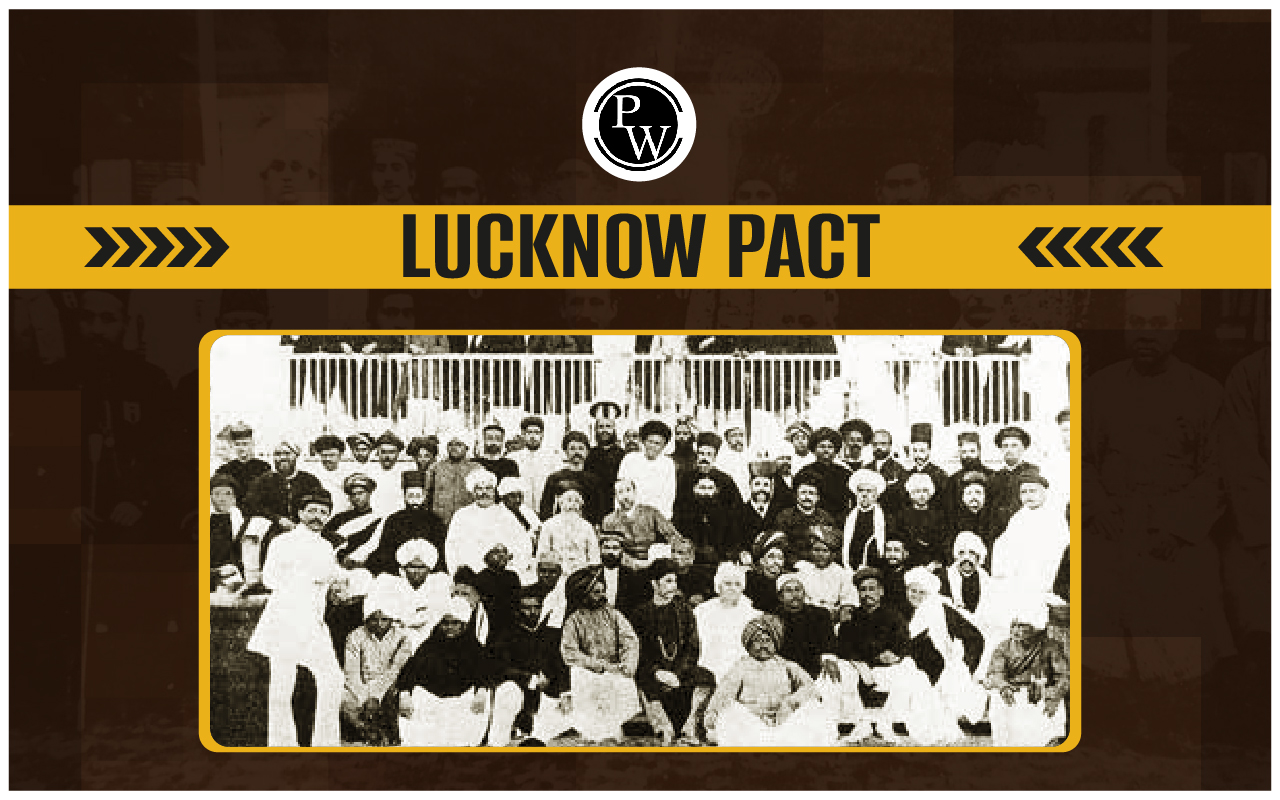
Lucknow Pact: In December 1916, there was a significant agreement called the Lucknow Pact. It was a big deal because two important Indian political groups, the Indian National Congress and the All India Muslim League, got together and agreed on some important things. They met in Lucknow and talked about what they both wanted politically. They really wanted India to be able to govern itself after the war.
Mohammed Ali Jinnah was a key person in these events. He was connected to both parties and played an important role. They wanted to push the British rulers to give more freedom to India so that its people could govern themselves. The Congress and the Muslim League became friendly with each other during this time. Jinnah gave Sarojini Naidu, a well-known Indian leader, the special title of "Ambassador of Hindu-Muslim Unity.Lucknow Pact
The Lucknow Pact was a significant agreement between the All-India Muslim League (AIML) and the Indian National Congress. This agreement was about both groups coming together in Lucknow to ask the British rulers for more freedom for India. Muhammad Ali Jinnah, who was part of both parties, played a crucial role in convincing them to work together. They wanted more power for Indians to govern their own country and to protect the rights of Muslims. As part of this agreement, they decided that people from different religions should have a say in making laws in their provinces. The Muslim League leaders agreed to support the Congress in their fight for India's independence. This agreement showed how different groups in Indian politics could work together. Bal Gangadhar Tilak represented the Congress, while Muhammad Ali Jinnah and Mahatma Gandhi were also present. Sarojini Naidu, known as India’s Nightingale, called Jinnah 'the Ambassador of Hindu-Muslim Unity' for trying to bring these groups together. Because of strong pressure from the Indian people, the British government said they would think about some ideas. They considered having about half of the members in charge of making important decisions and having more members chosen by the people in charge of making laws. Both the Congress and the Muslim League supported these ideas. They knew that by working together, they could ask for more changes and improvements.Lucknow Pact History
In 1906, the All India Muslim League was formed with a goal to build good relations with the British. But when the British decided to divide Bengal, the League changed its support. The Muslim League and the Indian National Congress, with Mohammed Ali Jinnah as a member, joined forces to push the British for reforms. They met together, but seemed uninterested during their joint session for the first time. When extremists led by Tilak and moderates led by Gokhale met in Bombay, they aimed for Hindu-Muslim unity. The Muslim League joined them, discussing their demands for change. Both parties’ leaders came together, sharing similar viewpoints and arguments. Later in October 1916, 19 elected members from both parties requested a discussion on constitutional revisions from the Viceroy. The proposals from their previous meeting were reviewed and accepted at a subsequent meeting in Calcutta in November 1916. Finally, the Lucknow Pact was agreed upon by both the Muslim League and the Indian National Congress during their annual sessions held at Lucknow in December 1916.Lucknow Pact Significance
The Lucknow Pact of 1916 was a really important agreement. It was a big deal because it was the first time Hindus and Muslims worked together and asked the British for changes in how the country was run. This made people in India start thinking that they could have their own government someday. Before this agreement, the Muslim League and the Indian National Congress didn't get along. They were like rivals, always doing their own thing. But after this, they started to build a better relationship. It changed how they saw each other. This pact also helped bring together two groups in the Indian National Congress that didn't always agree: the 'extremists' and the 'moderates'. The extremists, led by people like Lala Lajpat Rai, Bal Gangadhar Tilak, and Bipin Chandra Pal, and the moderates, led by Gopal Krishna Gokhale and later by Mahatma Gandhi, started to work together more. Even though later on, Jinnah wanted a separate country for Muslims, in 1916, he was part of both the Congress and the Muslim League, and he knew Tilak.Lucknow Pact Nature
In India, people are asking for the power to govern themselves. They want changes in how their leaders are chosen and how decisions are made. They believe the old system, like the Indian Council, should end. They think the British government should pay the salary of their leader dealing with Indian affairs, not India's money. They want their local leaders to pick the president and want them to have longer terms in power, like five years. Different groups of people should have their own votes until they decide differently. They want more Indians in a big group that helps make decisions, and they think about half of them should be from India. They also want more say in who gets to be in these groups by voting for most of them. They think Muslims should have a good number of seats too, about one-third of the big group. They want fair representation for everyone, especially small groups. The main groups, Congress and the Muslim League, together asked the government for these changes. They agreed to keep separate votes until everyone feels ready for joint voting. Muslims got a fixed number of seats in the big groups that make decisions for the whole country and for their local areas.Lucknow Pact Provisions
The Lucknow Pact held many important provisions. Here are the key takeaways:- Both the Muslim League and the Indian National Congress agreed on separate electorates. This showed how deeply local politics and different community aspirations mattered, eventually influencing the country's division in 1947.
- Recognizing the need for representation, especially for the Muslim community, make the way for communal politics.
- Before the Lucknow Pact, the Muslim League didn't have much political presence.
- The disagreement between leaders and people led to riots among various communities in places like Bengal and Bihar.
- If three-fourths of the members didn't agree, the legislature couldn't approve a decision. This aimed to prevent communalism through veto power.
- The agreement highlighted the diverse interests of India's major communities, acknowledging their specific concerns and territories
Lucknow Pact Outcomes
Even though both groups tried to show they were together, the Congress wanted separate voting groups, showing they and the Muslim League were separate in politics. This changed how the Muslim League saw having two nations. When the leaders from both sides met, they didn't really try to bring the two communities together. Meanwhile, the Congress supporting the idea of separate voting groups was meant to ease the worries of smaller groups about those with more power. People were expecting this to come together.Lucknow Pact Analysis
The Indian National Congress and the Muslim League agreed on something called a separate electorate. This recognized that different groups of people in India had their own representation, especially for Muslims. However, this agreement caused problems later by encouraging politics that focused on religious differences. Eventually, it played a big role in India splitting into two countries in 1947. Before 1916, the Muslim League didn't have much power in politics. But when they made the Lucknow Pact, things changed. People in places like Bihar, the United Provinces, and Bengal started fighting each other because they didn't agree with their leaders. The government also made a rule that decisions couldn't happen if three-fourths of any religious group disagreed. They tried to be fair by giving one-third of the power to Muslims since they were a smaller group. But this decision turned out to cause problems because it made people focus more on their religious differences. The Lucknow Pact showed that India had lots of different groups, each with their own interests. But it also made special rules for these groups based on their religions, which wasn't a good idea according to Congress. At first, the Lucknow Pact seemed like a good sign that Hindus and Muslims could work together. But this friendship didn't last long.Lucknow Pact Result
The Lucknow Pact made it seem like Hindus and Muslims were working together in Indian politics, but this cooperation didn't stay for long. It created a way for Hindus and Muslims to vote separately, which began the idea of communal politics in India. This agreement also suggested that India had two distinct groups with different requirements. Because of this pact, the Muslim League, which wasn't very significant before, became a strong force in Indian politics alongside the Congress Party. To succeed in upcoming exams, candidates should consider exploring PW SSC Books We provide high-quality content at an affordable price, including sample papers, mock tests, guidance sessions, and more to ensure aspirants secure their selection. Also, enroll today on SSC Online Coaching to turn your dreams into reality.| Other Related Links | |
| Tiger Reserves in India | National Parks in India |
| Biosphere Reserves in India | Elephant Reserves in India |
Lucknow Pact FAQs
Q1 Who signed the Lucknow Pact?
Ans. The Indian National Congress and the Muslim League agreed to the Lucknow Pact in 1916. To achieve independence from the British, the two political groups established this partnership.
Q2 What was Lucknow Pact?
Ans. The Indian National Congress (INC) and the All India Muslim League signed the Lucknow Pact during a combined meeting of both parties in Lucknow in 1916.
Q3 Who was the leader of Lucknow Pact?
Ans. The All-India Muslim League, led by Muhammad Ali Jinnah, and the Indian National Congress, led by Maratha leader Bal Gangadhar Tilak, reached the Lucknow Pact in December 1916. Both organisations adopted the pact on December 31.
Q4 When was the Lucknow Pact signed?
Ans. At a joint meeting of both parties convened in Lucknow in December 1916, the Indian National Congress and the Muslim League came to an agreement known as the Lucknow Pact.
Q5 Who was the president of Congress during the signing of the Lucknow Pact?
Ans. Both the relationship between the Hindu and Muslim communities and the make-up of India’s government were discussed in the Lucknow Pact. When the Lucknow Pact was struck, this combined session was presided over by Ambica Charan Mazumdar.
🔥 Trending Blogs


Talk to a counsellorHave doubts? Our support team will be happy to assist you!


Check out these Related Articles




Join 15 Million students on the app today!
 Live & recorded classes available at easeDashboard for progress trackingMillions of practice questions at your fingertips


Free Learning Resources
PW Books
Notes (Class 10-12)
PW Study Materials
Notes (Class 6-9)
Ncert Solutions
Govt Exams
Our Other Websites
Class 6th to 12th Online Courses
Govt Job Exams Courses
UPSC Coaching
Defence Exam Coaching
Gate Exam Coaching
Other Exams
Know about Physics Wallah
Physics Wallah is an Indian edtech platform that provides accessible & comprehensive learning experiences to students from Class 6th to postgraduate level. We also provide extensive NCERT solutions, sample paper, NEET, JEE Mains, BITSAT previous year papers & more such resources to students. Physics Wallah also caters to over 3.5 million registered students and over 78 lakh+ Youtube subscribers with 4.8 rating on its app.
We Stand Out because
We provide students with intensive courses with India’s qualified & experienced faculties & mentors. PW strives to make the learning experience comprehensive and accessible for students of all sections of society. We believe in empowering every single student who couldn't dream of a good career in engineering and medical field earlier.
Our Key Focus Areas
Physics Wallah's main focus is to make the learning experience as economical as possible for all students. With our affordable courses like Lakshya, Udaan and Arjuna and many others, we have been able to provide a platform for lakhs of aspirants. From providing Chemistry, Maths, Physics formula to giving e-books of eminent authors like RD Sharma, RS Aggarwal and Lakhmir Singh, PW focuses on every single student's need for preparation.
What Makes Us Different
Physics Wallah strives to develop a comprehensive pedagogical structure for students, where they get a state-of-the-art learning experience with study material and resources. Apart from catering students preparing for JEE Mains and NEET, PW also provides study material for each state board like Uttar Pradesh, Bihar, and others
Copyright © 2026 Physicswallah Limited All rights reserved.