







States and Capitals of India 2026: List of 28 States & 8 UTs
 Parul Rishi9 Sept, 2026
States and Capitals of India: India is the seventh-largest country globally and one of the most populated. It's a diverse, rich nation with 28 states and 8 Union territories. Each of these regions has its own unique identity, history, and administrative centre. India is located in Southern Asia and follows a parliamentary system of government. Managing such a vast country can be challenging, so the Indian Constitution allows the central government to create states and union territories as needed.
This article provides:
-
Updated List of 28 States and Capitals
-
List of 8 Union Territories and Capitals
-
List of State Languages
-
Specialities of each State
-
Easy Table format for revision & memorization
How Many States and Union Territories Are There in India in 2026?
| Type | Total Count |
|---|---|
| States | 28 |
| Union Territories | 8 |
| Total Districts | 806 (approx.) |
| Largest State (Area) | Rajasthan |
| Smallest State | Goa |
| Capital of India | New Delhi |
Important for Exams: Many students still search for “29 states of India”, but after Telangana was formed in 2014, the correct number remains: 28 States
How Many States Are There in India in 2026?
In 2026, India has 28 states (भारत में 2026 में कुल 28 राज्य और 8 केंद्र शासित प्रदेश हैं।). The 28 states of India are Andhra Pradesh, Arunachal Pradesh, Assam, Bihar, Chhattisgarh, Goa, Gujarat, Haryana, Himachal Pradesh, Jharkhand, Karnataka, Kerala, Madhya Pradesh, Maharashtra, Manipur, Meghalaya, Mizoram, Nagaland, Odisha, Punjab, Rajasthan, Sikkim, Tamil Nadu, Telangana, Tripura, Uttar Pradesh, Uttarakhand and West Bengal.
State and Capital Name 1 to 28
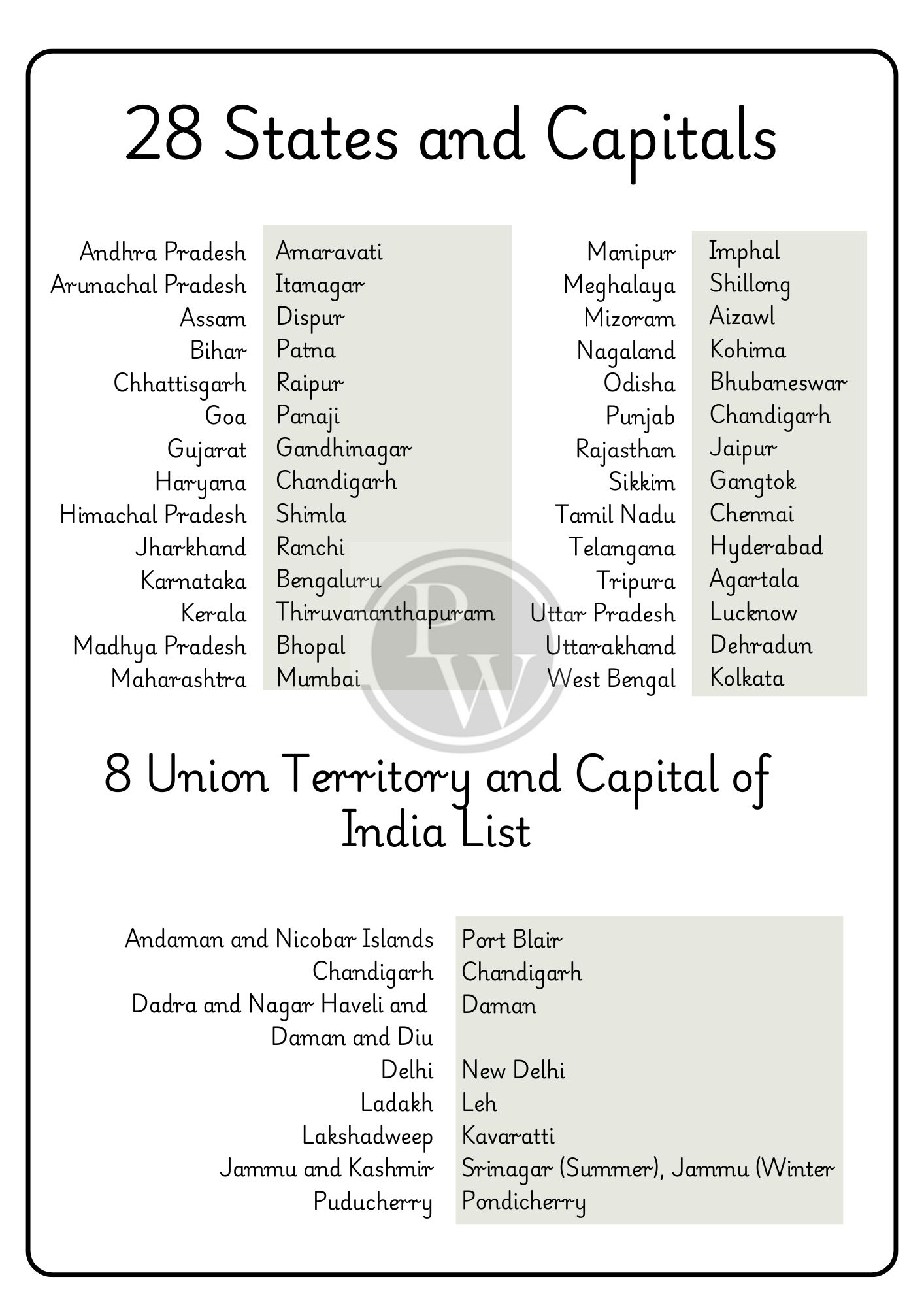
India is divided into 28 states and 8 union territories. Each state is further divided into districts, which are then subdivided into tehsils, blocks, and villages. Let's explore the complete States and Capitals of India List and their capitals:
|
States and Capitals of India List |
||
|
S.No. |
State |
Capital |
|
1 |
Amaravati |
|
|
2 |
Itanagar |
|
|
3 |
Dispur |
|
|
4 |
Patna |
|
|
5 |
Raipur |
|
|
6 |
Panaji |
|
|
7 |
Gandhinagar |
|
|
8 |
Chandigarh |
|
|
9 |
Shimla |
|
|
10 |
Ranchi |
|
|
11 |
Bengaluru |
|
|
12 |
Thiruvananthapuram |
|
|
13 |
Bhopal |
|
|
14 |
Mumbai |
|
|
15 |
Imphal |
|
|
16 |
Shillong |
|
|
17 |
Aizawl |
|
|
18 |
Kohima |
|
|
19 |
Bhubaneswar |
|
|
20 |
Chandigarh |
|
|
21 |
Jaipur |
|
|
22 |
Gangtok |
|
|
23 |
Chennai |
|
|
24 |
Hyderabad |
|
|
25 |
Agartala |
|
|
26 |
Lucknow |
|
|
27 |
Dehradun |
|
|
28 |
Kolkata |
|
8 Union Territories of India List
India is a federal country consisting of 28 states and 8 union territories. States have their own elected governments and are self-governing, while union territories are administered centrally by the Indian government. Union territories are also divided into districts, though they don't possess the same level of self-governance as states.
New Delhi is the capital of India and is located within the National Capital Territory (NCT) of Delhi, which is a Union Territory.. The other union territories include Andaman and Nicobar Islands, Chandigarh, Dadra and Nagar Haveli, Daman and Diu, Jammu and Kashmir, Ladakh, Lakshadweep, and Puducherry.
|
Union Territory and Capital of India List |
||
|
S.NO |
Union Territories |
Capital |
|
1 |
Port Blair |
|
|
2 |
Chandigarh |
|
|
3 |
Daman |
|
|
4 |
New Delhi |
|
|
5 |
Leh |
|
|
6 |
Kavaratti |
|
|
7 |
Srinagar (Summer), Jammu (Winter) |
|
|
8 |
Puducherry |
|
28 Indian States and their Languages
India has lots of different languages spoken all around the country. Each place you go might have its own special language. The government and schools give extra importance to 22 of these languages, calling them "scheduled languages."Read More: National Language of India, Complete List of Official Language of India
| Other Related Links | |
| Tiger Reserves in India | National Parks in India |
| Biosphere Reserves in India | Elephant Reserves in India |
States and Capitals of India FAQs
How many Union territories are there in India?
What are the Twenty-eight states of India?
How many States are there in India?
Which state has two capitals in India?
What is the newest state of India?











Get Free Counselling Today
and Clear up all your Doubts
 Live & recorded classes available at easeDashboard for progress trackingLakhs of practice questions

