







CSAT Formula Book for UPSC Prelims 2026
 Deeksha Dixit24 May, 2026
CSAT Formula: The UPSC Civil Services Aptitude Test (CSAT) requires candidates to demonstrate proficiency in comprehension, logical reasoning, basic numeracy, and data interpretation. Candidates struggle with the CSAT syllabus because it can be overwhelming to revise all topics at the last minute. In such a scenario, the CSAT Formula PDF can be highly beneficial by offering quick tricks and revision before the exam.
The CSAT formula book has a collection of ready-to-use quick formulas and tricks that may come in handy in the last-minute revision and earn a few extra marks. Explore some important formulas in the PW OnlyIAS CSAT formula book to revise before the exam with ease.UPSC CSAT Formula Book
To prepare for the CSAT paper or GS Paper II, candidates should ensure that they have covered all the topics mentioned in the syllabus. The UPSC CSAT exam syllabus has been mentioned in the notification and covers the following subjects:- Comprehension
- Interpersonal skills, including communication skills
- Logical reasoning and analytical ability
- Decision-making and problem-solving
- General mental ability
- Class X level Basic numeracy (numbers and their relations, orders of magnitude, etc.)
- Data interpretation (charts, graphs, tables, data sufficiency, etc. — Class X level)
Also Read: UPSC CSAT Books, Books For IAS Prelims CSAT Paper
UPSC CSAT Formula Book PDF Download
CSAT Formula PDF can be a valuable resource for UPSC aspirants preparing for this paper. UPSC CSAT Formula books compile essential formulas, concepts, and tricks crucial for success in the exam in a structured and organized format. PW offers a comprehensive and crisp CSAT Formula PDF that contains a collection of important formulas and tricks that can be useful for last-minute revision.| CSAT Formula Book | |
| Book Title | Download Link |
| PW OnlyIAS CSAT Formula Book | Click Here |
Important CSAT Formulas
Having a strong command over the CSAT Formula enables candidates to solve problems more efficiently during the exam, saving valuable time and ensuring accuracy. These formulas cover various topics such as algebra, geometry, ratio, and data interpretation, among others. Here are important CSAT formulas for basic numeracy and reasoning sections:Arithmetic Progression
Arithmetic Progression (AP) is a sequence of numbers in which the difference between consecutive terms is constant. This constant difference is called the "common difference." The formula for Arithmetic Progression in CSAT is: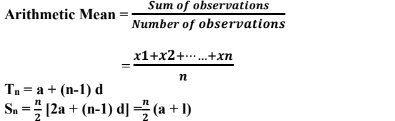 Where a = First term, d = Common difference, Tn = nth term, Sn = Sum of n terms
Algebraic Formulas
Algebraic formulas encompass a wide range of equations and expressions used to solve problems involving variables and constants. Some of the algebraic formulas useful in the CSAT exam include:- (a+b)² = a² + b²+ 2ab
- (a-b)² = a²+ b²– 2ab
- a² + b² = (a-b)² +2ab.
- a² – b² = (a-b)(a+b)
- a³+b³ = (a+b) (a² – ab + b²)
- a³-b³ = (a-b) (a² + ab + b²)
- (a+b+c)² = a²+b²+c²+2ab+2ac+2bc.
- (a-b-c)² = a²+b²+c²-2ab-2ac+2bc.
Profit & Loss
In mathematics, the concept of Profit and loss is generally used from an economic perspective. Profits occur when a good is sold higher than its actual cost, whereas a loss is caused if it is sold lower than the cost price. To find out whether there is profit or loss, the difference between the cost price and the selling price is considered:- Profit = Selling Price – Cost Price
- Loss = Cost Price – Selling Price
- Profit % = Profit / Cost Price x 100
- Loss % = Loss / Cost Price x 100
- Discount = Marked Price – Selling Price
- Discount % = Discount / Marked Price x 100
Average
The average, also known as the arithmetic mean, is a central measure of a set of numbers. It is calculated by summing all values and dividing by the total number of values. In UPSC CSAT, the average is one of the most important topics that is repeated almost every year. Here is the formula for calculating the average:Percentage
Percentages represent a portion of a whole number expressed in terms of 100. In CSAT percentage formula is commonly used to compare proportions and solve quantitative aptitude problems. It also has relevance in the other topics of the syllabus, such as the Data interpretation section. Here is how to calculate the ‘Percentage’ in the CSAT exam:Divisibility Rule
Divisibility rules are simple shortcuts or tricks that help us quickly determine whether a number can be divided evenly by another number without actually doing the division.
- Divisible by 1: Every number is divisible by 1.
- Divisible by 2: A number is divisible by 2 if its last digit is even (0, 2, 4, 6, 8).
- Divisible by 3: A number is divisible by 3 if the sum of its digits is divisible by 3.
- Divisible by 4: A number is divisible by 4 if the last two digits form a number that is divisible by 4.
How to Revise the CSAT Formula for Exam?
- Review fundamental topics in mathematics, logical reasoning, and language comprehension.
- Take note of frequently asked questions and focus revision around them.
- Summarize all important formulas on a single sheet or flashcards.
- Create memory aids or visual tricks to remember complex formulas. For example, use acronyms.
- Revise formulas by solving 5–10 problems daily from each major topic.
Get ready for the UPSC Prelims 2025 exam. Explore PW UPSC Courses!
|
Paper |
Expected Level |
|
GS Paper 1 |
Moderate to Challenging |
|
CSAT (Paper 2) |
Moderate to Challenging |
|
Overall Nature |
Analytical & Concept-Oriented |
The examination is likely to reward aspirants who possess strong conceptual preparation, current affairs integration, and effective time management skills.
UPSC Prelims Exam Analysis Previous Years & Trend
Analyzing the UPSC Prelims Previous Year Papers helps aspirants understand the evolving exam pattern, subject-wise weightage, and changing nature of questions. It provides valuable insights into important focus areas, recurring trends, and the overall approach followed by UPSC in recent years.
UPSC Prelims Previous Year Subject-Wise Question Distribution (2020–2025) Here;
|
Subjects |
2025 |
2024 |
2023 |
2022 |
2021 |
2020 |
|
Ancient History |
6 |
3 |
1 |
1 |
3 |
3 |
|
Art & Culture |
2 |
4 |
8 |
7 |
10 |
5 |
|
Economy |
18 |
13 |
16 |
16 |
14 |
21 |
|
Environment & Ecology |
15 |
13 |
16 |
18 |
18 |
19 |
|
Indian Geography |
1 |
4 |
8 |
5 |
5 |
6 |
|
Indian Polity |
14 |
19 |
15 |
12 |
18 |
15 |
|
International Relations |
8 |
6 |
10 |
11 |
2 |
3 |
|
Medieval History |
1 |
3 |
5 |
4 |
2 |
|
|
Modern History |
8 |
3 |
3 |
3 |
7 |
9 |
|
Physical Geography |
7 |
8 |
3 |
2 |
2 |
1 |
|
Science & Technology |
13 |
11 |
10 |
15 |
13 |
13 |
|
Social Issues & Schemes |
3 |
7 |
3 |
2 |
2 |
2 |
|
World Geography |
5 |
8 |
4 |
3 |
2 |
1 |
|
Total |
100 |
100 |
100 |
100 |
100 |
100 |
The expected UPSC Prelims Exam Analysis 2026 suggests that UPSC is steadily moving towards a more analytical and application-oriented examination model.
The exam increasingly rewards aspirants who possess:
-
Strong conceptual clarity
-
Interdisciplinary understanding
-
Smart elimination skills
-
Revision discipline
-
Calm decision-making under pressure
For success in UPSC Prelims 2026 and beyond, aspirants should focus on balanced preparation, integrated current affairs study, regular revision, and consistent mock test practice.
CSAT Formula FAQs
How many maths questions are there in CSAT?
What is basic numeracy in UPSC CSAT?
What is the scoring pattern of the CSAT paper?
What is the formula of probability for CSAT in UPSC?
What is the formula for time and work in UPSC CSAT?





 Live & recorded classes available at easeDashboard for progress trackingLakhs of practice questions


