








Dr. Manmohan Singh: Former Prime Minister and Architect of India’s Economic Reforms
Dr. Manmohan Singh, India’s former Prime Minister and eminent economist, was known for his key contributions, political career, and pivotal role in India’s economic reforms. He played a major role in liberalising the Indian economy in 1991 and was respected for his integrity, calm leadership, and vision for India’s growth.
 Deeksha Dixit6 Dec, 2025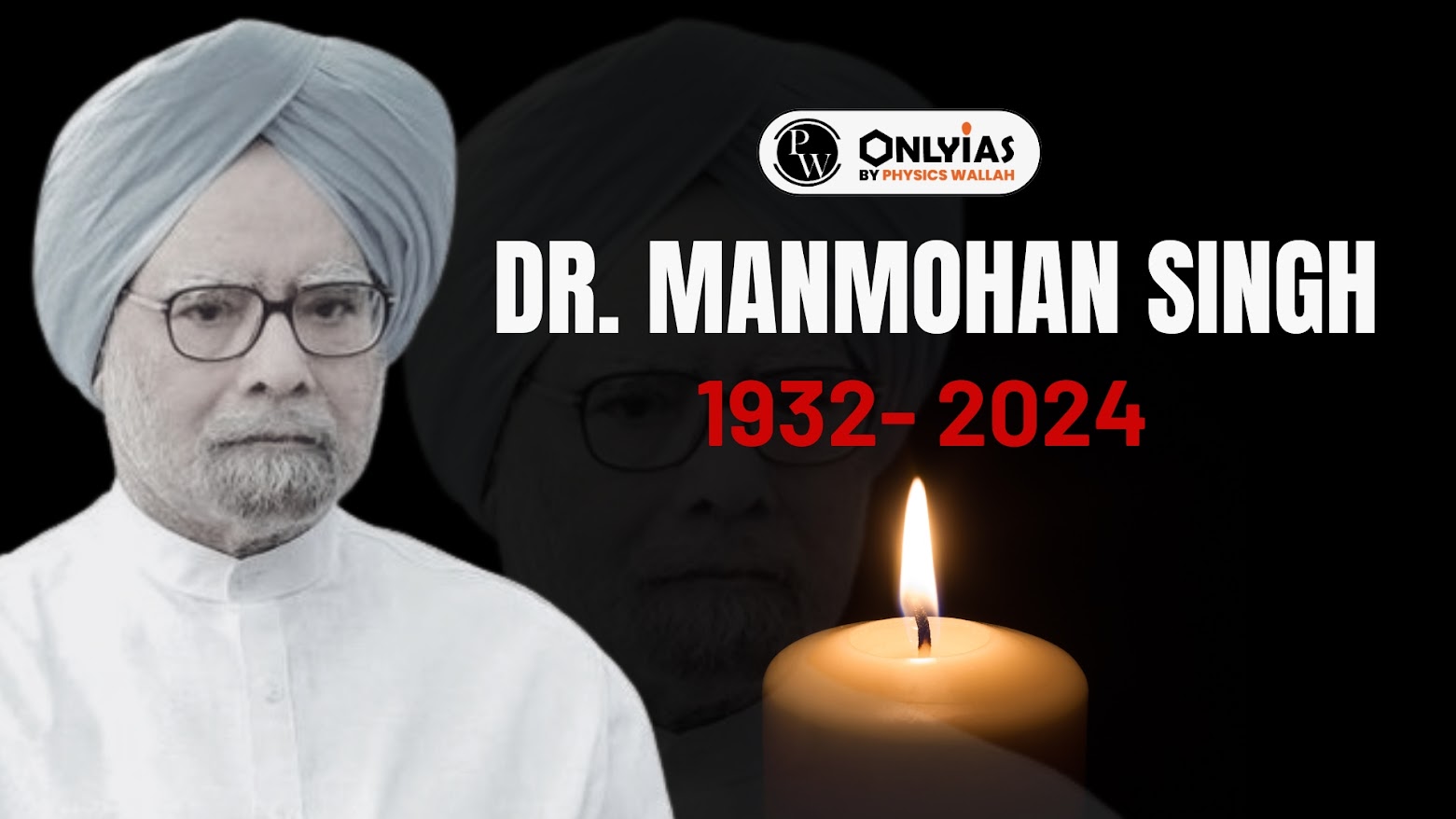
Dr Manmohan Singh (September 26, 1932 – December 26, 2024) was a renowned Indian economist, statesman, and politician who indelibly shaped the modern economic trajectory of India. Serving as the country's 13th Prime Minister from 2004 to 2014, he became the first Prime Minister since Jawaharlal Nehru to be re-appointed after completing a full five-year term.
However, his most transformative contribution remains his role as the Union Finance Minister in 1991, where he championed the monumental economic liberalisation that rescued India from a severe financial crisis. His quiet, scholarly approach, combined with visionary economic foresight, has cemented his place as one of the most significant figures in India's post-independence history.
Dr. Manmohan Singh Overview
Dr Manmohan Singh was one of India’s most respected economists and political leaders, known for his integrity and quiet leadership. His contributions, especially the 1991 economic reforms, played a major role in shaping modern India.
|
Dr. Manmohan Singh Overview |
|
|
Category |
Details |
|
Full Name |
Dr. Manmohan Singh |
|
Date of Birth |
26 September 1932 |
|
Place of Birth |
Gah, Punjab (now in Pakistan) |
|
Profession |
Economist, Academic, Politician |
|
Key Roles |
Prime Minister of India (2004–2014) |
|
Political Party |
Indian National Congress |
|
Education |
BA (Punjab University), MA (Punjab University), Economics Tripos (Cambridge), DPhil (Oxford) |
|
Major Contributions |
Architect of India’s 1991 economic reforms; liberalisation of the Indian economy |
|
Positions Held Before PM |
Finance Minister of India (1991–1996), Governor of RBI, Deputy Chairman of Planning Commission |
|
Known For |
Economic reforms, stable leadership, integrity, soft-spoken personality |
|
Awards |
Padma Vibhushan (1987) |
|
Famous Work Area |
Economic policy, financial reforms, and global economic diplomacy |
Dr. Manmohan Singh Early Life and Educational Journey
Born on September 26, 1932, in Gah, a village in the Punjab province of undivided India (now in Pakistan), Dr. Manmohan Singh’s early life was marked by the tumult of the Partition. Following the Partition in 1947, his family migrated to Amritsar, India.
His academic record was consistently brilliant.
-
He earned his Bachelor’s (1952) and Master’s (1954) degrees in Economics from Panjab University.
-
He went on to complete a First Class Honours degree in Economics from the University of Cambridge in 1957.
-
He later secured a D. Phil. (Doctor of Philosophy) in Economics from Nuffield College, University of Oxford, in 1962. His doctoral thesis, India's Export Trends and Prospects for Self-Sustained Growth, was a seminal work that criticised India's inward-oriented trade policies.
Dr. Manmohan Singh as the Finance Minister (1991-1996)
Dr. Singh's administrative career began in the 1970s, holding key posts such as Chief Economic Advisor (1972–1976) and Governor of the Reserve Bank of India (1982–1985).
The pivotal moment of his career came in 1991 when Prime Minister P.V. Narasimha Rao appointed him as the Union Finance Minister. India was facing a severe balance of payments crisis, with foreign exchange reserves barely enough to cover a few weeks of imports.
In response, Dr. Singh spearheaded a comprehensive set of reforms known as the Liberalisation, Privatisation, and Globalisation (LPG) Reforms. This economic program fundamentally changed India's closed, centrally planned economy, marking a significant shift in the country's economic path.
Key Aspects of the 1991 Reforms:
-
Dismantling the 'License Raj': Industrial licensing was abolished for most sectors, ending a system that had hampered private enterprise and contributed to corruption.
-
Trade Policy Reforms: The rupee was devalued to boost exports, and import restrictions were eased.
-
Encouraging Foreign Investment: Policies were liberalised to attract Foreign Direct Investment (FDI) and technology.
-
Financial Sector Reforms: Interest rates were deregulated, and private banks were allowed to enter the market.
Dr. Manmohan Singh as the Prime Minister of India (2004-2014)
Following the 2004 General Elections, Dr. Manmohan Singh was sworn in as India’s 13th Prime Minister, leading the United Progressive Alliance (UPA) coalition government. His first term (2004-2009) saw an unprecedented period of high economic growth, with the economy growing at an average of 8–9% annually. India emerged as the world's second-fastest-growing major economy in 2007.
After securing a majority again in 2009, he served a second consecutive term (2009-2014). While his tenure saw significant legislative and economic achievements, the latter years were marred by challenges like rising inflation and corruption scandals. Despite the political challenges, his reputation for integrity and diligence remained widely acknowledged.
Achievements and Landmark Legislation
Dr. Singh’s tenure as Prime Minister focused on achieving "inclusive growth" and enacted several landmark pieces of legislation that extended rights and entitlements to citizens.
Social Sector Reforms
The UPA government under Dr Singh launched several major social welfare programs aimed at reducing poverty and enhancing human capital.
-
Mahatma Gandhi National Rural Employment Guarantee Act (MGNREGA), 2005: This monumental scheme guaranteed 100 days of wage employment in a financial year to every rural household whose adult members volunteer to do unskilled manual work. This made employment a legal right and provided a social safety net for millions.
-
Right to Information (RTI) Act, 2005: Empowering citizens by promoting transparency and accountability in government functioning.
-
National Rural Health Mission (NRHM), 2005: A flagship program to improve healthcare delivery, particularly in rural areas, focusing on reducing infant and maternal mortality.
-
Right of Children to Free and Compulsory Education (RTE) Act, 2009: Made education a fundamental right for children aged 6 to 14.
-
National Food Security Act (NFSA), 2013: Ensured subsidised food grains for approximately two-thirds of India's population.
Foreign Policy and Global Standing
A significant foreign policy achievement during his time was the Indo-U.S. Civil Nuclear Agreement.
-
Indo-U.S. Civil Nuclear Agreement (2008): This landmark deal ended India's decades-long nuclear isolation by granting it access to civilian nuclear technology and fuel from the U.S. and other nations, without requiring India to sign the Nuclear Non-Proliferation Treaty (NPT).
-
He also steered India through the 2008 global financial crisis and worked to strengthen relationships across the globe, including with Southeast Asian nations through the 'Look East Policy'.
Legacy and Contributions to the Nation
Dr. Manmohan Singh’s legacy is defined by his deep commitment to pragmatic economic policy and his personal qualities of integrity and humility. He is credited with transforming India into a global economic power and laying the foundation for sustained, market-oriented growth.
His key contributions spanned multiple domains:
-
Economic Transformation: He masterminded the shift from the 'Hindu rate of growth' to a dynamic, high-growth economy.
-
Institutional Reform: His policies emphasised the need for institutional reforms to reduce corruption and enhance efficiency.
-
Inclusive Growth: He successfully balanced market liberalisation with a focus on social justice and targeted welfare programs, ensuring that the benefits of economic growth reached the masses.
Dr. Manmohan Singh FAQs
What were the three main components of the 1991 economic reforms?
Which major social welfare schemes were launched during Dr. Manmohan Singh tenure as PM?
Where did Dr Manmohan Singh get his doctorate (D.Phil.)?
What significant foreign policy achievement is attributed to Dr. Singh?


Have questions about your prep?
Our experts can answer all your questions








 Live & recorded classes available at easeDashboard for progress trackingMillions of practice questions at your fingertips

