








Polity Questions in UPSC Prelims 2026: The Questions & Solutions

Polity Questions in UPSC Prelims 2026: The UPSC Civil Services Examination (CSE) Prelims 2026 General Studies Paper I serves as a crucial examination for aspiring candidates, often featuring numerous Polity Questions in UPSC Prelims 2026. The paper carries a maximum of 200 marks and includes a penalty for incorrect answers, emphasizing accuracy.
|
UPSC Prelims 2026 Related Topics |
|
|
UPSC Prelims Answer Key Year 2026 With Solution PDF (Hindi & English) |
|
Polity Questions in UPSC Prelims 2026 Overview
The 2026 Polity section required in-depth understanding of topics, confirming UPSC's trend toward analytical rather than factual questions.
|
Polity Questions in UPSC Prelims 2026 Overview |
|
|
Parameter |
Details |
|
Total Questions |
14 |
|
Question Set |
Set A,B,C, D, GS Paper I |
|
Marks per Question |
2 marks each |
|
Negative Marking |
⅓ for incorrect answers |
Detailed Breakdown of Polity Questions in UPSC Prelims 2026
A significant number of Polity Questions in UPSC Prelims 2026 General Studies Paper I are drawn from recent global and national events. These questions highlight the importance of staying updated with contemporary developments and their implications. In this year’s Paper, there were 14 questions asked about Polity. Here are the questions of Polity, asked in the examination:
Ques. Match List I with List II and select the answer using the code given below the Lists:
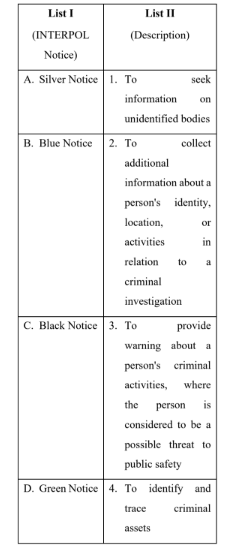
Code:
(a) 3 1 2 4
(b) 3 2 1 4
(c) 4 2 1 3
(d) 4 1 2 3
Correct Answer - C
The Bureau of Indian Standard (BIS) recently introduced a national standard to test and assess bomb disposal system. Which of the following statements with regard to this system is/are correct?
1. The new standard is known as IS 19445: 2025.
2. It will improve interoperability of equipment across agencies.
3. It was developed by TBRL, DRDO in collaboration with the 30th Central Scientific Research Institute, Russia.
Select the answer using the code given below:
(a) 1, 2 and 3
(b) 2 and 3 only
(c) 1 and 2 only
(d) 1 only
Correct Answer - C
Which of the following statements about insurance in aviation sector is/are correct?
1. 'Aviation Hull Insurance' covers the physical aircraft, including the body, engine, and on-board equipment.
2. Under the Montreal Convention, adopted in 1999 by over 130 countries, including India, airlines are strictly liable to pay compensation to the family/nominee of every deceased passenger without requiring the family to prove fault.
Select the answer using the code given below:
(a) 1 only
(b) 2 only
(c) Both 1 and 2
(d) Neither 1 nor 2
Correct Answer - C
Mr. X, a senior officer, was overseeing a critical vaccination programme during a pandemic. He found that a private service provider responsible for vaccine distribution was compromising on quality to make profits. Despite immense pressure to manage the issue due to vested interests, he raised his voice based on the principles of public administration which he learnt during various training programmes attended across his career. He reported the issue to the appropriate vigilance authority and halted the contract to ensure citizen welfare.
Which one among the following principles of public administration was most strongly demonstrated by Mr. X's actions?
(a) Esprit de corps
(b) Equity
(c) Accountability
(d) Delegation
Correct Answer - C
77. In a multi-ethnic district where both economic and historical grievances frequently led to community tensions, a Government appointment has arisen with a decision to allocate land for a waste management facility near a tribal hamlet, sparking protests by the tribal community, which claimed that the land was sacred and critical to their cultural identity. At the same time, urban residents and local industries supported the project, citing severe solid waste challenges and health concerns due to lack of a proper disposal site. The conflict has escalated with road blockades, social media campaigns, and allegations of police excesses.
As a responsible Government official, you are tasked with resolving the situation through mediation, ensuring a sustainable outcome that balances environmental needs, tribal rights, and urban public health.
Consider the following statements with reference to the above:
- A successful conflict resolution process must begin with acknowledging the cultural concerns of the protesting tribal community before discussing technical alternatives.
2. The Government should move ahead with the project without delay to address urban health concerns, which outweigh the sentiments of a small group.
3. Creating a multi-stakeholder dialogue platform — including tribal leaders, environmental experts, and municipal representatives — to build mutual understanding and help de-escalate tensions.
4. Conducting an independent Environmental and Social Impact Assessment (ESIA) and sharing findings transparently with both sides to facilitate evidence-based decision
making.
Which of the statements given above would contribute to the resolution process?
(a) 1, 3 and 4 only
(b) 2, 3 and 4 only
(c) 1 and 2 only
(d) 1, 2, 3 and 4
Correct Answer - A
Ms. X is a mid-level civil service official working in the urban development department of a major city. Recently, she was involved in approving a contract for a public infrastructure project — a new community park. During the approval process, she received a piece of confidential information indicating that one of the shortlisted contractors had a history of poor workmanship and allegations of corruption in other cities, though nothing had been legally proven. The Head of the Department, Mr. Y, advised her not to disclose this information to the project committee or the public because it could delay the project and damage the city's reputation. However, Ms. X believed that withholding such information compromised transparency and public trust.
What amongst the following should Ms. X do now?
1. Immediately disclose the information to the project committee and the public
2. Recommend removing the contractor from the shortlist to protect the project's integrity
3. Propose a 'limited disclosure' to an oversight committee, while keeping the information confidential from the public for the time being
Select the answer using the code given below:
(a) 1 and 2 only
(b) 3 only
(c) 2 and 3 only
(d) 1, 2 and 3
Correct Answer - b
X' was addressing a seminar on the meaning of the term 'law' as provided under Article 13, part III of the Constitution of India. 'X' explained that the meaning of the term 'law' in the Constitution of India was comprehensive. It included ordinances, orders, and even rules and regulations. 'Y' pointed out that the term 'law' Article 13 also included custom or usage having in the territory of India the force of law, to which 'X' was not convinced.
Based on the above, select the correct conclusion from the options given below:
(a) 'X' is correct in the interpretation of law, including the view on non-inclusion of custom.
(b) The view of 'Y' that 'law' included custom is not correct.
(c) The views of both 'X' and 'Y' are correct.
(d) The view of only 'Y' is correct.
Correct Answer - d
Consider the following statements with reference to the Constitution of India:
1. There is no Article in the Constitution of India that specifies that the Constitution of India will be officially called the 'Constitution of India'.
2. There is no Article in the Constitution of India that specifies that the Indian Independence Act, 1947 and the Government of India Act, 1935 stand repealed.
3. There is no Article in the Constitution of India that mentions 26th January, 1950 as the date of the commencement of the Constitution of India.
Which one of the following conclusions based on the above statements is correct?
(a) All three statements are correct.
(b) There is no correct statement.
(c) There are two correct statements that include statement 3.
(d) There is only one correct statement.
Correct Answer - b
Which of the following statements with regard to the persons with disabilities in India is/are correct?
1. The Rights of Persons with Disabilities Act, an Act passed by the Parliament of India in 2018, mandates reservation in education and employment, places a legal duty on Governments to ensure accessibility and non-discrimination.
2. The Sugamya Bharat Abhiyan focuses on achieving universal accessibility for Persons with Disabilities across three key domains — built infrastructure, transport systems and information and communication technology.
3. The National Divyangjan Finance and Development Corporation (NDFDC) is a public sector organisation set up by the Ministry of Corporate Affairs as a not
for-profit company to promote entrepreneurship among Persons with Disabilities (PwDs).
Select the answer using the code given below:
(a) 1 and 2
(b) 2 only
(c) 1 and 3
(d) 1 only
Correct Answer - b
Consider the following statements about the provisions pertaining to the Scheduled Castes and the Scheduled Tribes in India:
1. Provisions regarding the administration of the Tribal Areas in the States of Assam, Meghalaya, Tripura and Mizoram are given in the Fifth Schedule of the Constitution of India.
2. Some tribes of India are entitled to exemption from paying Income Tax on certain incomes.
3. The Constitution of India provides for reservation of seats in Panchayats for women belonging to the Scheduled Castes and the Scheduled Tribes.
Which one of the following conclusions based on the above statements is correct?
(a) There are two correct statements, that include statement 2.
(b) There are two correct statements, that are statements 1 and 3.
(c) There is only one correct statement.
(d) All three statements are correct.
Correct Answer - A
Consider the following statements in respect of questions asked by the Members in the Parliament of India:
1. Unstarred questions are those to which a Member desires an oral answer in the House.
2. Starred questions are those to which a Member desires a written answer.
3. No supplementary question can be asked on an unstarred question.
Which one of the following conclusions based on the above statements is correct?
(a) All the three statements are correct.
(b) There are two correct statements, that include statement 2.
(c) There is only one correct statement.
(d) There is no correct statement.
Correct Answer - C
Consider the following statements about the Committee on the Welfare of Scheduled Castes and Scheduled Tribes of the Parliament of India:
1. Although members of this Committee are elected from both Houses of Committee is appointed by the
Chairman of the Rajya Sabha.
2. Twenty members are elected by the Rajya Sabha and ten members by the Lok Sabha.
3. No Minister, except for the Union Minister of Social Justice and Empowerment, is eligible to be a member of this Committee.
4. Members are elected for a fixed term of two years from the date they enter their office.
Which one of the following conclusions based on the above statements is correct? (a) There are four correct statements.
(b) There is only one correct statement, that is statement 2.
(c) There are two correct statements, that include statement 1.
(d) There is no correct statement.
Correct Answer - D
Consider the following statements about Mission Sudarshan Chakra of India:
1. It aims to enhance India's air defence, ballistic missile defence and aerial offensive capabilities.
2. This Mission is being designed to enhance rapid, precise, and powerful defence responses, reinforcing India's strategic autonomy.
3. One of the aims of this Mission is to cover all public places of India by an expanded nationwide security shield by 2035.
Which of the statements given above is/are correct?
(a) 1, 2 and 3
(b) 1 and 2 only
(c) 2 and 3 only
(d) 1 only
Correct Answer - A
Consider the following statements about river bridges connecting India with neighbouring countries:
1. 'Maitri Setu', built over Feni river, connects Ramgarh in India with Sabroom in Bangladesh.
2. Jhulaghat suspension bridge connects India with Myanmar.
3. Mechi bridge and its approaches connect Panitanki Bypass in India with Kakarvitta in Nepal.
Which of the statements given above is/are correct?
(a) 1 and 2
(b) 2 and 3
(c) 1 only
(d) 3 only
Correct Answer - D
How to prepare Polity Questions for UPSC Prelims
To prepare Polity questions for UPSC Prelims, focus on concept clarity, repeated revision, and lots of MCQ practice. Polity is a high-scoring area, and standard guidance emphasizes NCERT basics, a strong core textbook, previous-year questions, and topic-wise MCQs.
-
Start with the Constitution basics, then move to core topics like Fundamental Rights, Directive Principles, Parliament, President, Prime Minister, Judiciary, and Federalism.
-
Read one standard source thoroughly instead of multiple books, then revise the same notes repeatedly.
-
Solve previous-year questions topic-wise to understand UPSC’s pattern and recurring themes.
UPSC Psychology Optional Subject 2026 FAQs
Q1. Why choose UPSC Psychology over subjective humanities optionals for high scoring?
Q2. How compatible is the Psychology syllabus with an Engineering or STEM background?
Q3. What is the exact cross-paper synergy of Psychology with GS and Essay papers?
Q4. What is the realistic preparation timeline to complete the UPSC Psychology syllabus?
Q5. Are diagrams, case studies, and experiments mandatory for a 280+ score in Psychology?


Have questions about your prep?
Our experts can answer all your questions


 Live & recorded classes available at easeDashboard for progress trackingLakhs of practice questions

