







UPSC PYQ Masterclass 2027: 25+ Questions with Detailed Analysis for Prelims
 Mishika Gupta5 Oct, 2026
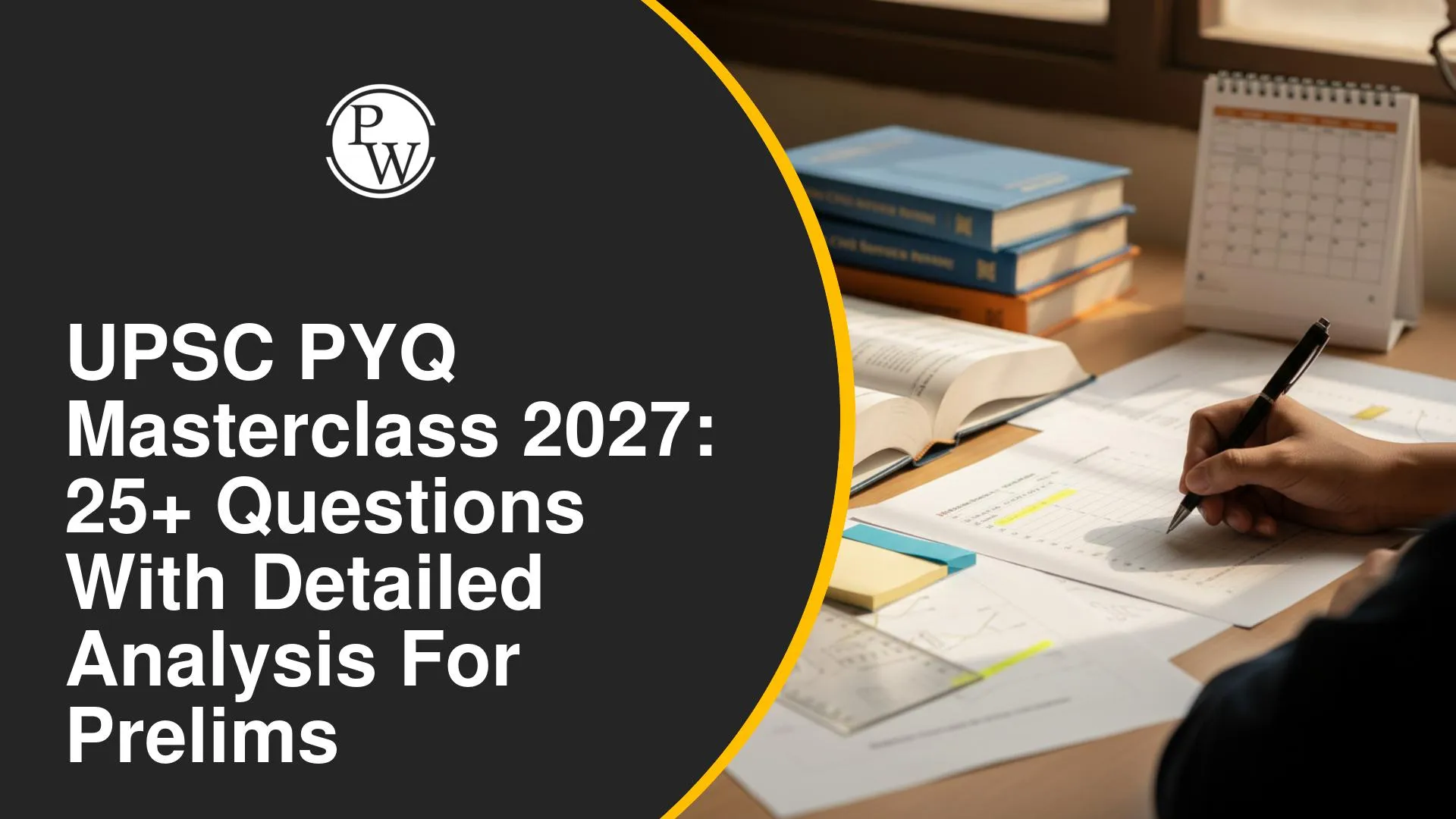
Understanding UPSC Previous Year Questions is important for recognising how the examination tests concepts through statements, applications and carefully framed options. Many questions may appear familiar but require more than factual recall to identify the correct answer. Without analysing the reasoning behind each question, it can be difficult to recognise recurring themes, eliminate incorrect options and understand the depth of knowledge expected in UPSC Prelims 2027.
A detailed analysis of PYQs can help bridge this gap by connecting each question with its underlying concept and question pattern. This masterclass decodes 25+ UPSC questions along with practice questions based on similar themes. It highlights key concepts, answer logic and important areas for revision, helping you use PYQs more effectively for Prelims 2027 preparation.
UPSC PYQ Questions Decoded for Prelims 2027
The following questions combine actual UPSC CSE PYQs with practice questions based on related concepts. The practice questions are designed to help you apply the understanding gained from the original PYQs.
1. UPSC CSE PYQ 2025: Raja Rammohan Roy
Question: Consider the following statements regarding Raja Rammohan Roy:
-
He possessed a great love and respect for the traditional philosophical system of the East.
-
He desired his countrymen to accept the rational scientific approach and the principles of human dignity and social equality of all men and women.
Options:
-
(a) Only 1 is correct
-
(b) Only 2 is correct
-
(c) Both 1 and 2 are correct
-
(d) Neither 1 nor 2 is correct
Answer: (c) Both 1 and 2 are correct
Concept Decoded:
Raja Rammohan Roy combined respect for India's intellectual traditions with an emphasis on reason, rational inquiry and social reform. His reformist approach addressed practices such as Sati while also promoting education, human dignity and social equality.
What UPSC Tested:
The question tests whether you can recognise that Roy's ideas cannot be reduced to either complete rejection of tradition or complete acceptance of Western thought.
UPSC Previous Year Question Papers
Practice Question: Raja Rammohan Roy
Consider the following statements regarding Raja Rammohan Roy:
-
He regarded reason and rational inquiry as important tools for examining religious beliefs and social practices.
-
He supported the abolition of Sati and campaigned against its practice through writings and public advocacy.
-
He believed that India should completely reject its traditional philosophical and intellectual heritage in favour of Western ideas.
Options:
-
(a) 1 and 2 only
-
(b) 2 and 3 only
-
(c) 1 and 3 only
-
(d) 1, 2, and 3
Answer: (a) 1 and 2 only
Explanation:
Statements 1 and 2 correctly describe Roy's rational and reformist approach. Statement 3 is incorrect because Roy respected several aspects of India's intellectual traditions while advocating reform through reason and social equality.
2. UPSC CSE PYQ 2013: Ilbert Bill
Question: The Ilbert Bill controversy was related to the:
-
(a) Imposition of restrictions on the carrying of arms by the Indians
-
(b) Imposition of restrictions on newspapers and magazines published in Indian languages
-
(c) Removal of disqualifications imposed on the Indian magistrates with regard to the trial of the Europeans
-
(d) Removal of a duty on imported cotton cloth
Answer: (c) Removal of disqualifications imposed on the Indian magistrates with regard to the trial of the Europeans
Concept Decoded:
The Ilbert Bill was introduced during Lord Ripon's tenure. It sought to remove racial discrimination in the judicial system by allowing qualified Indian judges and magistrates to exercise criminal jurisdiction over European British subjects.
What UPSC Tested:
The question tests the connection between the Ilbert Bill and racial discrimination in colonial India's judicial administration.
Practice Question: Ilbert Bill
Consider the following statements regarding the Ilbert Bill Controversy:
-
The Ilbert Bill was introduced during the tenure of Lord Ripon with the objective of removing racial restrictions in the criminal jurisdiction of Indian judges.
-
The controversy demonstrated the opposition of the European community in India to the exercise of judicial authority over Europeans by qualified Indian judges.
-
The final settlement of the controversy retained the complete exclusion of Indian judges from trying European British subjects in criminal cases.
Options:
-
(a) 1 and 2 only
-
(b) 2 and 3 only
-
(c) 1 and 3 only
-
(d) 1, 2, and 3
Answer: (a) 1 and 2 only
Explanation:
Statements 1 and 2 are correct. The final settlement did not completely exclude Indian judges from such cases; instead, it introduced safeguards that reflected the opposition to the original proposal.
3. UPSC CSE PYQ 2012: Dadabhai Naoroji
Question: What was the most effective contribution made by Dadabhai Naoroji to the cause of the Indian National Movement?
-
He exposed the economic exploitation of India by the British.
-
He interpreted the ancient Indian texts and restored the self-confidence of Indians.
-
He stressed the need for eradication of all social evils before anything else.
Options:
-
(a) 1 only
-
(b) 2 and 3 only
-
(c) 1 and 3 only
-
(d) 1, 2, and 3
Answer: (a) 1 only
Concept Decoded:
Dadabhai Naoroji's major contribution was his economic critique of colonial rule, particularly through the Drain of Wealth theory. He explained how resources were transferred from India to Britain without adequate economic return to India.
What UPSC Tested:
The question connects a nationalist leader with the specific contribution for which he is most closely associated.
Practice Question: Dadabhai Naoroji
Consider the following statements regarding Dadabhai Naoroji:
-
He argued that the poverty of India was closely connected with the unrequited transfer of resources from India to Britain.
-
He regarded the increasing employment of Indians in higher administrative positions as one means of reducing economic drain.
-
His economic critique was based on the argument that British rule benefited India's internal commerce and production.
Options:
-
(a) 1 and 2 only
-
(b) 2 and 3 only
-
(c) 1 and 3 only
-
(d) 1, 2, and 3
Answer: (a) 1 and 2 only
Explanation:
Statements 1 and 2 are consistent with Naoroji's economic critique. Statement 3 contradicts the central argument of the Drain Theory, which highlighted the economic costs of colonial rule.
4. UPSC CSE PYQ 2003: Mauryan, Shunga and Kanva Dynasties
Question: Consider the following statements:
-
The last Mauryan ruler, Brihadratha, was assassinated by his commander-in-chief, Pushyamitra Shunga.
-
The last Shunga king, Devabhuti, was assassinated by his Brahmana minister, Vasudeva Kanva, who usurped the throne.
-
The last ruler of the Kanva dynasty was deposed by the Andhras.
Options:
-
(a) 1 and 2 only
-
(b) 2 and 3 only
-
(c) 1 and 3 only
-
(d) 1, 2, and 3
Answer: (d) 1, 2, and 3
Concept Decoded:
The question requires you to connect the succession of three post-Mauryan dynasties. Pushyamitra Shunga ended Mauryan rule, Vasudeva Kanva succeeded the Shungas, and the Kanva dynasty was eventually replaced by the Satavahanas or Andhras.
Practice Question: Post-Mauryan Dynasties
Consider the following statements regarding post-Mauryan dynasties:
-
Pushyamitra Shunga was a commander-in-chief under the Mauryas before establishing the Shunga dynasty.
-
Vasudeva Kanva succeeded the last Shunga ruler and established the Kanva dynasty.
-
The Kanva dynasty was longer-lived than the Shunga dynasty and exercised extensive political control over most of the former Mauryan Empire.
Options:
-
(a) 1 and 2 only
-
(b) 2 and 3 only
-
(c) 1 and 3 only
-
(d) 1, 2, and 3
Answer: (a) 1 and 2 only
Explanation:
Pushyamitra was a Mauryan commander who established the Shunga dynasty, while Vasudeva Kanva succeeded the last Shunga ruler. The Kanvas did not last longer than the Shungas or control most of the former Mauryan Empire.
5. UPSC CSE PYQ 2020: Ancient Ports
Question: With reference to the history of India, "Ghantasala", "Kadura", and "Chaul" were well known as:
-
(a) Ports handling foreign trade
-
(b) Capitals of powerful kingdoms
-
(c) Important Buddhist pilgrimage centres
-
(d) Centres of stone art and architecture
Answer: (a) Ports handling foreign trade
Concept Decoded:
The question tests knowledge of ancient and medieval Indian maritime trade. Ghantasala, Kadura and Chaul were associated with trade and maritime commercial activity.
Practice Question: Ancient Trade and Urban Centres
Which of the following pairs of ancient Indian centres and their characteristics are correctly matched?
-
Arikamedu – Indo-Roman maritime trade centre
-
Mathura – Major centre of sculpture and art
-
Nalanda – Major Buddhist monastery and educational centre
-
Ujjain – Important inland trading hub on major trade routes
Options:
-
(a) 1, 2, and 3 only
-
(b) 2, 3, and 4 only
-
(c) 1, 3, and 4 only
-
(d) 1, 2, 3, and 4
Answer: (d) 1, 2, 3, and 4
Explanation:
All four pairs correctly associate important Indian centres with their historical roles in trade, art, education and cultural exchange.
6. UPSC CSE PYQ 2004: Chinese Travellers
Question: Consider the following statements:
-
The Chinese pilgrim Faxian attended the Fourth Great Buddhist Council held by Kanishka.
-
The Chinese pilgrim Xuanzang met Harsha and found him to be antagonistic to Buddhism.
Options:
-
(a) 1 only
-
(b) 2 only
-
(c) Both 1 and 2
-
(d) Neither 1 nor 2
Answer: (d) Neither 1 nor 2
Concept Decoded:
Faxian travelled to India during the Gupta period, while Xuanzang visited during the reign of Harshavardhana. The Fourth Buddhist Council associated with Kanishka predates Faxian's visit, and Xuanzang's account does not support the claim that Harsha was antagonistic to Buddhism.
Practice Question: Chinese Travellers
Consider the following statements regarding Chinese Buddhist travellers to India:
-
Faxian visited India during the reign of Chandragupta II and provided valuable information about the condition of Buddhism and society during the Gupta period.
-
Xuanzang visited India during the reign of Harshavardhana and studied at Nalanda.
-
Both Faxian and Xuanzang visited India primarily to obtain information about Buddhist teachings, texts and monastic institutions.
-
Faxian and Xuanzang were contemporaries who travelled to India within the same century.
Options:
-
(a) 1 and 4 only
-
(b) 1, 2, and 3 only
-
(c) 2, 3, and 4 only
-
(d) 1, 2, 3, and 4
Answer: (b) 1, 2, and 3 only
Explanation:
Statements 1, 2 and 3 are correct. Faxian and Xuanzang belonged to different periods and were separated by several centuries, making Statement 4 incorrect.
7. UPSC CSE PYQ 2024: Genetically Modified Food
Question:
Statement I: India does not import apples from the United States of America.
Statement II: In India, the law prohibits the import of Genetically Modified food without the approval of the competent authority.
Options:
-
(a) Both Statement-I and Statement-II are correct and Statement-II is the correct explanation for Statement-I
-
(b) Both Statement-I and Statement-II are correct but Statement-II is not the correct explanation for Statement-I
-
(c) Statement-I is correct but Statement-II is incorrect
-
(d) Statement-I is incorrect but Statement-II is correct
Answer: (d) Statement-I is incorrect but Statement-II is correct
Concept Decoded:
The question tests the difference between a country's agricultural or regulatory conditions and an absolute claim about imports. The presence of genetically modified crops or food products does not automatically mean that all agricultural imports from that country are prohibited.
Practice Question: GM Foods
Consider the following statements regarding GM food in India:
-
The regulatory framework for Genetically Engineered Organisms in India derives, among other things, from the Environment Protection Act and the 1989 Rules framed under it.
-
The presence of GM crops in an exporting country automatically makes all food imports from that country illegal in India.
Options:
-
(a) 1 only
-
(b) 2 only
-
(c) Both 1 and 2
-
(d) Neither 1 nor 2
Answer: (a) 1 only
Explanation:
The regulatory framework includes the Environment Protection Act and the relevant 1989 Rules. Statement 2 uses an absolute claim and is incorrect.
8. UPSC CSE PYQ 2022: Biofilms
Question: Which of the following statements are correct regarding Biofilms?
-
Biofilms can form on medical implants within human tissues.
-
Biofilms can form on food and food processing surfaces.
-
Biofilms can exhibit antibiotic resistance.
Options:
-
(a) 1 and 2 only
-
(b) 2 and 3 only
-
(c) 1 and 3 only
-
(d) 1, 2, and 3
Answer: (d) 1, 2, and 3
Concept Decoded:
A biofilm is a community of microorganisms attached to a surface and enclosed in a self-produced matrix. Biofilms can develop on medical devices, food-processing surfaces and living tissues. Their protective environment can also make microorganisms more difficult to eliminate using antimicrobial treatments.
Practice Question: Biofilms
Consider the following statements regarding Biofilms:
-
Biofilms consist exclusively of bacteria and cannot contain fungi or other microorganisms.
-
Biofilms can develop resistance to antimicrobial agents, making them difficult to eradicate.
-
Biofilms can form on both living tissues and non-living industrial or medical surfaces.
Options:
-
(a) 1 and 2 only
-
(b) 2 and 3 only
-
(c) 1 and 3 only
-
(d) 1, 2, and 3
Answer: (b) 2 and 3 only
Explanation:
Biofilms can contain different types of microorganisms, so Statement 1 is incorrect. Their formation on living and non-living surfaces and their increased tolerance to antimicrobial treatment make Statements 2 and 3 correct.
Understanding UPSC Question Patterns Through PYQ Analysis
The question patterns observed in previous year questions can be understood better alongside the broader UPSC exam pattern, including the nature and scope of the Prelims examination.
|
Pattern |
How It Appears in Questions |
|
Statement-based questions |
Multiple statements require individual evaluation |
|
Concept and application |
Scientific concepts are tested through their uses |
|
Historical connections |
Personalities, events and dynasties are linked with specific contributions |
|
Factual associations |
Places, travellers and institutions are matched with their historical roles |
|
Elimination |
Incorrect, exaggerated or absolute statements can help eliminate options |
|
Statement I and II |
Both statements need to be evaluated independently before checking the relationship |
|
Cross-topic understanding |
A question may require knowledge of a concept beyond a single textbook definition |
Common Concepts to Revise from These UPSC PYQs
The questions cover different areas, but several concepts can be grouped together for more focused revision.
History
-
Raja Rammohan Roy and social reform
-
Ilbert Bill and colonial judicial administration
-
Dadabhai Naoroji and Drain Theory
-
Mauryan, Shunga and Kanva succession
-
Ancient Indian ports and trade
-
Faxian and Xuanzang
-
Gupta and Harsha-period history
Science and Technology
-
Genetically Modified food
-
Regulation of genetically engineered organisms
-
Biofilms and antimicrobial resistance
-
Nanomaterials
-
Carbon nanotubes
-
Applications of nanotechnology
What to Focus On
Rather than remembering only the correct options, revise the concept that led to the answer. This makes it easier to handle a differently worded question on the same topic.
|
Area |
What to Revise |
|
Personalities |
Major ideas, contributions and associated movements |
|
Modern History |
Acts, reforms, controversies and colonial policies |
|
Ancient History |
Dynasties, succession, trade, travellers and cultural centres |
|
Science |
Definitions, properties and applications |
|
Technology |
Practical uses, limitations and emerging applications |
|
Environment and regulation |
Laws, institutions and regulatory mechanisms |
Along with revising these concepts through PYQs, refer to the UPSC Prelims GS Paper 1 2027 syllabus and subject areas to keep your preparation aligned with the topics tested in the examination.
How to Use UPSC PYQs for Prelims 2027 Preparation
PYQ practice becomes more useful when you analyse both the correct answer and the reasoning behind the incorrect options.
-
Attempt the original PYQ first: Solve it without immediately checking the answer.
-
Analyse every statement: Do not stop after identifying the correct option.
-
Find the underlying concept: Ask what topic the question is actually testing.
-
Study the incorrect statements: Understand why each one is wrong.
-
Observe the wording: Pay attention to words such as only, always, completely, primarily and other limiting terms.
-
Practise similar questions: After analysing the questions discussed above, practise more questions from different years using the UPSC PYQ Paper collection to understand recurring themes and variations in question framing.
-
Maintain an error record: Revisit concepts that repeatedly lead to incorrect answers.
-
Revise by theme: Group PYQs from history, polity, economy, science, environment and other subjects to identify recurring areas.
Along with General Studies, CSAT is an important part of UPSC Prelims preparation. Reviewing the UPSC CSAT 2027 syllabus and paper details can help you understand the areas covered and plan your preparation accordingly.
Effective UPSC preparation requires more than memorising answers from previous years' questions. Analysing concepts, statements, distractors and question framing helps identify recurring patterns and improve elimination skills. For Prelims 2027, combining PYQ analysis with concept-based practice can strengthen revision, clarify expectations and build confidence while tackling unfamiliar questions.
UPSC PYQ Masterclass 2027: 25+ Questions with Detailed Analysis for Prelims FAQs
Why are UPSC Previous Year Questions important for Prelims 2027?
How many years of UPSC Prelims PYQs should you solve?
What can UPSC PYQ analysis reveal about question patterns?
How can practice questions help after solving PYQs?










 Live & recorded classes available at easeDashboard for progress trackingMillions of practice questions at your fingertips

