






Cell Theory, Definition, History, Principles & Examples
 Krati Saraswat4 Dec, 2025
Share
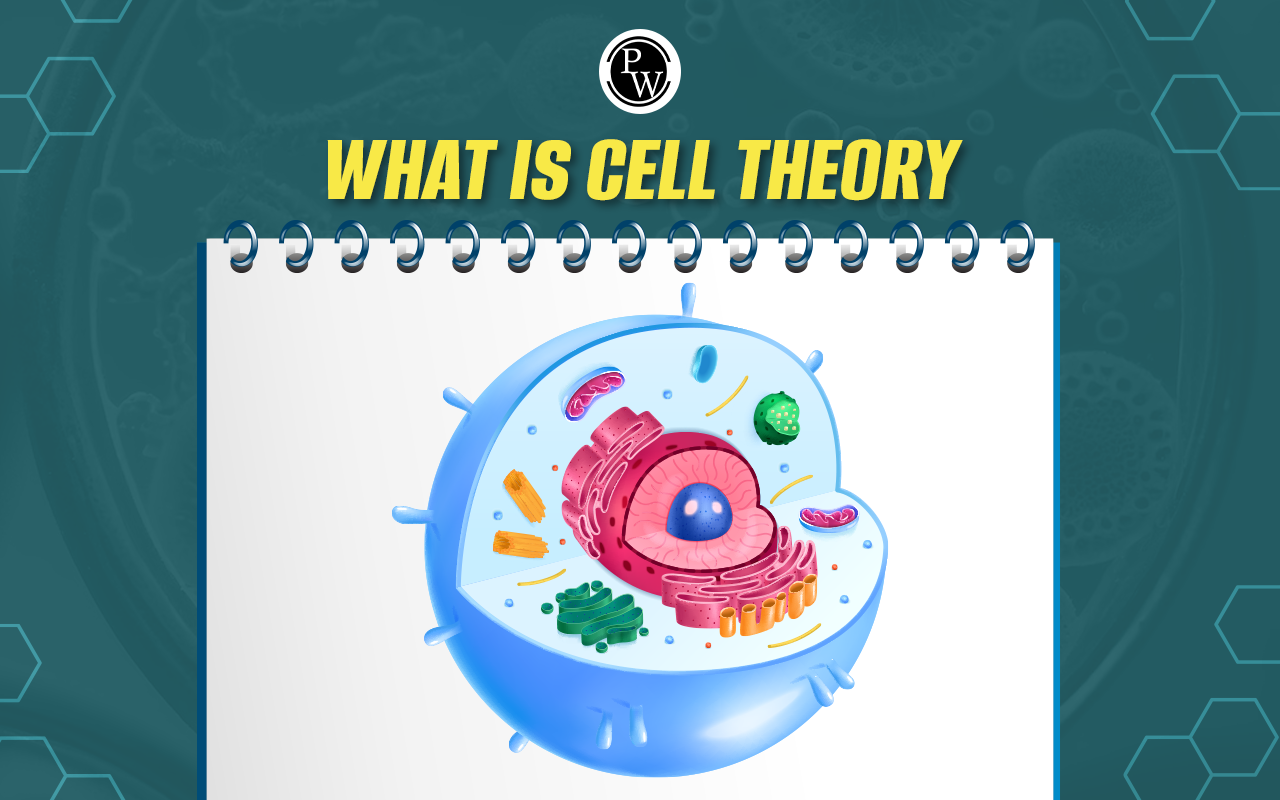
Cell Theory is one of the most important foundations of biology. It explains that all living things are made of cells, cells are the basic units of life, and all cells arise from pre-existing cells. The theory was proposed by Matthias Schleiden and Theodor Schwann, and later expanded by Rudolf Virchow.
This article explains the cell theory definition, its history, postulates, and examples, helping you clearly understand what cell theory is and why it is important.
Cell Theory History
Modern understanding of cells emerged gradually through improvements in microscopes. In the 1600s, Anton van Leeuwenhoek designed powerful single-lens microscopes and observed tiny living organisms, which he called animalcules.
In 1665, Robert Hooke coined the word cell after observing cork under a microscope. His discovery laid the foundation for future studies.
By the 1830s, botanist Matthias Schleiden and zoologist Theodor Schwann examined plant and animal tissues and independently concluded that all living things are made of cells.
Later, in 1858, Rudolf Virchow stated “Omnis cellula e cellula,” meaning all cells come from pre-existing cells, strengthening the modern cell theory.
The three widely accepted principles became:
-
The cell is the basic unit of structure and function.
-
All organisms are composed of cells.
-
Cells originate from existing cells through division.
Also Check: NEET Biology Syllabus
Who Proposed Cell Theory?
The classical Cell Theory was proposed by Matthias Schleiden (1838) and Theodor Schwann (1839). Schleiden studied plants, while Schwann studied animals. Their combined observations showed that both plants and animals are built from cells.
Later, Rudolf Virchow added a crucial third principle—cells arise only from pre-existing cells summarizing it with the famous line omnis cellula e cellula.
Cell Theory Definition
Cell Theory is a scientific explanation that states:
-
All living things are made of cells.
-
Cells are the basic units of life.
-
All cells come from pre-existing cells.
There are two forms:
-
Classical Cell Theory proposed by Schleiden & Schwann
-
Modern Cell Theory, which includes molecular and biochemical understanding of cells.
Also Check: NEET Biology MCQ
What is Cell Theory?
Cell Theory explains the structure and function of living organisms. It states that every living thing contains one or more cells, and each cell arises from an existing cell. All cells share similar chemical composition and perform essential life processes.
This theory helped scientists understand growth, reproduction, heredity, and how organisms maintain life.
Also Check: NEET Previous Years Question Papers
Cell Theory Principles
The three main postulates of Cell Theory are:
All living things are made of cells
Schleiden and Schwann observed that plants and animals are composed of cells. This means cells are the basic building blocks of life.
Cells are the basic units of life, both structurally and functionally.
Every organism’s structure and function depend on activities occurring within its cells. Processes like energy flow, metabolism, and homeostasis occur inside cells.
All cells come from existing cells.
Based on Virchow’s work, cells do not appear spontaneously; they arise through division of pre-existing cells. This principle helped disprove spontaneous generation.
Cell Theory Examples
Here are simple examples showing how cell theory applies to living organisms:
Bacteria
Bacteria are unicellular organisms without a nucleus. They illustrate that all living things are made of cells, even the simplest forms of life.
Plants
Plants are made of eukaryotic cells with organelles. Photosynthesis, respiration, and reproduction all occur at the cellular level, showing that cells are functional units of life.
Animals
Animals have specialised cells—muscle, nerve, blood, etc. These show how cellular structures determine function.
Humans
Humans contain trillions of cells organized into tissues and organs. Every activity—movement, digestion, breathing—depends on the coordinated functions of cells.
| NEET Exam Important Links | |
|---|---|
| NEET Biology Syllabus | NEET Biology Diagrams |
| NEET Biology MCQ | NEET Biology Chapter wise Weightage |
| NEET Biology Notes | NEET Previous Year Question papers |
Cell Theory FAQs
Who discovered the living cell?
Who discovered the cell?
What is cell theory?
What is a cell?
Who proposed the cell theory?
When was cell theory developed?












 Live & recorded classes available at easeDashboard for progress trackingMillions of practice questions at your fingertips

