Relative Stability
 Manoj Singh20 Oct, 2023
Relative Stability:
Relative stability in control systems refers to the system's ability to return to a stable state after experiencing a disturbance or perturbation. It is a measure of how well a control system can maintain its desired or setpoint condition in the presence of external changes, uncertainties, or variations in the system itself. Relative stability is an important aspect of control system design, as it directly affects the system's performance and robustness.
Relative stability can be analyzed using the Routh-Hurwitz criterion:
- Characteristic Equation : Start with the characteristic equation of the control system. This equation is obtained by setting the denominator of the closed-loop transfer function to zero. It is in the form of a polynomial with coefficients in terms of system parameters.
- Routh Array : Create a Routh array using the coefficients of the characteristic polynomial. The Routh array is a tabular representation that provides a systematic way to analyze the roots of the polynomial. It has rows corresponding to the powers of 's' in the polynomial and columns for different coefficients.
- Determine Relative Stability : Analyze the Routh array to determine the relative stability of the system. The key criteria area . The number of sign changes in the first column of the Routh array corresponds to the number of roots with positive real parts. If there are no sign changes, then the system is considered marginally stable . If there are sign changes in the first column, the system is considered stable if all the elements in the first column are positive . If there are sign changes and there are some elements in the first column that are zero or negative, the system is considered unstable.
- Marginal Stability : If the system is marginally stable (no sign changes in the first column), it implies that the system might exhibit oscillations without damping in response to disturbances. The exact degree of oscillation will depend on other factors.
The Routh-Hurwitz criterion provides a way to determine whether a control system is stable, marginally stable, or unstable. However, it does not provide information about transient response characteristics like overshoot and settling time, which are typically analyzed using other methods.
Root Calculation when Odd Row is never zero
For nth order polynomial (1) Form RH Table Observe the first column (2) 1 st column elements : Same Sign → All Roots are on L.H.P.: K sign change → K roots In R.H.P. , (n-k) in L.H.P.
Note : I.P – Inner product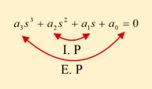 E.P – External Product
All coefficient should have same sign
E.P – External Product
All coefficient should have same sign
- IP > EP all roots in LHP
- IP = EP (1 ROOT IN L.H.P, 2 in R.H.P.)
Special Cases:
- 1 st element of row = 0 other elements non zero
- No odd row is zero, two sign changes: 2→ R.H.P.
- If all element of odd row are zero
- Few roots at image location.
- Form auxiliary characteristic equation has been formed from the row just above the odd row, A/(s)= 0.
- Then, d/ds (A(s)), B(s).
- Replace odd row of zeros with B(s) coefficients
- Roots of A(s) = Roots of D(s), A(s) roots will be at image location A(s) is always a factor of D(s) , D(s)/A(s) = P(s), for remaining roots
- Both location and exact value of roots can be calculated.



 Live & recorded classes available at easeDashboard for progress trackingMillions of practice questions at your fingertips