Types of Transformer Testing
 Ranvijay Singh20 Nov, 2023
Performance of transformer should be known before connecting it to the power system network. For predicting the performance of transformers without actually loading them, two no-loading tests are conducted known as Open circuit test and Short circuit test. From the readings of voltage, current and power obtained from these tests, four parameters are determined that give approximate equivalent circuit of transformers. Apart from these two tests, a simple test called Polarity test is conducted to know the polarity ends on both the windings of the transformer. However, these tests can’t predict the rise in temperature if the transformer is continuously fully loaded. Hence, another test called Sumpter’s (Back-to-Back) Test is carried out to determine steady temperature rise.
Open Circuit Test
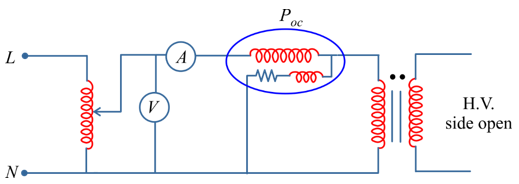 It is carried out at rated voltage and rated frequency. It determines core loss i.e. shunt branch parameters of equivalent circuit of transformer. Generally, this test is performed on low voltage side and HV side kept open-circuited. This is because arranging the rated voltage supply at LV side is easier compared to that on HV side. Measuring instruments are also cheaper as compared to HV side and working at low voltage is safer than working on high voltage.
In open circuit test, the transformer draws a small no-load current. Hence the voltage drop and copper loss in primary winding are neglected. Hence, the approximate equivalent circuit will be
It is carried out at rated voltage and rated frequency. It determines core loss i.e. shunt branch parameters of equivalent circuit of transformer. Generally, this test is performed on low voltage side and HV side kept open-circuited. This is because arranging the rated voltage supply at LV side is easier compared to that on HV side. Measuring instruments are also cheaper as compared to HV side and working at low voltage is safer than working on high voltage.
In open circuit test, the transformer draws a small no-load current. Hence the voltage drop and copper loss in primary winding are neglected. Hence, the approximate equivalent circuit will be
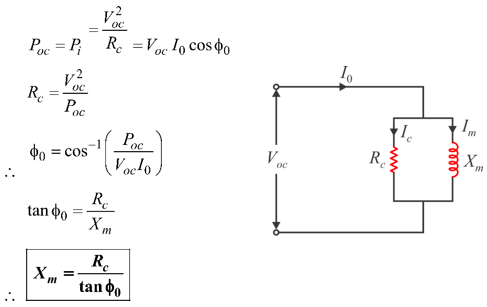 Power factor of transformer on no load is very poor. Hence, Low Power Factor wattmeter is recommended for open circuit test.
Short Circuit Test
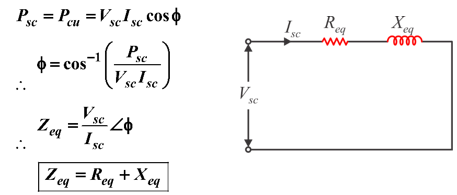
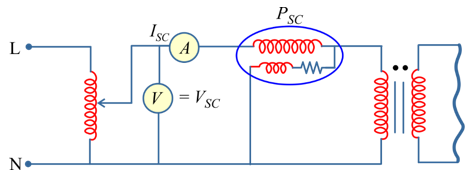 It is carried out at rated current. It determines copper loss i.e., series parameters of equivalent circuit of transformer. It need not to be performed strictly at rated frequency because winding resistance is not affected by variation in frequency. Generally, this test is performed on high voltage side and low voltage side is shorted with the help of thick conductors. This is because on HV side, current rating is lower and hence the measuring instruments will be cheaper in cost. Since, LV side is shorted so, only 5 to 10% of rated voltage is required to circulate full load current in the transformer. Hence, at that much reduced voltage, core loss can be neglected. Hence, no load current and shunt branch parameters in the equivalent circuit are neglected. The equivalent circuit is
Polarity Test
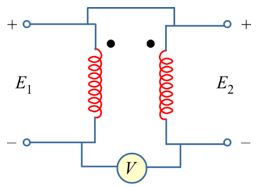 Polarity test is conduced to know the polarity of windings of transformer. It is essential if transformers are to be operated in parallel or to be used in poly phase circuit.
For determining the polarity of windings, both the windings are connected in series across a voltmeter and a suitable voltage source is connected across any one winding. The voltmeter should read E
1
– E
2
. If it reads E
1
+ E
2
, then the polarity marking is not correct and it should be interchanged in any one winding.
Polarity test is conduced to know the polarity of windings of transformer. It is essential if transformers are to be operated in parallel or to be used in poly phase circuit.
For determining the polarity of windings, both the windings are connected in series across a voltmeter and a suitable voltage source is connected across any one winding. The voltmeter should read E
1
– E
2
. If it reads E
1
+ E
2
, then the polarity marking is not correct and it should be interchanged in any one winding.
Sumpner’s (Back-to-Back) Test
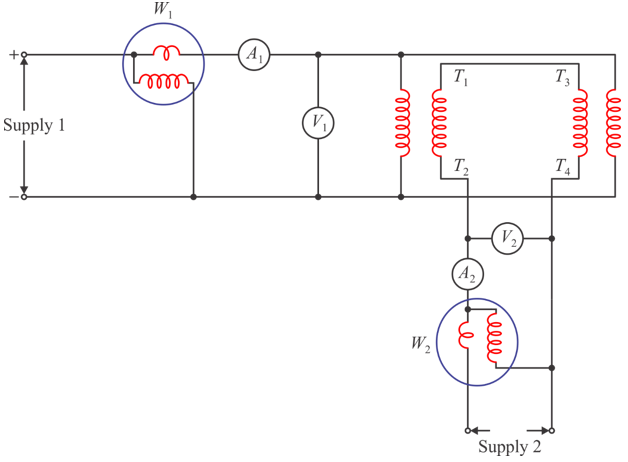 In OC and SC tests, there is either iron loss or ohmic loss but not both. Hence, OC and SC tests can’t be used for heat run test.
In Sumpner’s Test, primary windings of two transformers are connected across a common rated voltage supply. Their secondary windings are connected in phase opposition across another supply voltage. Both the supplies are taken from same mains.
As per Superposition Theorem, when V
2
is assumed shorted, both transformers appear as open circuit to source 1 and hence, the total power drawn from V
2
is core loss of both the transformers.
When V
1
is assumed shorted, both transformers appear as short circuit to source 2 and hence, the total power drawn from V
2
is the copper loss of both the transformers.
Hence, in Sumpner’s test, the total power supplied from the two sources are
2(P
i
+ P
cu
)
and the transformers are not actually loaded. Hence, heat run test can be conducted on both transformers without actually loading them.
In OC and SC tests, there is either iron loss or ohmic loss but not both. Hence, OC and SC tests can’t be used for heat run test.
In Sumpner’s Test, primary windings of two transformers are connected across a common rated voltage supply. Their secondary windings are connected in phase opposition across another supply voltage. Both the supplies are taken from same mains.
As per Superposition Theorem, when V
2
is assumed shorted, both transformers appear as open circuit to source 1 and hence, the total power drawn from V
2
is core loss of both the transformers.
When V
1
is assumed shorted, both transformers appear as short circuit to source 2 and hence, the total power drawn from V
2
is the copper loss of both the transformers.
Hence, in Sumpner’s test, the total power supplied from the two sources are
2(P
i
+ P
cu
)
and the transformers are not actually loaded. Hence, heat run test can be conducted on both transformers without actually loading them.



 Live & recorded classes available at easeDashboard for progress trackingMillions of practice questions at your fingertips