






High Weightage Chapters for JEE Main Physics 2027: Chapter-wise Weightage
 Shrivastav15 Sept, 2026
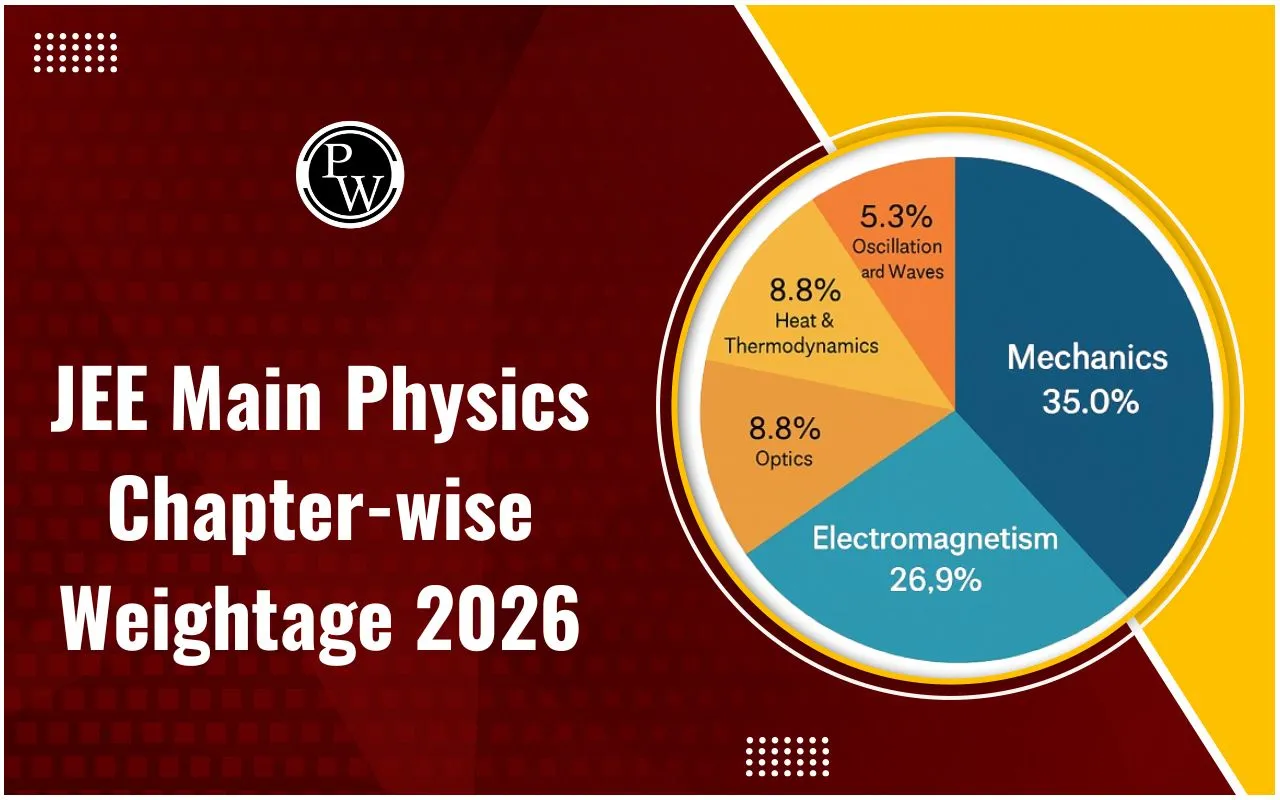
For JEE Main Physics 2027, students can prioritise chapters that have shown higher question frequency in previous JEE Main sessions. Ray Optics, Rotational Motion, Electric Charges and Fields, Fluid Mechanics, Moving Charges and Magnetism, Thermodynamics, and Electrostatic Potential and Capacitance are among the key chapters highlighted by the available question trends.
The JEE Main Physics chapter-wise weightage can vary across shifts and sessions, so it should be used to plan revision rather than predict the exact number of questions in JEE Main 2027. Students should also cover both Class 11 and Class 12 Physics and practise previous-year questions from important chapters.
Also Check:
JEE Main Physics Syllabus 2027
Physics in JEE Main 2027 covers topics from Class 11 and Class 12. Understanding the syllabus helps students organise their preparation before using chapter-wise weightage trends to prioritise revision.
Students should check the latest JEE Main 2027 syllabus before finalising their chapter list and preparation schedule.
Also Check : JEE Main Physics Syllabus 2026
JEE Main Physics Chapter-wise Weightage 2027
The table below shows the number of questions recorded from different Physics chapters in the January and April 2025 JEE Main sessions. This historical data can help students identify chapters that appeared frequently in previous sessions.
The number of questions can vary between shifts and sessions, so the data should be used as a preparation reference rather than a fixed prediction for JEE Main 2027.
|
Chapter Name |
Question No JEE Main 2025 April session |
Question No JEE Main 2025 January session |
|
Ray Optics and Optical Instruments |
19 |
23 |
|
Units and Measurements |
13 |
20 |
|
Rotational Motion |
13 |
14 |
|
Electric Charges and Fields |
13 |
14 |
|
Fluid Mechanics |
10 |
16 |
|
Moving Charges and Magnetism |
12 |
12 |
|
Thermodynamics |
9 |
13 |
|
Electrostatic Potential and Capacitance |
12 |
9 |
|
Wave Optics |
9 |
10 |
|
Dual Nature of Radiation and Matter |
7 |
12 |
|
Semiconductor Electronics |
9 |
10 |
|
Current Electricity |
8 |
9 |
|
Work, Power and Energy |
4 |
11 |
|
Gravitation |
6 |
8 |
|
Electromagnetic Waves |
5 |
9 |
|
Thermal Properties of Matter |
5 |
8 |
|
Waves |
10 |
3 |
|
Alternating Current |
6 |
7 |
|
Kinetic Theory of Gases |
7 |
5 |
|
Atoms |
7 |
5 |
|
Newton’s Laws of Motion |
8 |
3 |
|
Motion in a Plane |
6 |
4 |
|
Motion in a Straight Line |
5 |
4 |
|
Simple Harmonic Motion |
4 |
5 |
|
System of Particles and Centre of Mass |
3 |
5 |
|
Nuclei |
5 |
3 |
|
Mechanical Properties of Solids |
6 |
1 |
|
Electromagnetic Induction |
1 |
6 |
|
Magnetism and Matter |
3 |
0 |
|
Vector and Calculus |
0 |
1 |
High Weightage Chapters for JEE Main Physics 2027
Based on the historical question trends shown above, students can give particular attention to:
- Ray Optics and Optical Instruments
- Rotational Motion
- Electric Charges and Fields
- Fluid Mechanics
- Moving Charges and Magnetism
- Thermodynamics
- Electrostatic Potential and Capacitance
- Wave Optics
- Dual Nature of Radiation and Matter
- Semiconductor Electronics
- Current Electricity
These chapters should be prioritised for revision, but students should not completely skip other chapters because question distribution can change across JEE Main shifts.
Important Physics Chapters for JEE Main
Some Physics topics have strong search demand because students specifically look for their individual weightage.
Rotational Motion Weightage in JEE Main
Rotational Motion is an important Mechanics topic. Students should revise torque, angular momentum, moment of inertia, rotational dynamics, and related numerical problems.
Modern Physics Weightage in JEE Main
Modern Physics includes Dual Nature of Radiation and Matter, Atoms, and Nuclei. Revise the important concepts, formulas, and previous-year questions from these topics.
Current Electricity Weightage in JEE Main
Current Electricity includes concepts such as current, resistance, electrical circuits, and Kirchhoff's laws. Practise numerical questions after revising the core concepts.
Thermodynamics Weightage in JEE Main
Revise the laws of thermodynamics, heat, work, internal energy, and thermodynamic processes along with previous-year questions.
Ray Optics Weightage in JEE Main
Ray Optics and Optical Instruments had a high number of questions in the analysed 2025 sessions. Revise mirrors, lenses, refraction, reflection, and optical instruments.
Wave Optics Weightage in JEE Main
Wave Optics includes important concepts such as interference and diffraction. Students should revise the key formulas and practise JEE Main-level questions.
Fluid Mechanics Weightage in JEE Main
Fluid Mechanics had notable question frequency in the analysed sessions. Revise pressure, buoyancy, fluid flow, Bernoulli's principle, and related applications.
Moving Charges and Magnetism Weightage in JEE Main
Important areas include magnetic force, magnetic fields, motion of charged particles, and current-carrying conductors.
Also Check : JEE Main Syllabus 2026
Physics Sub-Discipline Question Trends
Mechanics
Mechanics includes Kinematics, Laws of Motion, Work, Power and Energy, Rotational Motion, Gravitation, and related topics. Students should combine conceptual revision with numerical practice.
Modern Physics
Modern Physics includes Dual Nature of Radiation and Matter, Atoms, and Nuclei. Focus on concepts, formulas, and previous-year questions.
Electromagnetism
Electromagnetism includes Electrostatics, Current Electricity, Moving Charges and Magnetism, Electromagnetic Induction, Alternating Current, and Electromagnetic Waves.
Thermodynamics and Kinetic Theory
Thermodynamics and Kinetic Theory include both conceptual and numerical questions. Revise the fundamental laws, equations, and common applications.
Optics
Ray Optics and Wave Optics are important areas within the Physics syllabus. Regular formula revision and numerical practice can improve speed and accuracy.
JEE Main Physics Class 11 High Weightage Chapters
Important Class 11 areas include:
- Rotational Motion
- Units and Measurements
- Fluid Mechanics
- Thermodynamics
- Work, Power and Energy
- Gravitation
- Kinematics
- Newton's Laws of Motion
- Thermal Properties of Matter
- Kinetic Theory of Gases
- Simple Harmonic Motion
JEE Main Physics Class 12 High Weightage Chapters
Important Class 12 areas include:
- Electric Charges and Fields
- Electrostatic Potential and Capacitance
- Moving Charges and Magnetism
- Current Electricity
- Ray Optics
- Wave Optics
- Semiconductor Electronics
- Dual Nature of Radiation and Matter
- Electromagnetic Waves
- Electromagnetic Induction
- Alternating Current
- Atoms and Nuclei
JEE Main 2027 Class-wise Distribution of Physics Questions
Physics questions in JEE Main are drawn from both Class 11 and Class 12 topics. The available 2024 and 2025 data shows questions from both classes across the analysed sessions.
|
Year |
Attempt |
Class XI |
Class XII |
|
2024 |
January |
141 |
159 |
|
April |
143 |
157 |
|
|
2025 |
January |
121 |
129 |
|
April |
109 |
116 |
The distribution can vary between sessions and shifts. Students should therefore prepare both Class 11 and Class 12 Physics.
How to Prioritise High Weightage Chapters for JEE Main Physics
- Start with frequently tested chapters: Revise Ray Optics, Rotational Motion, Electrostatics, Fluid Mechanics, Thermodynamics, and Moving Charges and Magnetism.
- Revise formulas and concepts together: Make short formula notes and solve numerical questions after revision.
- Practise previous-year questions: Solve chapter-wise JEE Main PYQs.
- Cover Class 11 and Class 12: Do not rely only on one class or a small group of chapters.
- Take mock tests: Analyse incorrect and unattempted questions after each test.
Practice and Mock Tests for JEE Main Physics
After revising a high-weightage chapter, solve relevant JEE Main previous-year questions. Analyse mistakes after each test and revise the concepts where accuracy is low.
|
Study Material For JEE 2026 |
JEE Main Physics Chapter-wise Weightage 2027 FAQs
What are the high weightage chapters for JEE Main Physics 2027?
How many questions come from Modern Physics in JEE Main?
Is Magnetism and Matter included in JEE Main 2027 syllabus?
Which Physics chapters are most important for scoring in JEE Main?











Get Free Counselling Today
and Clear up all your Doubts
 Live & recorded classes available at easeDashboard for progress trackingLakhs of practice questions

