







Pressure Isotropic, Variation Of Pressure, Hydraulic Lift, Important Points
 Shrivastav 8 Apr, 2024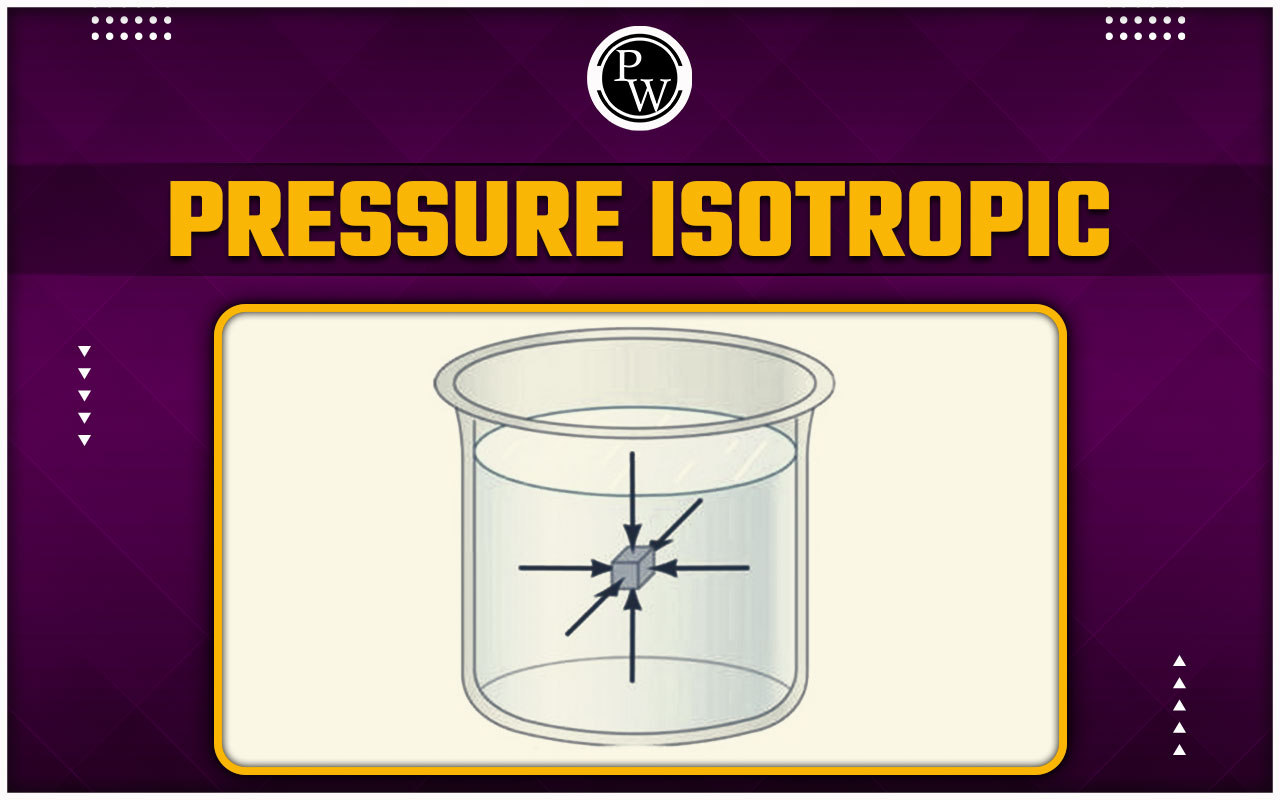
Pressure Isotropic : We will learn that Pascal’s law or the principle of transmission of fluid-pressure is a principle in fluid mechanics that states that pressure exerted anywhere in a confined incompressible fluid is transmitted equally in all directions throughout the fluid. The simplest instance of this is stepping on a balloon; the balloon bulges out on all sides under the foot and not just on one side. This is precisely what Pascal’s law is all about – the air which is the fluid in this case, was confined by the balloon and you applied pressure with your foot causing it to get displaced uniformly.
Pressure Isotropic
Pressure Isotropic : Imagine a static fluid and consider a small cubic element of it deep within the fluid as shown in Figure. Since this fluid element is in equilibrium, therefore, forces acting on each lateral face of this element must also be equal in magnitude. Because the areas of each face are equal, therefore, the pressure on each of the lateral faces must also be the same. In the limit as the cube element reduces to a point, the forces on the top and bottom surfaces also become equal. Thus, the pressure exerted by a fluid at a point is the same in all directions – the pressure is isotropic.
Pressure
Pressure : The normal force or the thrust per unit area is called Fluid Pressure. Its S.I. unit is Nm −2 or pascal (Pa). Mathematically, we have

where (Δ F ) ⊥ is the normal force acting on surface of area A . If we consider an imaginary surface within the liquid, then the fluid on both the sides of the surface exerts equal and opposite force (Δ F ⊥ ) on each surface as shown. If this is not the case then the liquid surface will accelerate and the fluid will not remain at rest.


where F ⊥ is the normal force acting on one side of the imaginary surface. The average pressure in the fluid at the position of the element is given by


1 atm = 1.01325 × 10 5 Pa
1 bar = 1.00000 × 10 5 Pa
Pascal’s Law
Pascal’s Law : Liquids, being incompressible are capable of transmitting the pressure applied at one point to any other point. A principle regarding this was formulated by Blaise Pascal (1623-1662), a French mathematician, physicist and philosopher. The formulation is called Pascal’s Law.

The excess pressure, applied anywhere in a mass of a confined incompressible fluid (or liquid), is transmitted by the fluid in all directions and acts undiminished at every point of the fluid and at right angles to the surfaces exposed to the fluid. Consider a vessel full of water and filled with air tight pistons in different position as shown. Let the piston at
A
be pushed down with a force
F
1
(shown in Figure). Pressure
P
on the piston is


Hydraulic Lift
Hydraulic Lift : Hydraulic lift is used to support or lift heavy objects and works on the principle of Pascal’s Law. This principle is used in a hydraulic jack or lift, as shown in Figure. The pressure due to a small force F 1 applied to a piston of area A 1 is transmitted to the larger piston of area A 2 . The pressure at the two pistons is the same because they are at the same level.


Important Points To Remember
1. Absolute pressure is always positive and is never equal to zero:
2. Gauge pressure may be positive, zero or negative.
3. Positive gauge pressure means that pressure at a point is more than the atmospheric pressure.
4. Negative gauge pressure means that pressure at a point is less than the atmospheric pressure.
5. Practically, the exact value of absolute pressure cannot be measured due to the uncertainty in the value of atmospheric pressure.
6. The atmospheric pressure varies from place to place and at a place from time to time,
Variation Of Pressure With Depth
Variation Of Pressure With Depth :
Let
A
be the area of cross section of this volume element,
dy
be its thickness,
P
0
be the atmospheric (i.e., outside) Pressure acting on the free surface of liquid,
F
be the total force acting downward on the top face of the volume element =
P
×
A
,


As this volume element is in equilibrium,
( P + dP ) – PA = dW

or


P
0
+ ρ
1
gh
1
=
P
0
+ ρ
2
gh
2
or
ρ
1
h
1
= ρ
2
h
2
or


Barometer
Barometer It is a device used to measure atmospheric pressure.
In principle, any liquid can be used to fill the barometer, but mercury is the substance of choice because its great density makes possible an instrument of reasonable size.
p 1 = p 2 Here, p 1 = atmospheric pressure ( p 0 ) And p 2 = 0 + ρ gh = ρ gh Here, ρ = density of mercury
p
0
= ρ
gh

Thus, the mercury barometer reads the atmospheric pressure ( p 0 ) directly from the height of the mercury column. For example, if the height of mercury in a barometer is 760 mm, then atmospheric pressure will be
p 0 = ρ gh = (13.6 × 10 3 ) (9.8) (0.760) = 1.01 × 10 5 N/m 2
Manometer
Manometer It is a device used to measure the pressure of a gas inside a container.
The U-shaped tube often contains mercury.


 Here, ρ is the density of the liquid used in U-tube.
Thus, by measuring
h
we can find absolute (or gauge) pressure in the vessel.
Here, ρ is the density of the liquid used in U-tube.
Thus, by measuring
h
we can find absolute (or gauge) pressure in the vessel.
Pressure Isotropic FAQs
Q. 1 : Write one application of Pascal’s law.
Q. 2 : What is Pascal’s law?
Q. 3 : Does Pascal’s law apply to gases?
Q.4 : Pressure ________with increase in depth














 Live & recorded classes available at easeDashboard for progress trackingMillions of practice questions at your fingertips

