







Inguinal Hernia: Types, Clinical Features & Ring Occlusion Test

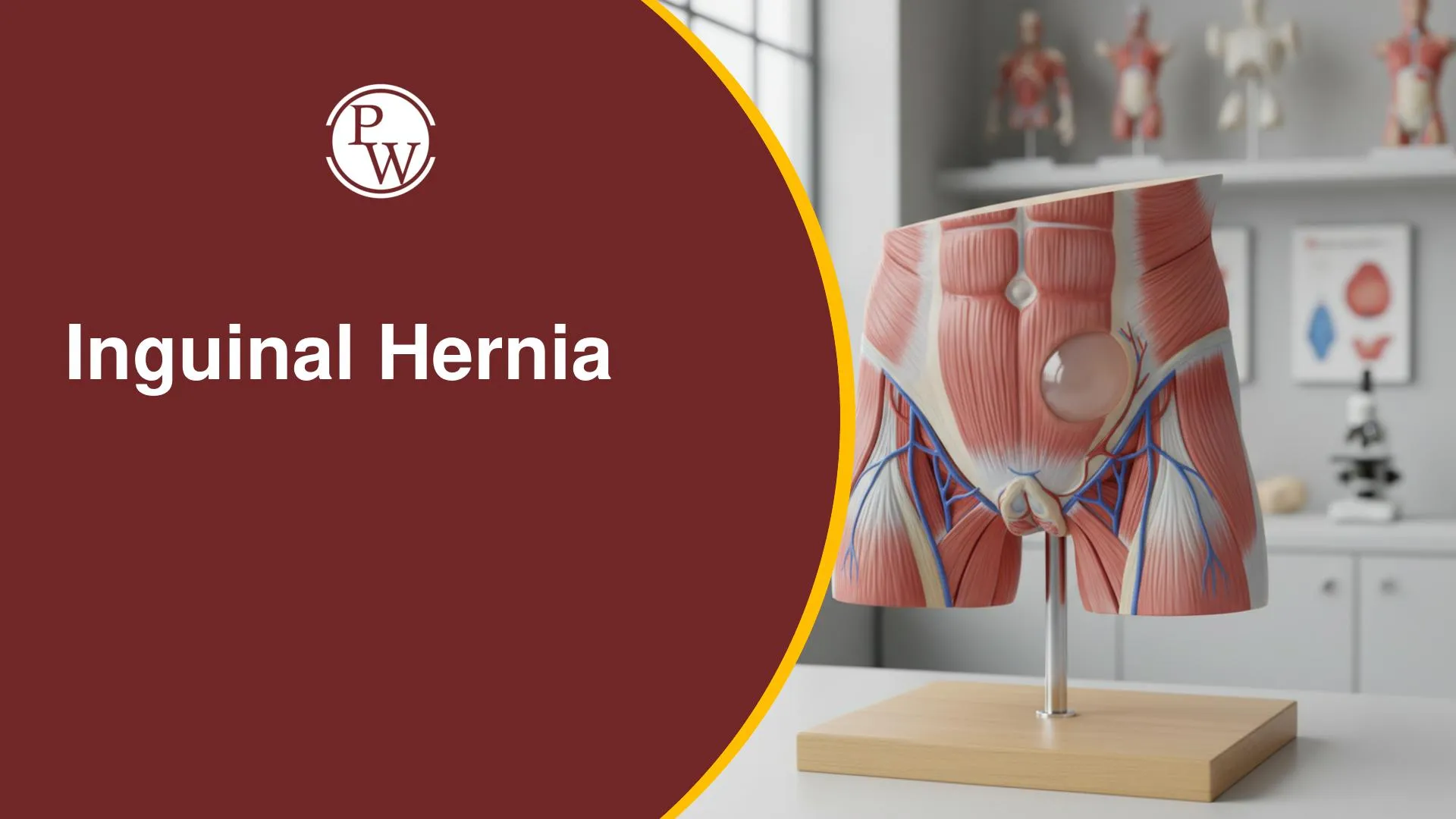
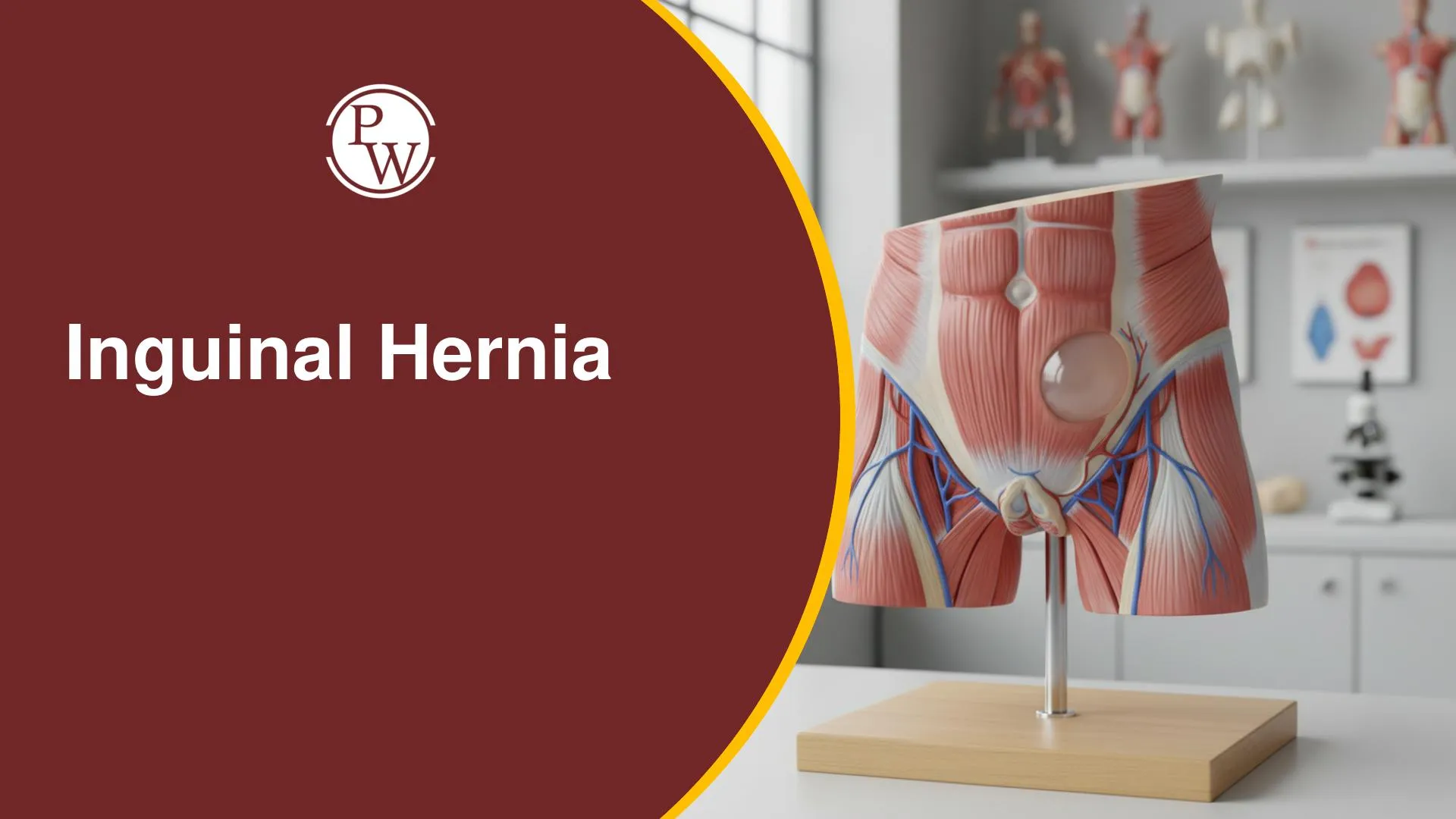
Inguinal Hernia is a common surgical condition in which abdominal contents protrude through a weak point in the lower abdominal wall, specifically in the groin region. It is one of the most frequently encountered conditions in clinical practice, especially among males, and holds significant importance in medical education and examinations.
Understanding inguinal hernia involves recognizing its underlying risk factors, anatomical basis, and clinical presentation. A clear distinction between its two main types, direct and indirect is essential for accurate diagnosis and management. Check a structured overview of the condition, including key examination findings and diagnostic techniques such as the ring occlusion test, helping build strong conceptual clarity for students and aspirants.
What is Inguinal Hernia?
An inguinal hernia occurs when abdominal contents protrude through a weak point in the abdominal wall, specifically in the groin region. Understanding this condition is crucial in medical diagnosis due to its common occurrence and potential complications. Know the risk factors, types, clinical presentation, and diagnostic approaches for inguinal hernias, distinguishing between indirect and direct varieties.
Risk Factors for Hernia Development
Not every patient develops a hernia. Factors contributing to hernia development can be broadly classified into two categories:
A. Abdominal Wall Weakness
Factors leading to abdominal wall weakness include:
-
Patent Processus Vaginalis: In males, the peritoneum descends with the testes, forming the processus vaginalis. Its failure to obliterate maintains an abdominal communication, allowing contents to move into the inguinal canal and scrotum.
-
Patent Canal of Nuck: The female equivalent of the patent processus vaginalis.
-
Connective Tissue Disorders: Such as Ehlers-Danlos Syndrome.
-
Defective Collagen Synthesis.
-
History of previous surgery.
-
Smoking.
B. Increased Intra-abdominal Pressure
Conditions that increase intra-abdominal pressure include:
-
Chronic Cough: For instance, in COPD patients.
-
Chronic Constipation.
-
Obstructive Uropathy.
-
Chronic Liver Disease (leading to ascites).
-
Any intra-abdominal mass.
-
Weightlifting (considered a lesser risk factor).
Types of Inguinal Hernia: Indirect vs. Direct
Inguinal hernias are divided into two main varieties: Indirect Inguinal Hernia and Direct Inguinal Hernia.
A. Indirect Inguinal Hernia
-
Mechanism: The hernia sac enters through the deep inguinal ring, traverses the inguinal canal, and exits through the superficial inguinal ring.
-
It is called "indirect" because it follows the congenital path of testicular descent via the patent processus vaginalis.
-
Pressure from abdominal contents forces the peritoneum to sink into the deep ring, entering the inguinal canal, and eventually exiting via the superficial inguinal ring.
B. Direct Inguinal Hernia
-
Mechanism: The hernia enters directly from the posterior wall of the inguinal canal, specifically through Hasselbach's Triangle, and exits through the superficial inguinal ring.
-
It is called "direct" because it directly protrudes through a weakened area of the abdominal wall, rather than following a pre-existing congenital path.
C. Hasselbach's Triangle
-
Definition: An area of inherent anatomical weakness in the posterior wall of the inguinal canal, not guarded by any muscle.
-
Boundaries:
-
Medial Boundary: Lateral border of the Rectus Abdominis muscle.
-
Lateral Boundary: Inferior Epigastric Artery.
-
Inferior Boundary: Inguinal Ligament (formed by the external oblique aponeurosis).
Read More - Pharyngeal Arches
Comparative Analysis: Indirect vs. Direct Inguinal Hernia
Here is a Comparative Analysis of Indirect vs. Direct Inguinal Hernia:
|
Comparative Analysis: Indirect vs. Direct Inguinal Hernia |
||
|---|---|---|
|
Feature |
Indirect Inguinal Hernia |
Direct Inguinal Hernia |
|
Entry Point |
Deep Inguinal Ring |
Hasselbach's Triangle (posterior wall) |
|
Exit Point |
Superficial Inguinal Ring |
Superficial Inguinal Ring |
|
Sac Composition |
Peritoneum |
Fascia Transversalis (and peritoneum) |
|
Common Contents |
Bowel (enterocele), Omentum (omental seal) |
Bowel (enterocele), Omentum (omental seal) |
|
Relation of Sac to Cord |
Sac lies lateral to the cord |
Sac lies medial to the cord |
|
Relation of Neck to Inferior Epigastric Artery |
Neck lies lateral to the Inferior Epigastric Artery |
Neck lies medial to the Inferior Epigastric Artery |
Definition of Sac and Content:
-
Sac: The outer covering of the hernia.
-
Content: Whatever is present inside the sac.
Clinical Presentation of Inguinal Hernia
-
Epidemiology: More common in males than females.
-
Primary Complaint: Presence of an inguino-scrotal swelling.
-
Usually painless.
-
Varies in size: Reduces in supine position (lying down) and increases on standing.
A. On Examination
When examining a patient for inguinal hernia, specific steps are followed.
-
Reducibility: It is a reducible swelling. When palpated in the supine position, it regresses inside.
-
Cough Impulse: Presence of an expansile cough impulse. The swelling reappears and expands when the patient coughs.
-
Extent of Swelling: You cannot get above the swelling because its other end is inside the abdominal wall.
-
Testes Palpation: The testes can be palpated separately from the content of the hernia.
Read More - Pelvis and Perineum
Differential Diagnosis: Inguinal Hernia vs. Hydrocele
A common differential diagnosis for inguino-scrotal swelling is hydrocele of the testes.
|
Differential Diagnosis: Inguinal Hernia vs. Hydrocele |
||
|---|---|---|
|
Feature |
Inguinal Hernia |
Hydrocele |
|
Reducibility |
Reducible |
Irreducible (except congenital hydrocele which can be reducible like a patent processus vaginalis) |
|
Cough Impulse |
Positive expansile cough impulse |
Negative cough impulse |
|
Extent of Swelling |
Cannot get above the swelling |
Can get above the swelling |
|
Testes Palpation |
Testes can be palpated separately from the swelling |
Testes cannot be felt separately from the swelling |
|
Fluctuation Sign |
Negative |
Positive fluctuation sign |
|
Transillumination Test |
Negative (no brilliant transillumination) |
Brilliant transillumination is present |
Ring Occlusion Test
From a clinical perspective, the ring occlusion test is most important to differentiate between a direct and indirect inguinal hernia.
A. Steps:
-
Reduce the hernia.
-
Occlude the Deep Inguinal Ring with the thumb.
-
Ask the patient to cough.
B. Interpretation:
-
Positive Impulse: If the swelling reappears (positive cough impulse) while the deep inguinal ring is occluded, it indicates a Direct Inguinal Hernia. This means the hernia originates from the posterior wall (Hasselbach's triangle), as the deep ring is blocked.
-
Negative Impulse: If the swelling does not reappear (negative cough impulse) while the deep inguinal ring is occluded, it indicates an Indirect Inguinal Hernia. This is because the entry point for an indirect hernia (deep inguinal ring) has been blocked.
C. Ring Occlusion Test Failure (Fallacies):
The test may fail to provide a conclusive result in the following situations:
-
Lax Deep Inguinal Ring: If the deep inguinal ring is so wide that the thumb cannot completely occlude it. This allows a portion of an indirect hernia to still protrude.
-
Pantaloon Hernia: A hernia where the patient has both a direct and an indirect inguinal hernia arising from the same inguinal canal. Occluding the deep ring might still result in a positive impulse from the direct component.
Investigations
Hernia is primarily a clinical diagnosis. No special tools are typically required. An ultrasound of the inguino-scrotal region may be performed bilaterally, mainly to rule out bilateral inguinal hernias (occurring in 8-10% of cases). It has no significant role in the primary diagnosis, as clinical examination is sufficient.
| Erb's Palsy | Lumbar Puncture |
| Cranio-Vertebral Joints | Montgomery Tubercles |
Inguinal Hernia FAQs
What are the primary risk factors for developing an inguinal hernia?
How do Indirect and Direct Inguinal Hernias differ in their entry points?
What are the key clinical signs of an inguinal hernia on examination?
How can a Ring Occlusion Test help differentiate between direct and indirect inguinal hernias?
Is special imaging, like ultrasound, always necessary for diagnosing an inguinal hernia?




 Live & recorded classes available at easeDashboard for progress trackingLakhs of practice questions


