








NEET Dress Code 2026: Rules for Female & Male Candidates

With the NEET UG 2026 Re-examination scheduled on 21 June 2026 by the National Testing Agency (NTA), after the cancellation of the May 3 exam due to reported irregularities and paper leaks, candidates must strictly follow the official dress code to avoid last-minute issues, delays, or disqualification at the exam centre.
To maintain fairness, transparency, and exam security, the NTA prescribes a dress code for candidates. The NEET Dress Code 2026 applies uniformly to all aspirants and must be followed on exam day. Failure to comply may lead to additional frisking or delays.
What is NEET UG Exam Dress Code 2026?
The NTA dress code for NEET provides essential guidelines for exam day. The National Testing Agency (NTA) sets these rules. They aim for fairness, transparency, and security. This code prevents unfair practices. All aspirants must follow this NEET Dress Code 2026 for admission.
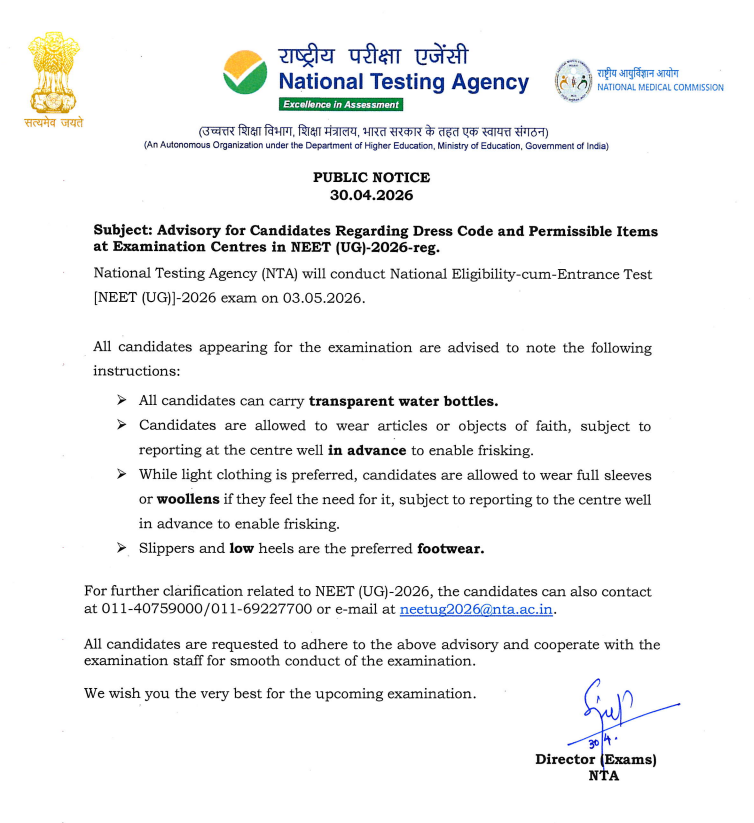
UPDATE (As per NTA Public Notice 30 April 2026):
- Full-sleeve clothes and woollens are now allowed, but candidates must report early for proper frisking.
- Articles of faith (religious items) are permitted, subject to early reporting and security checks.
- Transparent water bottles are allowed inside the exam centre.
NEET Dress Code for Males 2026
Male candidates appearing for NEET 2026 are required to wear simple and light clothing to ensure easy security checks. Clothes with unnecessary layers, heavy designs, or metal parts are strictly discouraged.
Permitted attire for male candidates includes:
-
Half-sleeve shirts or T-shirts
-
Plain and light-colored clothing
-
Simple trousers or pants without multiple pockets
-
Slippers or open-toed sandals with thin soles
UPDATE:
- Full sleeves are allowed (with early reporting for frisking).
Not allowed for male candidates:
-
Full-sleeve shirts or jackets
-
Kurtas or layered clothing
-
Shoes with thick soles
-
Belts, caps, watches, or metallic accessories
Candidates are advised to avoid clothes with zips, big buttons, or concealed pockets as they may lead to additional checking.
NEET Dress Code for Female Candidates 2026
Female candidates must also follow a simple and modest dress code as prescribed by NTA. The focus remains on comfort, ease of frisking, and exam integrity.
Permitted attire for female candidates includes:
-
Half-sleeve kurtas, tops, or T-shirts
-
Simple salwar, leggings, or trousers
-
Slippers or open-toed sandals with thin soles
UPDATE:
- Full-sleeve dresses are allowed (subject to early reporting and frisking).
- Religious or customary dress is allowed with prior declaration and early entry.
Strictly prohibited items for female candidates:
-
Full-sleeve tops or dresses
-
Heavy embroidery, frills, or layered clothing
-
High heels, fancy footwear, or boots
-
Jewelry of any kind, including earrings, bangles, rings, and necklaces
-
Hair accessories such as clips, pins, or bands
Female candidates should avoid tight-fitting outfits and opt for simple clothing to avoid inconvenience during security checks.
Can You Wear Jeans in NEET 2026?
Yes, jeans are allowed only if they are simple, without multiple pockets, heavy zips, or metal buttons. Avoid tight or designer jeans to prevent issues during security checks.
Are Leggings, Kurtis & T-Shirts Allowed in NEET?
Yes, candidates can wear simple leggings, half-sleeve kurtis, and plain T-shirts. Avoid embroidery, frills, or full sleeves. Clothes should be light and simple for easy frisking.
Are Pocket Pants Allowed in NEET 2026?
No, pants with multiple or hidden pockets are not allowed. Candidates should wear simple trousers or lowers without extra pockets.
NEET Customary Dress Code 2026
Candidates wearing traditional or religious attire, like a burqa or turban, may do so. They must declare "Customary Dress" on their NEET application form 2026. These candidates must arrive at the center one hour early. This allows for thorough security checks.
UPDATED RULE:
- Articles of faith are allowed
- Must report early at the centre for proper frisking
Prohibited Items in the NEET 2026 Examination Hall
The NTA strictly bans certain items. This prevents cheating. No storage is available at centers.
-
Electronic Devices: Mobile phones, smartwatches, cameras, Bluetooth, earphones, pagers, microchips, calculators.
-
Study Materials: Any written or printed paper, pencil cases, geometry boxes.
-
Accessories: Bags, belts, hats, sunglasses, wallets, all jewelry.
-
Other: Electronic pens, scanners, scales, erasers, and all food items (unless documented medical condition).
UPDATE:
- Transparent water bottle is allowed
COVID-19 Guidelines for NEET 2026 (Anticipated)
Anticipated guidelines may include masks, transparent water bottles, and a 50 ml hand sanitizer. Gloves might be allowed. Candidates also need their NEET 2026 admit card, photo ID, and signed Self Declaration.
Guidelines of NEET Dress Code 2026
The NTA dress code for NEET is framed to ensure uniformity and fairness. Candidates are expected to strictly follow these guidelines to avoid last-minute issues.
Key instructions include:
-
- Wear simple and light clothing
- Prefer slippers or low heels
- Avoid unnecessary accessories
- Reach the exam centre early
IMPORTANT UPDATE:
- Full sleeves and woollens allowed with early reporting
- Religious items permitted with frisking
Candidates wearing customary dress must strictly follow the additional reporting and verification process.
Last-Minute Dress Code Tips for NEET 2026
- Wear simple clothes (half or full sleeve both allowed now)
- Avoid heavy accessories
- Carry only permitted items
- Reach centre early for smooth entry
NEET Admit Card & Dress Code Rules
Candidates must carry their NEET 2026 admit card along with valid ID proof. Dress code rules must be followed along with admit card instructions to avoid entry issues.
NEET Dress Code 2026 FAQs
Can I wear jeans in NEET 2026?
Are leggings allowed in NEET exam?
Are shoes allowed in NEET?
Can girls wear kurti in NEET?






Have questions about your prep?
Our experts can answer all your questions
 Live & recorded classes available at easeDashboard for progress trackingLakhs of practice questions

