







What is Living? Definition, Characteristics, and Difference
What is Living: This article provides a detailed overview of what living is, its definition, characteristics, and the difference between living and non-living things.
 Krati Saraswat4 Jun, 2025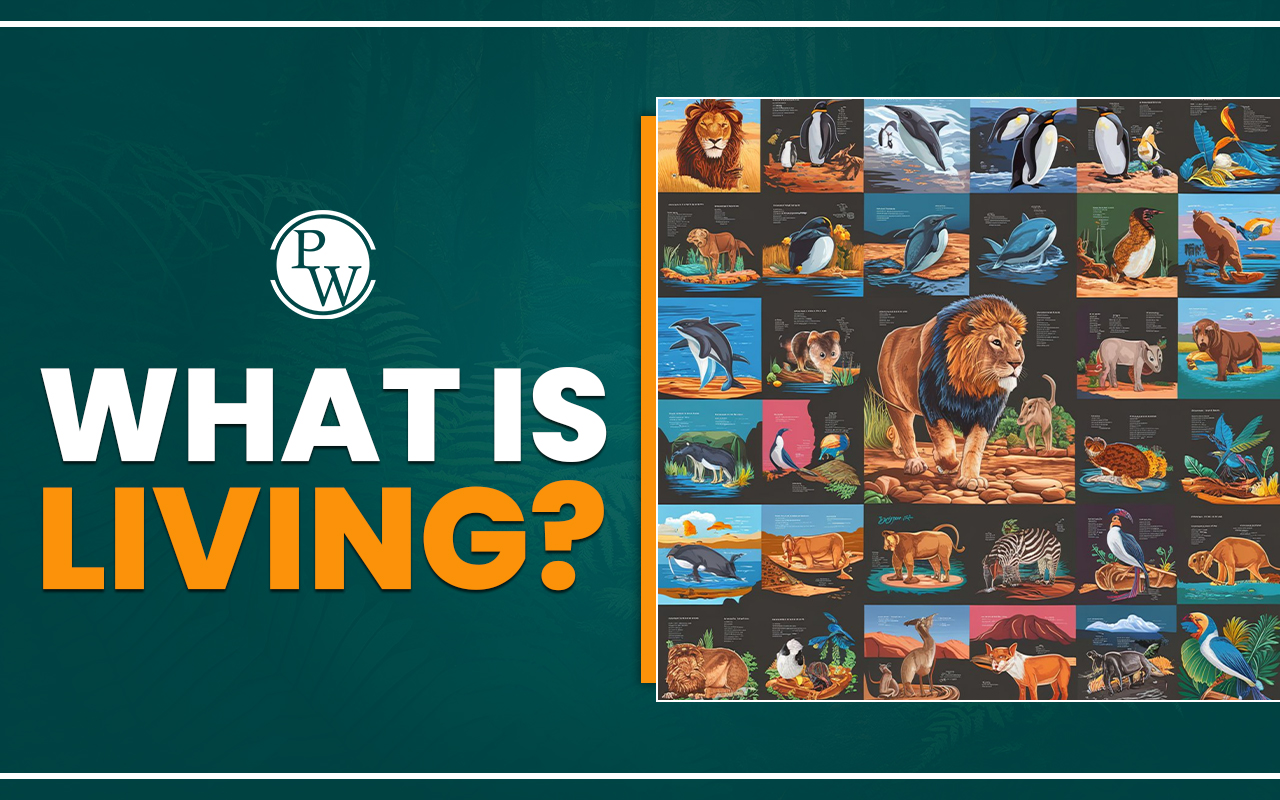
What is Living: Living refers to the state of being alive, encompassing the myriad of biological processes that sustain existence. Every individual around us relies on essential life functions such as respiration, growth, and reproduction to remain healthy and happy. Living organisms exhibit a range of characteristics, including the ability to grow, move, reproduce, and respond to stimuli.
Understanding the concept of living is important for the NEET Exam and is a critical component of the NEET syllabus .What is Living?
A living organism is defined as any life form that exhibits or possesses the qualities of life or being alive. These organisms share several fundamental characteristics that distinguish them from non-living entities.Characteristics of Living Organisms
Living organisms exhibit several distinctive features that set them apart from non-living entities. These characteristics include:- Growth : All living organisms have the capacity to grow, with plants experiencing continuous growth throughout their lifespan while animals grow only until a certain age.
- Growth is characterized by an increase in body mass and an increase in the number of individuals.
- In unicellular organisms, growth occurs through cell division, observable in in vitro cultures.
- Reproduction : Reproduction is a fundamental characteristic of living organisms, with no non-living object capable of self-replication.
- In multicellular organisms, reproduction produces progeny that resemble their parents, occurring through both sexual and asexual means.
- Examples of asexual reproduction include budding in fungi and lower organisms like Hydra, while true regeneration occurs in organisms like Planaria.
- Metabolism and Cellular Organization : Living organisms consist of various chemicals, constantly undergoing metabolic reactions, which can be categorized into anabolism (constructive metabolism) and catabolism (destructive metabolism).
- Metabolism encompasses all chemical reactions occurring within an organism, essential for maintaining life.
- Isolated metabolic reactions outside a living organism do not constitute life, highlighting that cellular organization is a defining feature of living organisms.
- Consciousness : Living organisms possess the ability to sense and respond to their environment, a feature that varies from simple prokaryotes to complex eukaryotes.
- Organisms respond to external factors such as light, water, and temperature, indicating a level of awareness of their surroundings.
- All living organisms exhibit some form of awareness and responsiveness to environmental cues.
- Self-Consciousness: Humans are unique in possessing self-consciousness, or the awareness of oneself as an individual.
- This capacity for self-awareness is considered a defining property of living organisms, distinguishing humans from other life forms.
- Interactions : Interactions at various levels of biological organization give rise to emergent properties, where the characteristics of higher levels cannot be fully understood by examining the individual components alone.
- For example, the properties of a tissue arise from the interactions among the constituent cells, demonstrating that life is characterized by complex interdependencies.
- This structured overview highlights the unique characteristics that define living organisms, illustrating their complexity and the essential qualities that distinguish them from non-living entities.
Difference Between Living and Non-Living Things
Living organisms are complex entities that exhibit the essential characteristics of life, including cellular organization, metabolism, growth, reproduction, and response to stimuli. They adapt to their environments and maintain homeostasis, distinguishing them from non-living matter.| Difference Between Living and Non-Living Things | ||
|---|---|---|
| Criteria | Living Things | Non-Living Things |
| Cellular Organization | Composed of one or more cells | Not composed of cells |
| Metabolism | Exhibit metabolism (anabolism and catabolism) | Do not perform metabolic processes |
| Growth | Grow and develop over time | Do not grow; may accumulate material externally |
| Reproduction | Capable of reproduction (asexual or sexual) | Cannot reproduce or create offspring |
| Response to Stimuli | Respond to environmental stimuli | Do not respond to stimuli |
| Homeostasis | Maintain internal balance and stability | Do not maintain internal stability |
| Adaptation | Adapt and evolve over generations | Do not adapt or evolve |
| Heredity | Possess genetic material (DNA or RNA) | Lack genetic material; cannot inherit traits |
| Complexity and Order | Exhibit complexity and organized structure | Usually simpler and lack organized structures |
| Metabolic Activities | Carry out various metabolic activities | Do not engage in metabolic activities |
MCQs of What is Living
Q1. How many (in number) of the following properties are the defining characteristics of living organisms?
1. Growth
2. reproduction
3. metabolism
4. consciousness.
- 2
- 3
- 4
- 1
Q2. Which of the following is a defining characteristic of living organisms?
- Growth
- Ability to make sound
- Reproduction
- Response to external stimuli
Q3. Growth in plants is:
- diffused
- localized
- determinate
- reversible
Answers to MCQs of What is Living
Ans1 . 4,| NEET Exam Important Links | |
|---|---|
| NEET Biology Syllabus | NEET Biology Diagrams |
| NEET Biology MCQ | NEET Biology Chapter wise Weightage |
| NEET Biology Notes | NEET Previous Year Question papers |
What is Living FAQs
Q. What is living?
Ans. Living refers to the state of being alive, characterized by growth, reproduction, response to stimuli, and metabolic processes.
Q. What defines living?
Ans. Living organisms are defined by criteria such as cellular organization, metabolism, growth, reproduction, response to stimuli, homeostasis, and adaptation.
Q. What are the means of living?
Ans. The means of living involve obtaining energy, maintaining homeostasis, reproducing, and responding to environmental changes.
Q. What is called living?
Ans. Any entity exhibiting the characteristics of life, such as plants, animals, fungi, and microorganisms, is considered living.
Q. What is called free living?
Ans. Free-living organisms exist independently in their environment and can carry out all necessary life processes without relying on a host. Examples include most plants, animals, and many microorganisms.


🔥 Trending Blogs


Talk to a counsellorHave doubts? Our support team will be happy to assist you!


Check out these Related Articles






Join 15 Million students on the app today!
 Live & recorded classes available at easeDashboard for progress trackingMillions of practice questions at your fingertips


Free Learning Resources
PW Books
Notes (Class 10-12)
PW Study Materials
Notes (Class 6-9)
Ncert Solutions
Govt Exams
Our Other Websites
Class 6th to 12th Online Courses
Govt Job Exams Courses
UPSC Coaching
Defence Exam Coaching
Gate Exam Coaching
Other Exams
Know about Physics Wallah
Physics Wallah is an Indian edtech platform that provides accessible & comprehensive learning experiences to students from Class 6th to postgraduate level. We also provide extensive NCERT solutions, sample paper, NEET, JEE Mains, BITSAT previous year papers & more such resources to students. Physics Wallah also caters to over 3.5 million registered students and over 78 lakh+ Youtube subscribers with 4.8 rating on its app.
We Stand Out because
We provide students with intensive courses with India’s qualified & experienced faculties & mentors. PW strives to make the learning experience comprehensive and accessible for students of all sections of society. We believe in empowering every single student who couldn't dream of a good career in engineering and medical field earlier.
Our Key Focus Areas
Physics Wallah's main focus is to make the learning experience as economical as possible for all students. With our affordable courses like Lakshya, Udaan and Arjuna and many others, we have been able to provide a platform for lakhs of aspirants. From providing Chemistry, Maths, Physics formula to giving e-books of eminent authors like RD Sharma, RS Aggarwal and Lakhmir Singh, PW focuses on every single student's need for preparation.
What Makes Us Different
Physics Wallah strives to develop a comprehensive pedagogical structure for students, where they get a state-of-the-art learning experience with study material and resources. Apart from catering students preparing for JEE Mains and NEET, PW also provides study material for each state board like Uttar Pradesh, Bihar, and others
Copyright © 2026 Physicswallah Limited All rights reserved.