



AI Skills Beyond Coding: 7 Digital and Human Skills That Can Help You Prepare for Future Careers


Learning to code is a valuable step towards building a career in technology, but succeeding in an AI-driven workplace requires a broader set of skills. Beyond programming, you also need to understand how to use AI, work with data, solve problems and make informed decisions.
According to the OECD report AI and Skills: What We Know So Far, fewer than 1% of workers are expected to need advanced AI-specific skills, such as programming or model development.
The findings suggest that the future workforce will need a combination of digital knowledge and human abilities. So, what skills do you need beyond coding to succeed in an AI-driven workplace? Let's explore the key skills shaping future careers and why they matter.
How Is AI Changing the Skills Employers Look For?
The growing adoption of AI is influencing the type of skills businesses need from their employees. The OECD report highlights that AI is increasing the demand for highly skilled workers while also changing the importance of different workplace capabilities.
Its survey of SMEs provides a clearer picture of this shift:
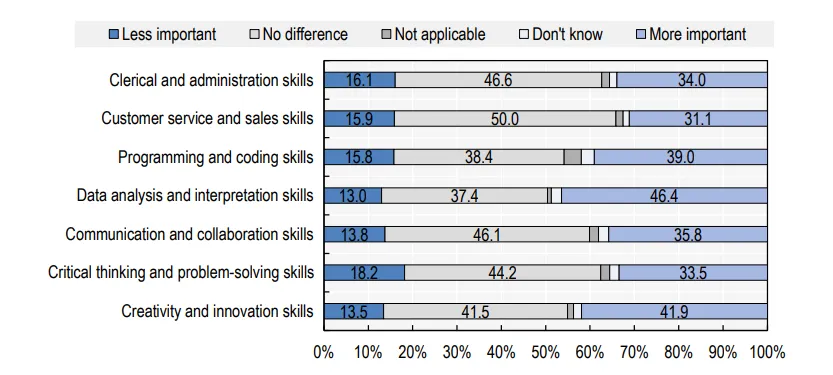
Source: OECD, Generative AI and the SME Workforce: New Survey Evidence (2025), as presented in AI and Skills: What We Know So Far (2026).
These findings offer an important insight: AI is not reducing the value of coding and technical skills. Instead, businesses increasingly need people who can combine programming knowledge with data interpretation, creativity and problem-solving.
Another important finding relates to the demand for social and emotional skills. Empathy, communication, active listening and conflict resolution remain valuable across many professions.
The real advantage lies in balancing technical expertise with human abilities. Professionals who can work with AI, think independently, and communicate effectively will be better prepared for the demands of modern workplaces.
Take your programming skills further with generative AI. Find out more about PW Skills’ Gen AI Engineering Course.
Why Do Future Careers Require More Than Coding Skills?
Coding provides a strong foundation for technology careers, but it is not enough to meet every workplace requirement. According to the OECD report, fewer than 1% of workers are expected to need advanced AI-specific skills, such as programming or AI model development.
As businesses adopt AI tools, employees must also know how to interpret data, evaluate AI-generated information, solve problems, and make informed decisions. These abilities help turn technical knowledge into practical workplace outcomes.
For example, a developer may use AI to generate code, but still needs problem-solving skills to identify errors, critical thinking to evaluate solutions, and communication skills to collaborate with a team.
Ultimately, future careers will require a combination of coding knowledge, AI literacy and human capabilities. These complementary skills help professionals use technology effectively and contribute beyond technical tasks.
What Are the 7 Most Important AI Skills Beyond Coding?
The OECD report identifies several skills that are becoming more important as generative AI enters the workplace. Here are seven capabilities worth developing:
1. Digital Literacy and AI Tool Usage
Using AI effectively starts with understanding what it can and cannot do. Digital literacy helps employees navigate technology, choose suitable tools, and apply them to everyday tasks.
You can use generative AI to organise information, summarise documents, support research and automate repetitive activities. The goal is not to become an AI expert but to know how technology can improve your work.
2. Data Analysis and Interpretation
The OECD report found that 46.4% of SMEs said generative AI had increased the importance of data analysis and interpretation skills, the highest proportion among the skills surveyed. AI can process large amounts of data, but understanding what that information means still requires human judgement.
Employees need to read reports, recognise patterns and use insights to support business decisions.
3. Critical Thinking and Problem-Solving
AI can provide answers, suggestions and possible solutions, but employees must evaluate whether these are accurate and relevant.
33.5% of SMEs said generative AI had increased the importance of critical thinking and problem-solving skills.
Critical thinking helps you question information, identify errors, and compare different viewpoints. Problem-solving allows you to apply this understanding to workplace challenges.
4. Communication and Collaboration
35.8% of SMEs reported an increased importance of communication and collaboration skills following generative AI adoption.
Communication and collaboration remain essential even when AI handles routine workplace activities. Employees need to explain ideas, share information, understand instructions and work with colleagues across teams. These abilities help ensure that technology supports teamwork and effective coordination.
5. Creativity and Innovation
AI can generate ideas, suggest alternatives and support creative tasks. However, employees still need to bring original thinking, context and fresh perspectives to their work.
41.9% of SMEs said generative AI had increased the importance of creativity and innovation skills.
Creativity helps explore different approaches, while innovation involves applying new ideas to improve processes or develop solutions.
6. Managerial and Decision-Making Skills
AI can support planning and analysis, but employees still need to decide what should be prioritised and how tasks should be completed.
Managerial skills help with organising work, coordinating responsibilities and managing deadlines. These abilities are useful not only for managers but also for professionals handling individual projects and team assignments.
The OECD identifies managerial capabilities as an important part of the skills needed in AI-enabled workplaces.
7. Adaptability and Continuous Learning
AI tools and workplace expectations are constantly evolving. Learning a new tool today may be useful, but staying relevant requires the willingness to keep updating your skills.
Continuous learning helps professionals respond to new responsibilities, technologies and career opportunities.
The OECD report highlights lifelong training and reskilling as important priorities, with employers, workers and governments sharing responsibility for improving access to relevant learning opportunities
Coding is only one part of working with AI. Find out what else employers expect from professionals in our article on AI skills employers want beyond ChatGPT.
How Can You Develop AI Skills and Prepare for Future Careers?
Knowing which skills matter is only the beginning. Developing them through practical learning and regular application is equally important.
The OECD report found that more than half of workers using AI had received employer-funded training. Workers who received training were also more likely to report positive outcomes, including better job performance and improved working conditions.
Here are six ways to start building these capabilities:
-
Explore digital tools: Learn to use AI platforms for research, communication and everyday tasks.
-
Practise data interpretation: Work with reports, charts and datasets to understand how information supports decisions.
-
Improve communication: Practise clear writing, presentations and teamwork.
-
Question AI outputs: Verify information and evaluate recommendations before applying them.
-
Keep learning: Participate in training programmes and update your skills regularly.
-
Work on practical projects: Apply your knowledge to assignments and real-world challenges.
To sum up, preparing for an AI-driven workplace does not mean everyone needs to become a programmer or AI specialist. The OECD report highlights the importance of combining digital capabilities with data interpretation, critical thinking, creativity, communication, and managerial skills.
AI can help employees process information and complete tasks more efficiently, but people still need to evaluate results, make decisions, and solve problems. Building a balance of digital and human skills, supported by continuous learning, can help you adapt to changing workplace expectations.
The future of work is not just about knowing how to use AI. It is about knowing how to work effectively with it.


Have questions about your prep?
Our experts can answer all your questions