CBSE Class 12 Chemistry Last 10 Days Revision Plan: Day-Wise Strategy
 Aarti .9 Feb, 2026
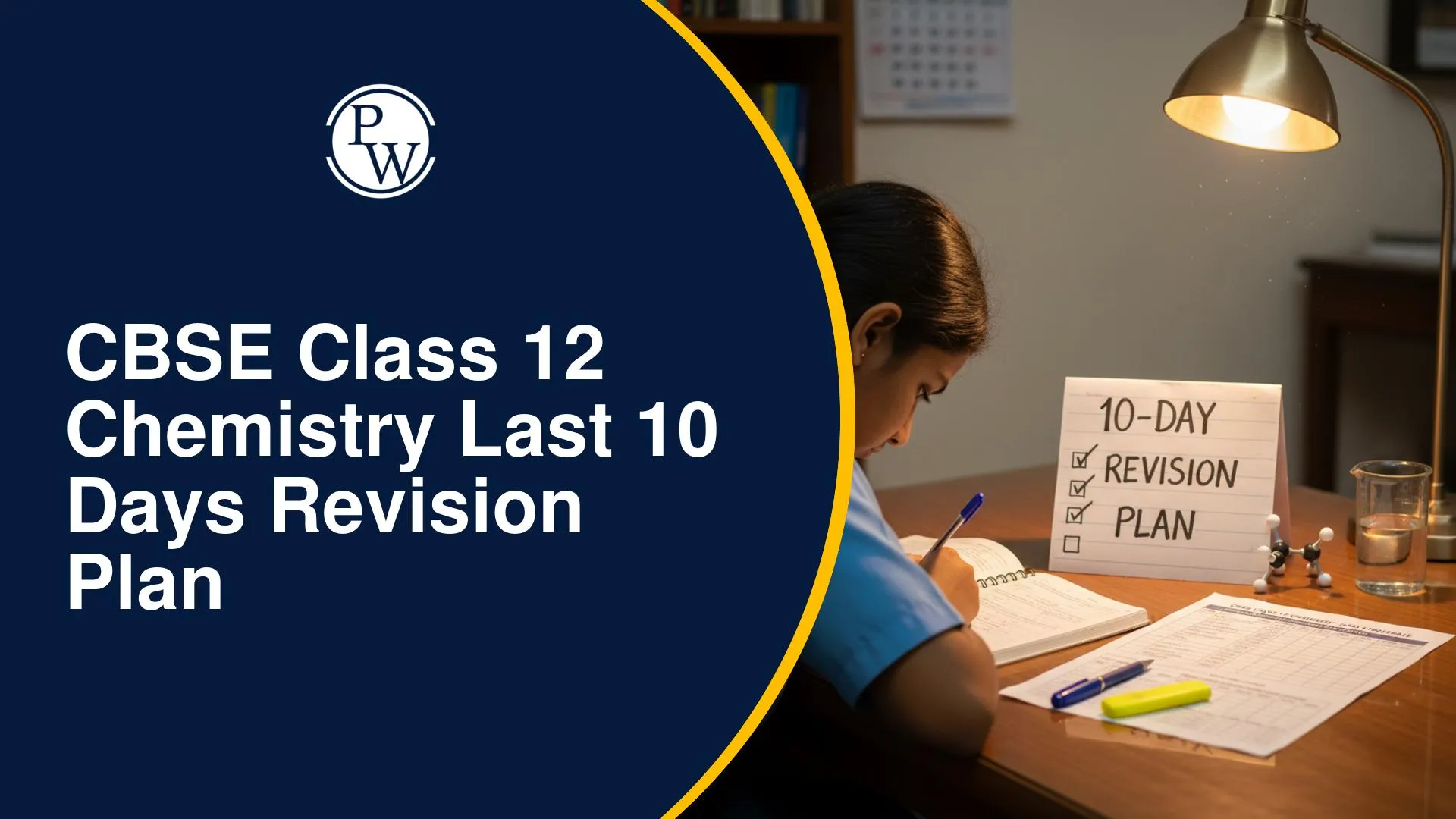
CBSE Class 12 Chemistry Last 10 Days Revision Plan: With the CBSE Class 12 Chemistry exam scheduled for February 28, 2026, the final 10 days play a decisive role in determining a student’s score.
Chemistry is a concept-based subject that demands a balanced approach to theory, numericals, reactions, and diagrams, making last-minute planning highly important.
A well-structured CBSE Class 12 Chemistry Last 10 Days Revision Plan helps students revise the entire syllabus systematically, prioritise high-weightage units, and avoid common exam mistakes. Instead of studying new topics, these final days should focus on strengthening core concepts, revising NCERT content, practicing numerical problems, and improving answer presentation.
CBSE Class 12 Chemistry Last 10 Days Study Plan
Effective planning is crucial for the final stage of exam preparation. This section outlines an effective CBSE Class 12 Chemistry last 10 days revision plan for students, covering unit weightage, daily study focus, and time management.
Unit-wise Weightage
Understanding the marks distribution guides your study priorities. Focus more on high-weightage units to maximize your score.
|
CBSE Class 12 Chemistry Unit Wise Weightage |
|
|---|---|
|
Unit Name |
Weightage (Marks)
|
|
Solutions |
7 |
|
Electrochemistry |
9 |
|
Chemical Kinetics |
7 |
|
D And F Block Elements |
7 |
|
Coordination Compounds |
7 |
|
Haloalkanes And Haloarenes |
6 |
|
Alcohols, Phenols And Ethers |
6 |
|
Aldehydes, Ketones And Carboxylic Acids |
8 |
|
Amines |
6 |
|
Biomolecules |
7 |
|
Total Marks (Theory) |
70 |
CBSE Class 12 Chemistry Day-Wise Revision Strategy
A structured day-wise approach helps cover all critical areas effectively in the last 10 days. Allocate specific topics for each day to ensure comprehensive revision.
-
Day 1: Solid State & Solutions: Prioritize numericals and formula application.
-
Day 2: Electrochemistry & Chemical Kinetics: Concentrate on numerical problem-solving.
-
Day 3: Surface Chemistry: Review definitions and practice MCQs.
-
Day 4: p-Block Elements: Study theory and essential chemical equations.
-
Day 5: d- & f-Block Elements + Coordination Compounds: Focus on diagrams, structures, and nomenclature.
-
Day 6: Haloalkanes & Haloarenes: Grasp reaction mechanisms and conversions.
-
Day 7: Alcohols, Phenols & Ethers: Master named reactions and their applications.
-
Day 8: Aldehydes, Ketones & Carboxylic Acids: Practice conversions and conceptual questions.
-
Day 9: Amines & Biomolecules: Prepare for short-answer type questions.
-
Day 10: Polymers & Chemistry in Everyday Life: Conduct a full review of all topics.
Daily Time Table for CBSE Class 12 Chemistry Exam 2026
A balanced daily time table for CBSE Class 12 Chemistry ensures productive study hours. Distribute your time wisely across different types of revision tasks.
|
Daily Time Table for CBSE Class 12 Chemistry Exam 2026 |
|
|---|---|
|
Activity |
Time (Hours)
|
|
Formula and Reaction Revision |
1 |
|
NCERT Theory Reading |
2 |
|
Numerical Practice (Physical Chemistry) |
1.5 |
|
Reaction Mechanisms & Conversions |
1.5 |
|
Previous Years’ Questions / Sample Questions |
1 |
|
Diagram, Structure & Equation Practice |
1 |
|
Total Study Time |
8 |
CBSE Class 12 Chemistry Revision Tips
Adopting smart revision strategies helps in retaining information and improving accuracy. These rules focus on high-yield areas for the CBSE Class 12 Chemistry exam.
Mastering Named Reactions
Memorize all named reactions and their reagents. These questions carry fixed marks. Practice writing them repeatedly to ensure accuracy in spelling and stoichiometry.
Numerical Problem Solving
Regularly solve numerical problems from physical chemistry. Pay close attention to formulas, units, and significant figures. This builds confidence and speed during the exam.
Accurate Structures and Equations
Practice drawing neat diagrams and correct chemical structures. Ensure all chemical equations are balanced and include reaction conditions. Presentation matters for scoring.
CBSE Class 12 Chemistry Last 10 Days Revision Plan FAQs
What is the most important part of the CBSE Class 12 Chemistry syllabus for revision?
How many hours should I study daily for CBSE Class 12 Chemistry in the last 10 days?
Should I only refer to NCERT for the last 10 days?
How can I improve my score in numerical problems?