







NCERT Solutions for Class 8 English Chapter 3 focuses on the importance of knowledge, observation, and wise decision-making in everyday life. The chapter highlights how wit and intelligence help solve problems and navigate challenging situations, as seen in stories of clever and insightful characters.
Students are encouraged to understand the difference between knowledge and wisdom—while knowledge involves learning facts and information, wisdom is the ability to use that knowledge with good judgment.
Chapter 3: Wisdom Paves the Way NCERT Solutions
The Wisdom Paves the Way chapter emphasizes the importance of knowledge, observation, and wise thinking in solving problems. It explains why we seek advice from elders, as their experience and insight help guide better decisions. The exercises distinguish between knowledge, which is learning facts, and wisdom, which is applying those facts thoughtfully. Below are the Wisdom Paves the Way Question Answers:
Wisdom Paves the Way Question Answer – Let us do these activities before we read. (Page 27)
I. Why do we seek the advice of the elderly in our family? Share your thoughts with your classmates and teacher.
Answer:
We ask for advice from the elderly in our family because they have lived through many situations and gained valuable experience. Their wisdom can guide us to make better choices and avoid mistakes. They also provide perspective and understanding that comes from years of learning and observing life.
II. Knowledge is about learning facts and information, while wisdom is about using that knowledge with good judgement.
Work in pairs. Read the following situations and classify each one as either ‘knowledge’ or ‘wisdom’. One example has been done for you.
1. Riya’s understanding of plant care helped her grow a healthy vegetable garden in her backyard.
2. Mr. Kumar values time with family over chasing wealth.
3. Karuna’s expertise in computer programming helped her develop a successful app.
4. Rohan understood the value of time management and created a timetable to complete his assignments systematically.
5. Ramesh chose to forgive his friend for a misunderstanding.
6. Ms. Vaijayanthi delivered a lecture on Indian Classical music at the cultural festival.

Answer: Riya’s understanding of plant care helped her grow a healthy vegetable garden in her backyard – this is knowledge.
-
Mr. Kumar values time with family over chasing wealth – this shows wisdom.
-
Karuna’s expertise in computer programming helped her develop a successful app – this is knowledge.
-
Rohan understood the value of time management and created a timetable to complete his assignments systematically – this demonstrates wisdom.
-
Ramesh chose to forgive his friend for a misunderstanding – this is wisdom.
-
Ms. Vaijayanthi delivered a lecture on Indian Classical music at the cultural festival – this is knowledge.
III. Observe the picture carefully. What do you think might have happened? Share your answers with your classmates and teacher.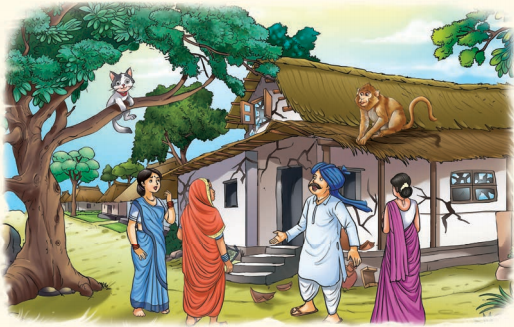
Answer:
I think the man might have lost his animal and is trying to find it. He goes to a house and sees some women standing outside. He asks them if they have seen his animal, but it seems they are unable to help him. Meanwhile, the commotion has caught the attention of a cat and a monkey, who are watching the situation unfold.
Wisdom Paves the Way Class 8 Question Answer – Let us discuss (Page 32)
I. Complete the following sentences with suitable reasons. One example has been done for you. Share your answers with your classmates and teacher.
1. Shiv Datt said, “I believe it has been over a week, perhaps even longer,” because it had been a long time since they left the village.
2. Dev Datt said, “Indeed, we ought to be united in this hope. That is why we press on towards Ujjain,” because ________.
3. Har Datt said, “Look there, friends. A camel has passed this way. The tracks are fresh,” because ________.
4. Shiv Datt said, “It appears to be a merchant, running as if pursued by trouble,” because ________.
5. The merchant said, “How could you possibly know that? The poor creature has been unwell for two weeks now. Surely you are a healer!” because ________.
6. Dev Datt said, “You are free to do as you wish, sir. If the King desires our presence, we shall be waiting under that banyan tree yonder,” because ________.
Answer:
-
Dev Datt said this because they all hoped to get employed by the King.
-
Har Datt said this because he had seen fresh camel tracks on the road.
-
Shiv Datt said this because the merchant was running fast and seemed worried.
-
The merchant said this because Dev Datt correctly guessed that the camel had stomach pain.
-
Dev Datt said this because he had nothing to fear and was ready to face the King.
Wisdom Paves the Way Class 8 Questions and Answers – Let us think and reflect (Pages 37-39)
I. Read the given extracts and answer the questions that follow.
1. Dev Datt: Ten days are but a short span in the grand scheme of things.
We may still have many more roads to wander before we find employment befitting all four of us.
Ram Datt: If only we could secure an audience with the King of Ujjain.
I am confident he would recognise our talents and appoint us to his service.
Shiv Datt: I share your belief.
Dev Datt: Indeed, we ought to be united in this hope. That is why we press on towards Ujjain.
Har Datt: (Pausing thoughtfully) Gaining an audience with the King is no simple task. We need to devise a strategy.
(i) Identify the false statement from the two given below and rectify it.
A. Dev Datt believes that finding employment is an easy task.
B. Ram Datt is confident that the King would recognise their talents.
Answer:
False Statement – A.
(ii) What does Ram Datt’s confidence in gaining the King’s recognition tell us about him?
Answer:
Ram Datt’s confidence in gaining the King’s recognition shows that he is self-assured, optimistic, and trusts in his own abilities to make correct observations and impress others.
(iii) Complete the sentence given below with the correct option from those given.
In the line, ‘That’s why we press on towards Ujjain’, the phrase ‘press on’ refers to ________
A. walking with heavy steps
B. moving forward with determi¬nation
C. slowing down frequently for rest
D. stopping briefly to save time
Answer:
B. moving forward with determination
(iv) Har Datt says, “We need to devise a strategy.” What can be inferred about Har Datt’s character from his statement?
A. He is doubtful of their abilities and wants to give up.
B. He is eager to rush into the palace without preparation.
C. He is cautious and thoughtful, preferring to plan ahead.
D. He relies on others to make decisions for the group.
Answer:
C. He is cautious and thoughtful, preferring to plan ahead.
2. King: (To the four men)
You have demonstrated remarkable intelligence and the ability to see beyond the obvious. Such minds are rare and highly valued in my court. I extend to you the honour of becoming my advisers. Your counsel shall guide my decisions, and your wisdom shall be a beacon for my kingdom. What do you say to my offer?
Ram Datt: (Stepping forward) Your Highness, it is an honour we had not dared to dream of.
(i) Select the option that is true for both Assertion (A) and Reason (R).
(A): The merchant left the court feeling humbled and ashamed.
(R): The King commanded that the four wise men join his court.
A. Both (A) and (R) are true, and (R) is the correct explanation of (A).
B. Both (A) and (R) are true, but (R) is not the correct explanation of (A).
C. (A) is true, but (R) is false.
D. (A) is false, but (R) is true.
Answer:
A. Both (A) and (R) are true, and (R) is the correct explanation of (A).
(ii) Complete the following sentence by choosing the correct option.
The line, ‘See beyond the obvious’ means that the men had the ability to ________
A. challenge common beliefs with reasoning
B. interpret information in traditional ways
C. notice details that others might overlook
D. predict what is going to happen in the future
Answer:
C. notice details that others might overlook
(iii) Complete the following sentence with a suitable reason.
Ram Datt described the King’s offer as ‘an honour we had not dared to dream of because ________
Answer:
Ram Datt described the King’s offer as ‘an honour we had not dared to dream of’ because he had never imagined receiving such recognition and respect from the King.
(iv) How does the King’s offer to the four men reflect his values as a ruler?
Answer:
The King’s offer to the four men reflects his values as a ruler because it shows he appreciates skill, keen observation, intelligence, and fairness in rewarding those who demonstrate wisdom and capability.
II. Answer the following questions.
Question 1.
What does the dusty road leading to Ujjain tell us about the challenges of the young men’s journey?
Answer:
The dusty road leading to Ujjain indicates that the young men faced a long and tiring journey, full of hardships and obstacles along the way.
Question 2.
Why did the merchant become suspicious of the four men? What does this tell us about him?
Answer:
The merchant became suspicious because the four men knew so many details about his camel without having seen it. This shows that he was cautious and perhaps quick to doubt, unable to recognize their skill and intelligence at first.
Question 3.
How do the four young men’s observations about the camel serve as a turning point in the play?
Answer:
The four young men’s detailed observations about the camel show their sharp thinking and cleverness, which impresses the King and changes the course of events in the play.
Question 4.
Why did the King believe the four young men and not the merchant?
Answer:
The King trusted the four men over the merchant because their explanations were precise, well-reasoned, and based on evidence, unlike the merchant’s claims.
Question 5.
How does the capability of the four young men make them suitable to become advisors?
Answer:
The four young men’s intelligence, keen observation, and ability to solve problems show that they are wise and trustworthy, making them fit to guide the King.
Question 6.
Why does the merchant feel ashamed for accusing the four young men of stealing his camel? Explain in your own words.
Answer:
The merchant feels embarrassed because he realized that he wrongly suspected the men, who had only shown their cleverness and honesty.
Wisdom Paves the Way Question Answer Class 8 – Let us learn (Pages 39-42)
Complete the sentences by Ailing in the noun form of the textual words given in the brackets.
1. Some word games need a lot of thought and ________ (deduce)
2. We need to make close ________ of animals in order to understand their behaviour, (observe)
3. A detailed ________ of the documents shows a lot of errors, (scrutinise)
4. You should not make any false ________ against anyone, (accuse)
5. She was given an award in ________ of her contribution to literature, (recognise)
Answer:
1. deduction
2. observation
3. scrutiny
4. accusation
5. recognition
II. Match the expressions in Column 1 with their meanings in Column 2.
|
Column 1 |
Column 2 |
|
1. with all our hearts |
(i) surprised |
|
2. to be precise |
(ii) starts cheering together |
|
3. gain an audience with |
(iii) hidden information that is not obvious |
|
4. catch his breath |
(iv) exact and accurate |
|
5. erupts in applause |
(v) meeting or hearing someone |
|
6. grand scheme of things |
(vi) complete sincerity |
|
7. taken aback |
(vii) to pause or rest for some time |
|
8. more than meets the eye |
(viii) overall plan of life in a larger context |
Answer:
|
Column 1 |
Column 2 |
|
1. with all our hearts |
(vi) complete sincerity |
|
2. to be precise |
(iv) exact and accurate |
|
3. gain an audience with |
(v) meeting or hearing someone |
|
4. catch his breath |
(vii) to pause or rest for some time |
|
5. erupts in applause |
(ii) starts cheering together |
|
6. grand scheme of things |
(viii) overall plan of life in a larger context |
|
7. taken aback |
(i) surprised |
|
8. more than meets the eye |
(iii) hidden information that is not obvious |
Now, make sentences using any five of the expressions from Column 1.
Answer:
With all our hearts: We helped the charity with all our hearts.
-
To be precise: The event starts at 6 p.m., to be precise.
-
Gain an audience with: The young lawyer worked hard to gain an audience with the judge.
-
Catch his breath: After climbing the hill, he paused to catch his breath.
-
Taken aback: She was taken aback when her friends threw her a surprise birthday party.
III. Match the different meanings of‘face’ and ‘bear’ with the correct usage in the sentences given in the table below, (n. stands for the word noun and v. stands for the word verb.)
|
Words |
Meanings |
Sentences |
|
face |
1. (n.) the front part of a person’s head from the forehead to the chin |
(i) Ravi turned to face his father, when he was called. |
|
2. (v..) to be positioned with the face or front towards |
(ii) The face of the clock was painted red and blue. |
|
|
3. (v.) to deal with a difficult task or situation |
(iii) She has a round, smiling face. |
|
|
4. (n.) the front or surface of a thing |
(iv) We should be ready to face life’s challenges. |
|
|
bear |
1. (v.) tolerate |
(i) The trees that I planted in my garden took a lone time to bear fruit. |
|
2. (v.) accept |
(ii) I spotted a bear on a wildlife safari. |
|
|
3. (n.) a large, heavy mammal |
(iii) Riva aereed to bear the responsibilities with confidence. |
|
|
4. (v.) produce; give birth to |
(iv) I can’t bear the sound of vehicles honking. |
Answer:
Face: 1. (iii) 2. (i) 3. (iv) 4. (ii)
Bear: 1. (iv) 2. (iii) 3. (ii) 4. (i)
IV. Match the highlighted words in the sentences in Column 1 with the functions they express in Column 2.
|
Column 1 |
Column 2 |
|
1. I will gladly pay your fee if you can cure it. |
(i) expression of disbelief |
|
2. You must have stolen it and sold it off. |
(ii) imagined (hypothetical) possibility |
|
3. You shall come with me to face the King! |
(iii) moral obligation or advice |
|
4. How could you possibly know that? |
(iv) challenge |
|
5. I am confident he would recognise our talents and appoint us to his service. |
(v) logical conclusion |
|
6. A camel with a long tail would have fended off these pests with ease. |
(vi) wish or hope |
|
7. They may tell us more than meets the eye. |
(vii) necessity |
|
8. May your wisdom shine upon Ujyain and guide us to prosperity. |
(viii) prediction |
|
9. Indeed, we ought to be united in this hope. |
(ix) willingness |
|
10. We need to devise a strategy. |
(x) command |
|
11. You speak of my camel as if it stood before you, yet you dare to claim not to have seen it! |
(xi) possibility |
Answer:
|
Column 1 |
Column 2 |
|
1. I will gladly pay your fee if you can cure it. |
(viii) prediction |
|
2. You must have stolen it and sold it off. |
(vii) necessity |
|
3. You shall come with me to face the King! |
(x) command |
|
4. How could you possibly know that? |
(iv) challenge |
|
5. I am confident he would recognise our talents and appoint us to his service. |
(v) logical conclusion |
|
6. A camel with a long tail would have fended off these pests with ease. |
(ii) imagined (hypothetical) possibility |
|
7. They may tell us more than meets the eye. |
(xi) possibility |
|
8. May your wisdom shine upon Ujyain and guide us to prosperity. |
(vi) wish or hope |
|
9. Indeed, we ought to be united in this hope. |
(iii) moral obligation or advice |
|
10. We need to devise a strategy. |
(ix) willingness |
|
11. You speak of my camel as if it stood before you, yet you dare to claim not to have seen it! |
(i) expression of disbelief |
V. Complete the following story with modal verbs in the box given below by using the clues from the functions given within brackets.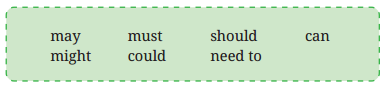
An old man, known for his wisdom, lived in a small village. One day, a young boy asked him, “How 1. _______ (ability) I become wise like you?” The old man smiled and said, “Wisdom 2._______ (necessity) be earned through patience. You 3. _______ (suggestion) listen, more than you speak.” The boy thought for a while and replied, “It 4. _______ (weak possibility) take years, but I’ll try.” The old man nodded. “You 5._______ (obligation) learn from your mistakes too. Wisdom 6. _______ (possibility)
come slowly, but it always arrives for those who seek it.” The boy knew he 7. _______ (ability) become wise if he followed the old man’s advice.
Answer:
1. can
2. must
3. should
4. might
5. need to
6. may
7. could
VI. Rewrite the following sentences using appropriate modal verbs.
You may take clues from the highlighted words. One example has been done for you.
1. It is advisable for you to think before you speak.
You should think before you speak.
2. It is unnecessary to worry about things beyond your control.
3. It is not possible for a person to gain experience without taking risks.
4. It is essential to treat others with kindness, even when they disagree with you.
5. It is not allowed to interrupt when someone else is speaking.
Answer:
You need not worry about things beyond your control.
-
You cannot gain experience without taking risks.
-
You must treat others with kindness, even if they disagree with you.
-
You must not interrupt when someone else is speaking.
Class 8 English Chapter 3 Question Answer – Let us listen (Page 42)
I. You will listen to four people sharing their thoughts on why they enjoy witty characters in stories. As you listen, match statements 1–6 given below to the speakers (i)–(iv). There are two statements you do not need. (Transcript for teacher on page 48)
Speaker (i): I love witty characters because they make serious situations funny! Even when things seem tense, they always have a clever response. Such characters never panic, think fast, and solve problems in the smartest way. I wish I could think that quickly!
Speaker (ii): Witty characters are the best because they make stories exciting. I especially like how they turn ordinary moments into something memorable. It makes me feel like intelligence and humour are just as powerful as strength.
Speaker (iii): I enjoy witty characters because they always have an answer for everything! They use humour instead of fighting, and that’s really wonderful. Even in folktales, they prove that smart thinking can win over force. It makes me laugh but also teaches me to stay calm in tricky situations.
Speaker (iv): Witty characters add charm to a story. Their intelligence keeps the reader engaged, and their humour makes learning fun. Whether it’s a folktale or a modern one, a clever character always stands out. I often feel that wit and wisdom go hand-in-hand!
|
Statements |
Speaker No. |
|
1. Witty characters prove that cleverness is as powerful as strength. |
|
|
2. Witty characters show us ways to make learning enjoyable. |
|
|
3. Witty characters in a story keep the reader involved. |
|
|
4. Witty characters teach me that tricky situations can be managed calmly. |
|
|
5. Witty characters add excitement to a story by their extraordinary deeds. |
|
|
6. Witty characters can deactivate tense situations with their cleverness. |
Answer:
1. (ii)
2. (iv)
3. (iv)
4. (iii)
5. (ii)
6. (i)
NCERT Class 8 English Poorvi Chapter 3 Question Answer – Let us speak (Page 43)
I. The way in which a word is stressed in a sentence can change its meaning.
Read the following examples.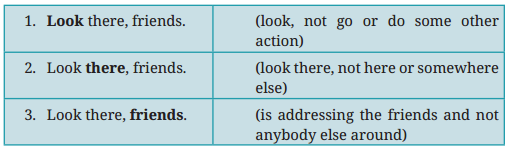
Now, work in pairs. Take turns to say the following sentences aloud by stressing on the highlighted words. Share the meanings of the sentences with each other and teacher.
I take my dog for a walk in the evening.
Answer:
I take my dog for a walk in the evening.
Emphasizes that you, not someone else, take the dog for a walk.
-
I take my dog for a walk in the evening.
Emphasizes the action of taking—not feeding, playing, or doing anything else. -
I take my dog for a walk in the evening.
Emphasizes that it’s your dog, not someone else’s dog. -
I take my dog for a walk in the evening.
Emphasizes the type of activity—a walk, not a run, ride, or drive. -
I take my dog for a walk in the evening.
Emphasizes the time of the walk—not morning or afternoon.
Class 8th English Chapter 3 Wisdom Paves the Way Question Answer – Let Us Write (Page 44)
I. You have observed that the kutcha road leading to your colony is in a very bad condition due to heavy rains. The potholes f are dangerous for people and can lead to
accidents. They also serve as a breeding ground for mosquitoes as there is stagnant water all around.
Write a letter of complaint to the Commissioner, Municipal Corporation or the Sarpanch, Gram Panchayat to look into the matter and take necessary action.
Follow the format of a formal letter and draft the letter with the help of cues given below.
|
Body of the Letter |
Useful Phrases |
|
Paragraph 1: state the purpose of writing, and the issue |
|
|
Paragraph 2: give details and consequences of the problem |
|
|
Paragraph 3: give suggestions and request for swift action |
|
Answer:
B-14, Green Valley Apartments
Himagiri Nagar
Bengaluru – 560102
8 April 20XX
To
The Commissioner
Bruhat Bengaluru Mahanagara Palike (BBMP)
Bengaluru – 560001
Subject: Complaint regarding the poor condition of the kutcha road in our colony
Respected Sir/Madam,
I am writing to draw your attention towards the extremely poor condition of the kutcha road leading to our colony. Due to the recent heavy rains, the road has developed large potholes, and stagnant water has collected in many places, making it dangerous for pedestrians and vehicles alike.
The potholes are causing damage to vehicles and increasing the risk of accidents, especially for children and the elderly. Moreover, the stagnant water is serving as a breeding ground for mosquitoes, raising the risk of vector-borne diseases like dengue and malaria. Consequently, the residents are facing significant inconvenience and health hazards.
I kindly request you to take immediate action. Firstly, the road should be repaired and, if possible, converted into a pucca road. Secondly, proper drainage facilities should be ensured to prevent future waterlogging. I look forward to your prompt and positive response to resolve this matter.
Thank you.
Yours faithfully,
Ashi Gupta
Wisdom Paves the Way Class 8 NCERT Solutions – Let us explore (Pages 44-45)
Read the steps to enact a play, from : [NCERT Textbook Pages 44-45.]
I. Staging a play requires creativity, organisation, and teamwork.
Answer:
To stage a play successfully, everyone must work together, plan carefully, and use creativity. Perform the play in front of an audience with proper expression, gestures, and intonation to bring the story to life.
II. Stories related to wit and wisdom have always fascinated the readers. Go to the library and read the stories associated with the following.
Vikramaditya and Betal — Tenali Rama
Gopal the Jester — Panchatantra Tales
“Let knowledge be the beacon that ; dispels the darkness of ignorance”. Savitribai Phule
“The highest education is that which : does not merely give us information but | that makes our life in harmony with all ; existence”. Rabindranath Tagore
Answer:
Savitribai Phule’s quote means that knowledge helps us overcome ignorance and guides us toward understanding and truth. Rabindranath Tagore’s quote emphasizes that true education is not just about collecting information, but about learning to live wisely, peacefully, and in harmony with everyone and everything around us. Together, these quotes teach us that learning should enlighten our mind and improve our life.
Benefits of Using NCERT Solutions for Class 8 English Chapter 3
Here are the benefits of using NCERT Solutions for Class 8 English Chapter 3:
-
Clear Understanding of Concepts – The solutions explain the chapter in simple and easy-to-understand language, helping students grasp key ideas about wisdom, knowledge, and reasoning.
-
Step-by-Step Answers – They provide structured, step-by-step solutions for all exercises, making it easier to learn how to frame answers correctly.
-
Saves Time – With ready solutions, students can quickly revise and practice without spending too much time figuring out how to answer each question.
-
Improves Exam Preparation – The solutions cover all types of questions, including short answers, long answers, and application-based questions, which builds confidence for exams.
-
Enhances Language Skills – They help improve grammar, sentence formation, vocabulary, and comprehension through exercises like writing letters, using expressions, and stressing words correctly.
-
Builds Critical Thinking – The chapter encourages students to analyze situations, observe carefully, and apply knowledge wisely, and the solutions guide them in understanding this process effectively.
-
Boosts Confidence – By practicing with accurate solutions, students can be more confident in attempting questions on their own during tests or exams.
-
Moral and Life Lessons – Besides academics, the solutions highlight values like honesty, patience, and careful observation, helping students learn important life skills.