







PW Class 6 Science Chapter 7: Temperature and Its Measurement Important Questions
 Gunika Shah29 Aug, 2026
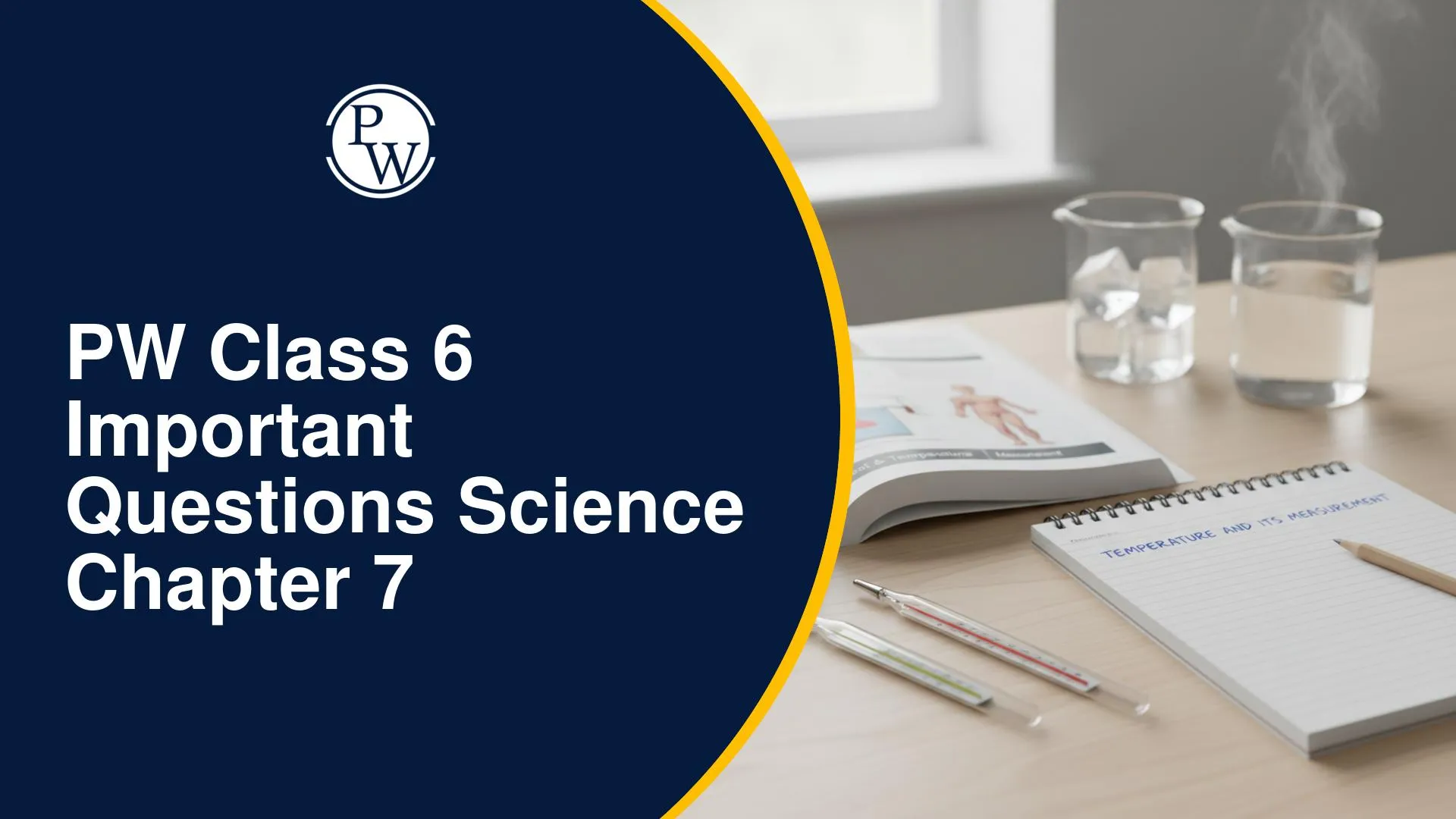
Touch can give you a general idea of whether something feels hot or cold, but it cannot provide an accurate temperature. Temperature and Its Measurement introduces thermometers as reliable measuring instruments and explains why different types of thermometers are used for different purposes.
PW Class 6 Science Chapter 7 Important Questions help students practise these ideas through conceptual and application-based questions. The selected questions below cover thermometer use and safety, temperature scales, clinical and laboratory thermometers, digital thermometers, and an experiment involving the heating of different liquids.
Temperature and Its Measurement: Important Questions for Practice
The PW practice material covers temperature measurement through MCQs, Assertion-Reason, matching, thermometer safety, comparisons, and application-based questions. Start with the objective questions and use the later questions for independent written practice.
Check Your Concepts with Objective Questions
1. Which of the following substance is cold?
(A) Hot soup
(B) Tap water
(C) Cookies
(D) Ice cream
Answer: (D) Ice cream
2. What will happen if a clinical thermometer is used to measure hot water?
(A) Nothing will happen
(B) Thermometer will give accurate reading
(C) Thermometer may burst
(D) It will cool down the water
Answer: (C) Thermometer may burst
3. Beaker A contains hot water. Beaker B contains cold water. Beaker C contains a mixture of hot and cold water. If initially your hand is put into a beaker containing ice, then putting your hand in which of the beakers A, B or C will give a sensation of warmth?
(A) A
(B) B
(C) C
(D) All of the above
Answer: (D) All of the above
4. Assertion (A): A digital thermometer shows temperature in digits.
Reason (R): It does not have mercury.
(A) Both A and R are true and R is the correct explanation of A.
(B) Both A and R are true but R is not the correct explanation of A.
(C) A is true but R is false.
(D) A is false but R is true.
Answer: (B) Both A and R are true but R is not the correct explanation of A.
5. Which out of the following is reliable to measure hotness or coldness of an object?
(A) Sense of vision
(B) Sense of touch
(C) Measuring temperature
(D) Both b and c
Answer: (C) Measuring temperature
6. Match the following:
|
Column A |
Column B |
|
A. 0°C |
1. Boiling point of water |
|
B. 100°C |
2. Freezing point of water |
|
C. 37°C |
3. Normal body temperature |
|
D. 25°C |
4. Equivalent to 37°C |
|
E. 98.6°F |
5. Approx. room temperature |
(A) A-1, B-2, C-3, D-4, E-5
(B) A-2, B-1, C-3, D-5, E-4
(C) A-1, B-3, C-2, D-4, E-5
(D) A-1, B-2, C-4, D-3, E-5
Answer: (B) A-2, B-1, C-3, D-5, E-4
7. How can we correctly judge whether an object is hot or cold?
(A) By touching it with the back of our hand
(B) By looking at its colour
(C) By measuring its temperature with a thermometer
(D) By asking someone else
Answer: (C) By measuring its temperature with a thermometer
8. Which substance was traditionally used in thermometers but is now avoided due to toxicity?
(A) Alcohol
(B) Mercury
(C) Water
(D) Glycerin
Answer: (B) Mercury
9. Assertion (A): A clinical thermometer can measure the temperature of boiling water.
Reason (R): Clinical thermometer has a range of 35°C to 42°C.
(A) Both A and R are true and R is the correct explanation of A.
(B) Both A and R are true but R is not the correct explanation of A.
(C) A is true but R is false.
(D) A is false but R is true.
Answer: (D) A is false but R is true.
10. What should be avoided when handling a laboratory thermometer?
(A) Holding it by the bulb
(B) Immersing it in the substance
(C) Reading it at eye level
(D) Keeping it vertical
Answer: (A) Holding it by the bulb
11. What is the difference between clinical and laboratory thermometers?
12. Explain why mercury or alcohol is used in thermometers instead of water.
13. What are the main differences between Celsius and Fahrenheit scales?
14. During a classroom experiment, two beakers containing equal amounts of water and oil are heated on identical burners. Thermometers are placed in both. After 5 minutes, it is observed that the temperature of oil rises faster than that of water. Explain the reason for this difference in temperature rise and state the conclusion of this experiment.
15. How can a digital thermometer be used and what is its advantage?
Temperature and Its Measurement Important Questions PDF
PW provides the Class 6 Science Chapter 7 Important Questions PDF for students who want to practise more questions from Temperature and Its Measurement. The complete set includes MCQs, Assertion-Reason questions, matching, comparisons, explanations, and experiment-based questions.
Class 6 Important Questions Science Chapter 7 PDF
Study without using the internet
Complete Class 6 Science Resources from PW
Students can use these PW resources along with Chapter 7 important questions to revise concepts, work through textbook exercises, and practise different question formats:
-
Class 6 Science Syllabus – Check the complete Science syllabus and plan chapter-wise revision.
-
Class 6 Science Notes – Revise important concepts and definitions from each Science chapter.
-
Class 6 Science Sample Papers – Test preparation through mixed-chapter and exam-style questions.
-
Class 6 Science NCERT Solutions – Refer to chapter-wise solutions while working through textbook exercises.
-
Class 6 Science Important Questions – Continue practising important questions from other chapters after completing Temperature and Its Measurement.
The PW Class 6 Science Chapter 7 Important Questions give students practice with temperature, thermometer types, temperature scales, safe measurement, and everyday applications. Working through both objective and descriptive questions can strengthen understanding of Temperature and Its Measurement. Students can then use PW Class 6 Science resources for further revision and practice.
Class 6 Important Questions Science Chapter 7 FAQs
1. What are the important topics in Class 6 Science Chapter 7?
2. What is the range of a clinical thermometer?
3. Why should a clinical thermometer not be used for boiling water?
4. How are clinical and laboratory thermometers different?






 Live & recorded classes available at easeDashboard for progress trackingMillions of practice questions at your fingertips

