

Class 10 Maths Chapter 3 Pair of Linear Equations in Two Variables Exercise 3.1 NCERT Solutions
 Ananya Gupta23 Nov, 2025
NCERT Solutions for Class 10 Maths Chapter 3 Exercise 3.1 introduces you to pairs of linear equations in two variables through graphical methods. The exercise explains how to plot equations on a coordinate plane and interpret the point of intersection as the solution, which is an important concept in the CBSE Class 10th syllabus. These step-by-step NCERT solutions will help you understand different cases, such as intersecting lines, parallel lines, and coincident lines.
NCERT Solutions for Class 10 Maths Chapter 3 Exercise 3.1
Q.1 Form the pair of linear equations in the following problems, and find their solutions graphically.
(i) 10 students of class X took part in a mathematics quiz. If the number of girls is 4 more than the number of boys, find the number of boys and girls who took part in the quiz.
(ii) 5 pencils and 7 pens together cost Rs 50, whereas 7 pencils and 5 pens together cost Rs. 46. Find the cost of one pencil and that of one pen.
Answer:
(i) Let number of boys = x Let number of girls = y According to given conditions, we have x + y = 10 And, x = 10 - y putting y=0,5,10,we get, X=10-0=10 X=10-5=5, X=10-10=0
| x | 10 | 5 | 0 |
| y | 0 | 5 | 10 |
Number of girls is 4 more than number of boys ........Given, so, Y=x+4 putting x=-4,0,4 we get, Y=-4+4=0 Y=0+4 Y=4+4=8
| x | -4 | 0 | 4 |
| y | 0 | 4 | 8 |
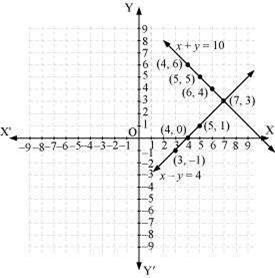
We plot the points for both of the equations to find the solution. (ii) Let the cost of one pencil=Rs.X and Let the cost of one pen=Rs.Y According to the given conditions, we have: =5x + 7y = 50 =5x=50-7y =x=10-7/5y
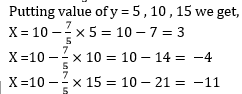
Three solutions of this equation can be written in a table as follows:
| x | 3 | -4 | -11 |
| y | 5 | 10 | 15 |
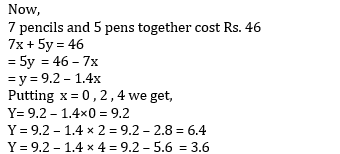
Three solutions of this equation can be written in a table as follows:
| x | 0 | 2 | 4 |
| y | 9.2 | 6.4 | 3.6 |
The graphical representation is as follows: 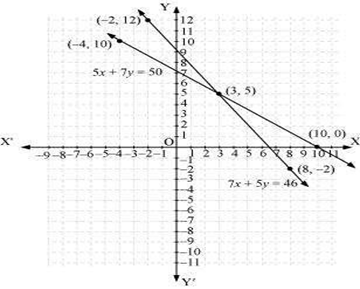
2. On comparing the ratios a 1 /a 2 ,b 1 /b 2 and c 1 /c 2 , find out whether the lines representing the following pairs of linear equations intersect at a point, are parallel or coincident:
(i) 5x − 4y + 8 = 0
(ii)9x + 3y + 12 = 0 7x + 6y – 9 = 018x + 6y + 24 = 0
(iii) 6x − 3y + 10 = 0 2x – y + 9 = 0
Answer:
(i) 5x − 4y + 8 = 0, 7x + 6y – 9 = 0 Comparing equation 5x − 4y + 8 = 0 with a 1 x + b 1 y + c 1 = 0and 7x + 6y – 9 = 0 with a 2 x + b 2 y + c 2 = 0,
We get, 
Hence, 
we find that,
(ii) 9x + 3y + 12 = 0, 18x + 6y + 24 = 0 Comparing equation 9x + 3y + 12 = 0 with a 1 x + b 1 y + c 1 = 0and 7x + 6y – 9 = 0 with a 2 x + b 2 y + c 2 = 0,
We get,
Hence 
We find that,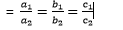 Hence, lines are coincident.
(iii) 6x − 3y + 10 = 0, 2x – y + 9 = 0 Comparing equation 6x − 3y + 10 = 0 with a 1 x + b 1 y + c 1 = 0and 7x + 6y – 9 = 0 with a 2 x + b 2 y + c 2 = 0,
We get, 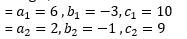
Hence
We find that, 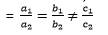 Hence, lines are parallel to each other.
3. On comparing the ratios a 1 /a 2 ,b 1 /b 2 and c 1 /c 2 , find out whether the following pair of linear equations are consistent, or inconsistent.
(i) 3x + 2y = 5, 2x − 3y = 8
(ii) 2x − 3y = 7, 4x − 6y = 9
(iii) 3x/2 + 5y/3 = 7, 9x − 10y = 14
(iv) 5x − 3y = 11, −10x + 6y = −22
Answer:
(i) 3x + 2y = 5, 2x − 3y = 7
Comparing equation 3x + 2y = 5 with a 1 x + b 1 y + c 1 = 0and 7x + 6y – 9 = 0 with a 2 x + b 2 y + c 2 = 0,
We get,

Hence,  Therefore these linear equations will intersect at one point only and have only one possible solution.
And, a pair of linear equations is consistent
(ii) 2x − 3y = 8, 4x − 6y = 9.
Comparing equation 2x − 3y = 8 with a 1 x + b 1 y + c 1 = 0and 7x + 6y – 9 = 0 with a 2 x + b 2 y + c 2 = 0,
We get,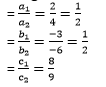
Hence, 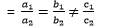
Therefore, these linear equations are parallel to each other and have no possible solution.In, a pair of linear equations is inconsistent
(iii)
 9x − 10y = 14
We get,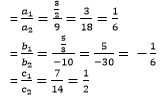
Hence,
Therefore, these linear equations will intersect each other at one point and have only one possible solution.
(iv) 5x − 3y = 11, −10x + 6y = −22
Comparing equation 5x − 3y = 11 with a 1 x + b 1 y + c 1 = 0and 7x + 6y – 9 = 0 with a 2 x + b 2 y + c 2 = 0, We get,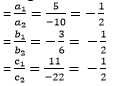
Hence,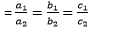
Therefore, this pair of lines has an infinite number of solutions
4. Which of the following pairs of linear equations are consistent/inconsistent? If consistent, obtain the solution graphically:
(i) x + y = 5, 2x + 2y = 10
(ii) x – y = 8, 3x − 3y = 16
(iii) 2x + y = 6, 4x − 2y = 4
(iv) 2x − 2y – 2 = 0, 4x − 4y – 5 = 0
Answer:
(i) x + y = 5, 2x + 2y = 10 We get, 
Hence,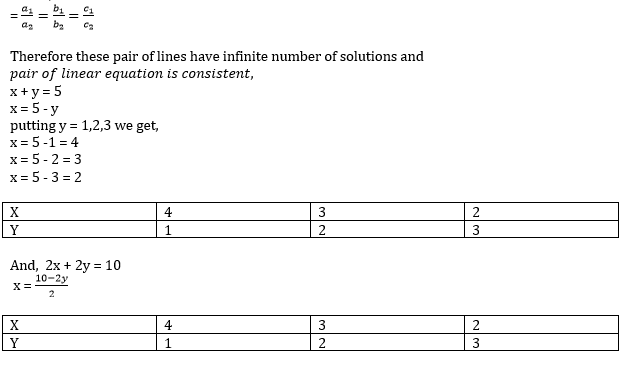
(ii) x – y = 8, 3x − 3y = 16
We get, Hence,
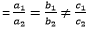 Therefore, these linear equations intersect each other at one point and thus have only one possible solution. Hence,the pair of linear equations is inconsistent.
(iii) 2x + y = 6, 4x − 2y = 4
We get,
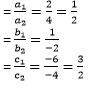 Hence,
Therefore, these linear equations are intersecting each other at one point and thus have only one possible solution. Hence the pair of linear equations is consistent
(iv) 2x − 2y – 2 = 0, 4x − 4y – 5 = 0
We get,
Hence,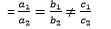
Therefore, these linear equations are parallel to each other and have no possible solution, Hence,the pair of linear equations is inconsistent.
5. Half the perimeter of a rectangular garden, whose length is 4 m more than its width, is 36 m. Find the dimensions of the garden.
Answer:
Let width of rectangular garden = x metres and length=y So,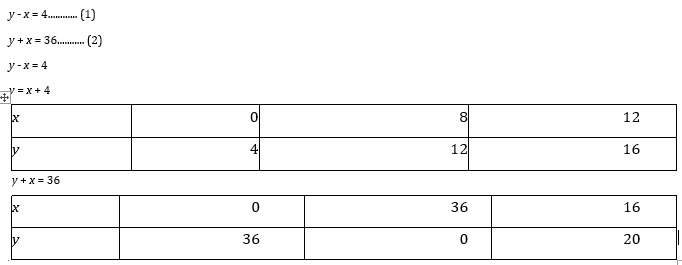 Hence, the graphic representation is as follows.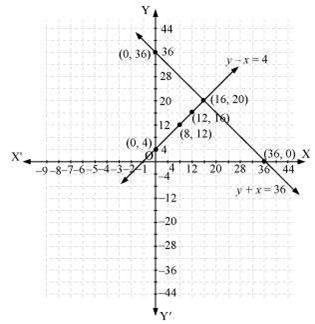
6. Given the linear equation (2x + 3y – 8 = 0), write another linear equation in two variables such that the geometrical representation of the pair so formed is:
(i) Intersecting lines
(ii) Parallel lines
(iii) Coincident lines
Answer:
(i) Let the second line be equal to a 2 x + b 2 y + c 2 = 0, Intersecting Lines: For this Condition, The Second line such that it is intersecting the given line is 2x+4y-6=0 As,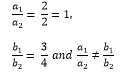
(ii) Let the second line be equal to a 2 x + b 2 y + c 2 = 0, parallel Lines: For this Condition,  hence, the second line can be 4x+6y-8=0 As,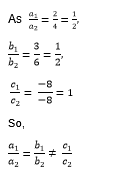
(iii) Let the second line be equal to a 2 x + b 2 y + c 2 = 0, Coincident lines: For coincident lines,  hence, the second line can be 6x+9y-24=0 As,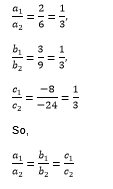
7. Draw the graphs of the equations x – y + 1 = 0 and 3x + 2y – 12 = 0. Determine the coordinates of the vertices of the triangle formed by these lines and the x-axis, and shade the triangular region.
Answer:
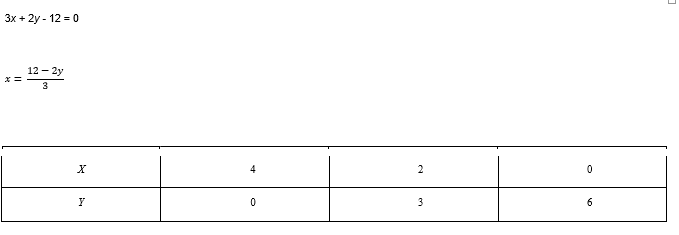
For equation x – y + 1 = 0, we have the following points which lie on the line For equation 3x + 2y – 12 = 0,
We have the following points which lie on the line
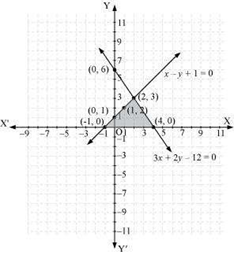
We can see from the graphs that points of intersection of the lines with the x–axis are (–1, 0), (2, 3) and (4, 0).
How to Score Better in Class 10 Maths Exam?
Scoring well in Class 10 Maths requires clear concepts, regular practice, and a focus on accuracy and answer presentation. To score better, you should:
-
Build Strong Concepts:
Focus on understanding concepts in Class 10 Maths instead of memorising steps, as this helps in solving application-based questions.
-
Practise Regularly:
Solve all CBSE Class 10 NCERT questions multiple times to strengthen your basics and improve accuracy.
-
Revise Formulas Daily:
Regular revision of PW Class 10 Maths MIQs helps avoid calculation mistakes in exams.
-
Solve Previous Year Papers:
Practising CBSE Class 10 Maths previous year questions (PYQs) helps you understand question patterns and important topics.
-
Attempt Sample Papers:
Solving PW Class 10 Maths sample papers improves time management and gives you exam-like practice.
-
Work on Weak Areas:
Focus on difficult topics from the Class 10 Maths syllabus instead of skipping them to avoid losing marks.
Explore Related Chapters
NCERT Solutions for Class 10 Maths Chapter 3 Exercise 3.1 FAQs
What is a pair of linear equations in two variables?
How do I solve a pair of linear equations in two variables?
What is the graphical method for solving these equations?
Can a pair of linear equations have no solution?