







What Are El Nino and La Nina, Meaning, Difference
El Nino and La Nina are two crucial phases of the El Nino-Southern Oscillation. El Nino and La Nina influence global weather patterns, including the Indian monsoon.
 Deeksha Dixit17 Dec, 2024
El Nino and La Nina are key climatic events that significantly impact weather patterns worldwide, particularly in India. El Nino tends to weaken the Indian monsoon, leading to droughts, while La Nina strengthens the monsoon, bringing much-needed rainfall.
The India Meteorological Department predicts the development of La Nina by late 2024 or early 2025 , which could result in a milder winter due to the delay. Understanding El Nino and La Nina phenomena is crucial for UPSC aspirants to answer questions in geography and environmental science.El Niño-Southern Oscillation
The El Niño-Southern Oscillation (ENSO) is a large-scale climate phenomenon in the Pacific Ocean that alternates between the warm phase (El Nino) and the cold phase (La Nina). The periodic fluctuations in sea surface temperatures and air pressure across the Pacific Ocean characterize ENSO. The Southern Oscillation refers to the shifting of the atmospheric pressure between the eastern and western Pacific. The phases of ENSO include:- El Nino (Warm Phase) : Sea temperatures rise, weakening trade winds. During El Nino, pressure increases in the western Pacific and decreases in the eastern Pacific.
- La Nina (Cold Phase): Sea temperatures drop, strengthening trade winds. During La Nina, the opposite occurs, with low pressure in the west and high pressure in the east.
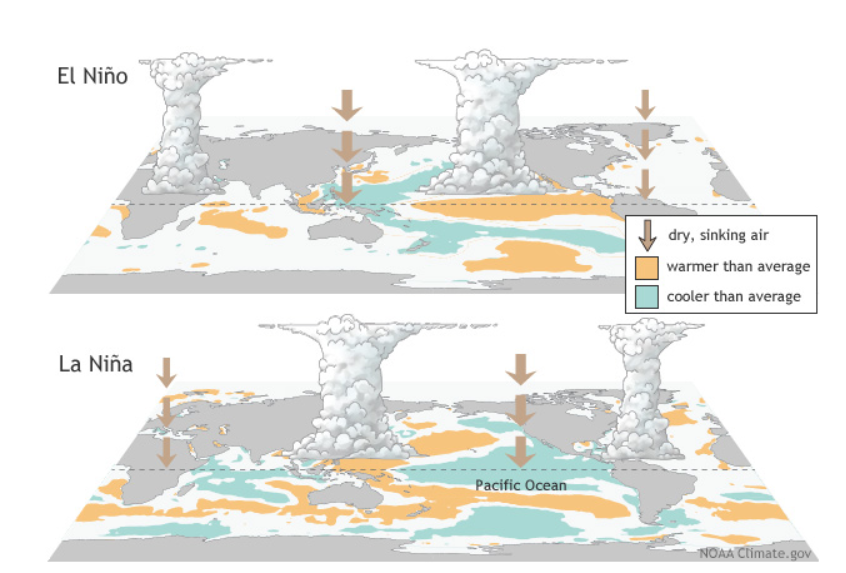 Image Credit: NOAAclimate.gov
What is El Nino?
El Nino is known as the periodic warming of sea surface temperatures in the central and eastern equatorial Pacific Ocean . This shift affects global weather patterns, including the Indian monsoon. In simpler terms, El Nino is a warm phase of the Southern Oscillation. The term “El Nino” originates from Spanish, meaning " The Little Boy, " referring to the Christ child because the event was noticed around Christmas. El Nino is not an unusual occurrence. It typically happens every 2 to 7 years , but it can vary in intensity. During an El Nino event, the normal trade winds that blow from east to west weaken, which allows warm water from the western Pacific to move eastward toward South America. This creates a chain reaction that affects the atmospheric pressure, wind patterns, and rainfall distribution across the globe.What is La Nina?
In contrast to El Nino, La Nina is known as the cold phase of the Southern Oscillation. It occurs when the sea surface temperatures in the central and eastern Pacific Ocean are cooler than normal. La Nina is the opposite of El Nino, and it has its own set of impacts on global weather patterns. La Nina happens when the trade winds are stronger than usual, pushing warm water toward the western Pacific and allowing cooler water to upwell along the coast of South America. This leads to a significant cooling of the ocean’s surface and affects atmospheric pressure and wind patterns, which in turn impacts weather patterns worldwide.Difference Between La Nina and EL Nino
Although El Nino and La Nina are both related to the Southern Oscillation, they have opposite effects on global weather patterns. Here are the main differences between the two:| El Nino Vs La Nina | ||
| Aspect | EL Nino | La Nina |
| Sea Surface Temperature | Occurs when sea surface temperatures in the central and eastern Pacific Ocean are warmer than usual. | Happens when sea surface temperatures in the central and eastern Pacific are cooler than normal. |
| Wind Patterns | Weakens trade winds, causing warm waters to move towards the east. | Strengthens trade winds, pushing warm water toward the western Pacific and allowing cooler water to rise in the eastern Pacific. |
| Impact on Rainfall | Leads to reduced rainfall in some regions (like India) and may cause drought. | Results in increased rainfall in regions like India, which can strengthen the monsoon. |
| Global Weather Effects | Can lead to floods, droughts, and disrupted agriculture worldwide. | Colder winters in the northern hemisphere and wet conditions in Southeast Asia and Australia. |
| Frequency | Occurs every 2 to 7 years | Often follows an El Nino event but can also occur independently |
Impact of El Nino and La Nina on Indian Monsoon
Monsoons are critical for Indian agriculture, which supports around 42.3% of the population's livelihood (Economic Survey 2023-24). The Indian monsoon is significantly influenced by both El Nino and La Nina. Here is the impact of El Nino and La Nina on Indian monsoon:Impact of El Nino
- Weak Monsoon: El Nino disrupts the monsoon winds, leading to below-average rainfall.
- Drought Conditions: IMD has recorded instances where El Nino resulted in up to 20% less rainfall than usual, leading to widespread drought conditions.
- Water Scarcity: Reduced rainfall causes water shortages in reservoirs and irrigation systems.
- Impact on Economy: Agricultural output declines, impacting rural livelihoods and GDP.
- Forest Fires : Dry conditions increase the risk of forest fires.
Impact of La Nina
- Stronger Monsoon: La Nina strengthens the Indian monsoon, leading to above-average rainfall (e.g. during 2022).
- Improved Agriculture: Excess rainfall boosts crop yields and productivity.
- Livestock Growth: Better pastures improve livestock productivity.
- Flood Risks: Heavy rainfall can sometimes lead to floods in vulnerable regions.
| UPSC Related Articles | ||
| Female Freedom Fighters of India | Mission Karmayogi | Kumbh Mela 2025 |
| Parliament Sessions | Cooperative Federalism | Anti-Defection Law |
El Nino and La Nina FAQs
What are El Nino and La Nina in geography?
El Nino and La Nina are climate phenomena caused by changes in sea surface temperatures in the Pacific Ocean. El Nino refers to warming, while La Nina refers to cooling.
What is La Nina in geography?
La Nina is the cold phase of ENSO, characterised by colder sea surface temperatures in the eastern Pacific and stronger trade winds.
What causes El Nino and La Nina?
El Nino occurs when trade winds weaken, causing warm water to move east. La Nina occurs when trade winds strengthen, pushing warm water towards the west.
What is the Difference Between La Nina and El Nino?
El Nino involves the warming of Pacific waters, weakening the Indian monsoon. La Nina involves the cooling of Pacific waters, strengthening the monsoon.
What is the Southern Oscillation?
The Southern Oscillation refers to fluctuations in air pressure between the eastern and western Pacific Ocean during El Nino and La Nina events.



🔥 Trending Blogs


Talk to a counsellorHave doubts? Our support team will be happy to assist you!


Check out these Related Articles










Join 15 Million students on the app today!
 Live & recorded classes available at easeDashboard for progress trackingMillions of practice questions at your fingertips


Free Learning Resources
PW Books
Notes (Class 10-12)
PW Study Materials
Notes (Class 6-9)
Ncert Solutions
Govt Exams
Our Other Websites
Class 6th to 12th Online Courses
Govt Job Exams Courses
UPSC Coaching
Defence Exam Coaching
Gate Exam Coaching
Other Exams
Know about Physics Wallah
Physics Wallah is an Indian edtech platform that provides accessible & comprehensive learning experiences to students from Class 6th to postgraduate level. We also provide extensive NCERT solutions, sample paper, NEET, JEE Mains, BITSAT previous year papers & more such resources to students. Physics Wallah also caters to over 3.5 million registered students and over 78 lakh+ Youtube subscribers with 4.8 rating on its app.
We Stand Out because
We provide students with intensive courses with India’s qualified & experienced faculties & mentors. PW strives to make the learning experience comprehensive and accessible for students of all sections of society. We believe in empowering every single student who couldn't dream of a good career in engineering and medical field earlier.
Our Key Focus Areas
Physics Wallah's main focus is to make the learning experience as economical as possible for all students. With our affordable courses like Lakshya, Udaan and Arjuna and many others, we have been able to provide a platform for lakhs of aspirants. From providing Chemistry, Maths, Physics formula to giving e-books of eminent authors like RD Sharma, RS Aggarwal and Lakhmir Singh, PW focuses on every single student's need for preparation.
What Makes Us Different
Physics Wallah strives to develop a comprehensive pedagogical structure for students, where they get a state-of-the-art learning experience with study material and resources. Apart from catering students preparing for JEE Mains and NEET, PW also provides study material for each state board like Uttar Pradesh, Bihar, and others
Copyright © 2026 Physicswallah Limited All rights reserved.