






ISRO Prefers Women Fighter Pilots For Gaganyaan Mission
 Praveen Kushwah22 Oct, 2023
Share
ISRO Prefers Women Fighter Pilots For Gaganyaan Mission
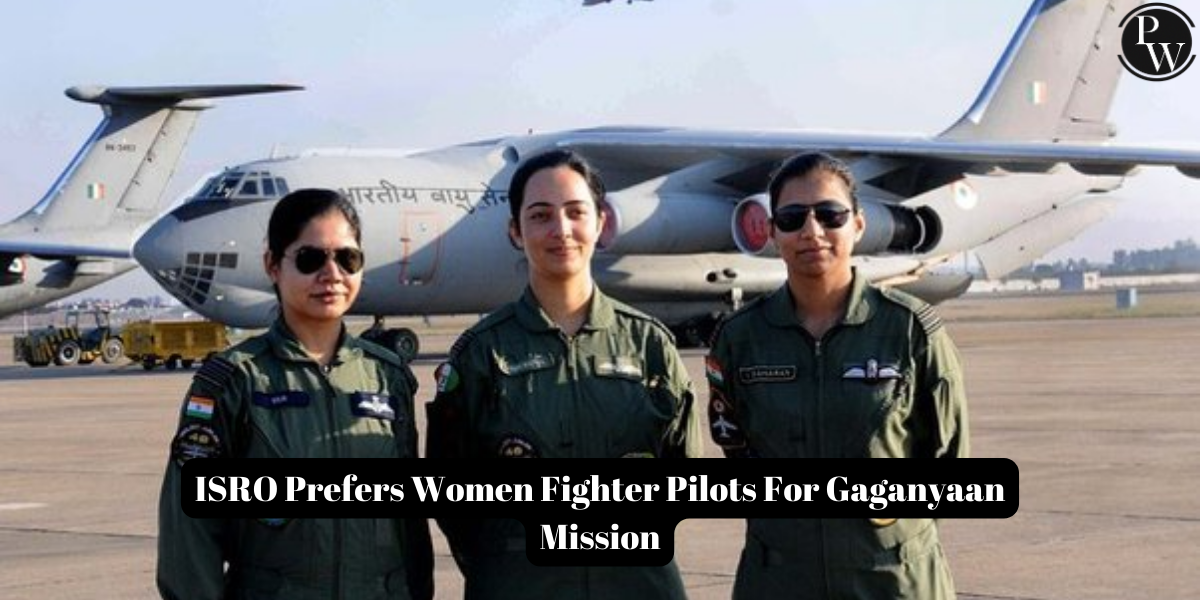
ISRO's Chief, S Somanath, revealed that the Indian Space Research Organisation prefers selecting women fighter test pilots or female scientists for its highly anticipated human spaceflight program, the G aganyaan mission. He emphasized the possibility of sending women candidates in the future. Additionally, he announced that ISRO plans to send a female humanoid (human-like robot) in its unmanned Gaganyaan spacecraft next year.
ISRO Prefers Women Fighter Pilots For Gaganyaan Mission Key Points:
- The Gaganyaan mission aims to send humans into space, orbiting at a Low Earth Orbit of 400 km for three days, and safely bringing them back to Earth.
- Somanath mentioned that the manned mission is expected by 2025, and candidates initially will be from Air Force fighter test pilots. However, since there are currently no women fighter test pilots, the options will expand in the future.
- ISRO achieved a successful launch of the TV-D1 test vehicle in preparation for the upcoming Gaganyaan human space flight mission. Despite facing initial challenges and delays, the space agency triumphantly sent the test vehicle into space, carrying payloads crucial to India's ambitious Gaganyaan program.
- During the mission, scientists conducted simulations of an abort situation, testing the Crew Escape System's capability to safely carry the Crew Module of the test vehicle. The culmination of the mission saw the test vehicle making a precise splashdown into the Bay of Bengal as part of the planned maneuvers.
He outlined two potential routes for selecting candidates—firstly, when women join as Air Force fighter test pilots, and secondly, when there is an increase in scientific activity, allowing scientists to become astronauts. Somanath expressed optimism that more opportunities for women will arise in the latter scenario.
Responding to a question, Somanath affirmed ISRO's target to establish a fully operational space station by 2035. The recent success in launching the TV-D1 test vehicle marked a significant step forward for the Gaganyaan mission, overcoming initial delays and demonstrating the Crew Escape System's effectiveness during simulated abort situations.
What is Gaganyaan?
Gaganyaan is a special mission by the Indian Space Research Organisation (ISRO) to send a three-person crew to space for about five to seven days by the year 2022.
The Prime Minister, Narendra Modi, first talked about this space mission in 2018 during his independence day speech to the nation. Before sending people into space, ISRO plans to send two unmanned missions as part of the Gaganyaan project.
Originally, the first unmanned mission was supposed to happen in December 2020, and the second one was planned for June 2021. Unfortunately, the first mission got delayed due to the challenges ISRO faced because of the coronavirus pandemic.
The Gaganyaan spacecraft will be put into a low earth orbit (LEO) at a height of 300-400 kilometers. The total cost of the entire program is expected to be less than Rs.10,000 crore.
Gaganyaan Spacecraft & Launch Vehicle
The Gaganyaan spacecraft has two main parts, the service module and the crew module, which together make up the Orbital Module. The mission will use the Geosynchronous Satellite Launch Vehicle GSLV Mk III for liftoff.
Gaganyaan Human Space Flight
The human spaceflight is estimated to take around 16 minutes to reach the planned low earth orbit.
- The three astronauts will travel in the crew module, which is 3.7 meters in diameter and 7 meters tall.
- The astronauts will wear orange space suits made by the Vikram Sarabhai Space Centre, Thiruvananthapuram. You can find a list of other space research centers in India in the linked article.
- The suits can carry an oxygen cylinder, allowing the astronauts to breathe in space for an hour.
- The manned mission will orbit the earth every 90 minutes, providing the astronauts with views of sunrise, sunset, India from space every 24 hours, and opportunities to conduct experiments in microgravity.
- The return journey will take about 36 hours, landing in the Arabian Sea off the Gujarat coast.
- ISRO has developed key technologies like a crew escape system, re-entry mission capability, thermal protection system, crew module configuration, deceleration and flotation system, and subsystems of life support systems to make this mission possible.
Astronaut Training
ISRO has partnered with Gavkosmos, a subsidiary of the Russian space agency ROSCOSMOS, to prepare the Indian astronauts for the mission.
- The four selected astronauts, all pilots from the Indian Air Force, are undergoing rigorous medical, physical, and language training.
- Training includes simulations in a centrifuge and a hyperbaric chamber to prepare for conditions like G-force, hypoxia, and pressure drops during spaceflight.
- The training in Russia will last a year, followed by module-specific training in India.
Gaganyaan Unmanned Missions
Before the manned mission, two unmanned missions are planned, subject to several crucial tests:
- Air drop test for the parachute system to demonstrate successful capsule recovery.
- Flight test of the test vehicle.
- Abort test to show crew escape in case of an emergency at the launch pad.
- The first unmanned mission will include six tests, covering areas like changes in kidney stone formation, the study of the SIRT1 gene, microbial contamination, and co-crystallization under microgravity conditions.
Significance of Gaganyaan
Gaganyaan is significant because it's the first mission created by India to send Indian astronauts to space. If successful, India will become the fourth country to achieve this incredible feat, after the US, Russia, and China. While ISRO is working on the spacecraft, Russia is assisting in training the astronauts.
Which ISRO prefers women fighter test pilots for its manned mission?
What is the main purpose of Gaganyaan mission?
What is the new mission of ISRO Gaganyaan?
Who is the first women fighter pilots in IAF?
Who is leading Gaganyaan mission?












 Live & recorded classes available at easeDashboard for progress trackingMillions of practice questions at your fingertips

