






English Poems for Kids - Building a Strong Foundation for Literacy
 Nivedita Dar10 Jan, 2026

The rhythmic bounce of a nursery rhyme is typically the first thing that gets kids interested in reading. Finding the proper English poem for kids isn't just about having fun; it's also about helping them learn how to speak, understand phonetics, and communicate their feelings. These poems are very important for a child's growth, whether you need an English poem for kids at the nursery level to calm a toddler or an English poem for kids with four lines for a rapid classroom recitation. A lot of parents and teachers hunt for English poems for kids that teach morals to develop good values early on. They typically look for English poems for kids in PDF format so they can easily access them for daily practice. In this book, we'll look at twenty classic poems that can spark your imagination and help you learn important reading and writing skills.
English Poem for Kids Nursery
For the youngest students, the "nursery" phase is more about sound than complicated meaning. At this point, english poem for kids nursery with a strong, steady beat the best. "Twinkle, Twinkle, Little Star" and "Baa Baa Black Sheep" are two of the most popular songs because they contain simple vowel sounds that are easy for little lungs to copy.
The original material says that these poems assist kids learn how to "hear" language. When a child recites "Humpty Dumpty," they aren't just narrating a narrative about an egg; they're also learning about how to end words and how to speak English. This aural processing is what comes before reading. When kids read poems that include hand gestures in them, like "The Itsy Bitsy Spider," they simultaneously work on their fine motor skills and language. The physical movement that goes along with the words makes the language "stick" in a way that just listening can't.
Short English Poem for Kids 4 Lines
When attention spans are short, brevity is a teacher's best friend. An english poem for kids 4 lines in length is the perfect "bite-sized" learning unit. These short verses are excellent for building confidence. A child who might be intimidated by a long story can easily memorize four lines of verse, such as the classic "Rain, Rain, Go Away" or "Jack and Jill" (focusing on the first quatrain).
The beauty of the four-line structure lies in its predictability. Most follow an AABB or ABAB rhyme scheme, which helps children anticipate the coming word. This anticipation is a high-level cognitive skill. It encourages kids to think ahead and use logic to fill in the blanks. For instance, in "Mary Had a Little Lamb," the repetitive nature of the four-line stanzas ensures that even if a child forgets a specific word, the rhythm guides them back to the correct path. These short poems are also the easiest to illustrate, allowing kids to draw what they hear, further bridging the gap between spoken words and visual representation.
English Poem for Kids with Moral Lessons
When students don't have a lot of time, short lessons are the best. A four-line english poem for kids with moral is the perfect "bite-sized" learning unit. These short poems are great for boosting your confidence. A kid who might be scared by a long story can easily remember four lines of verse, as the famous "Rain, Rain, Go Away" or "Jack and Jill" (focussing on the first quatrain).
The four-line arrangement is beautiful since you can always guess what will happen next. Most of them include an AABB or ABAB rhyme system, which helps kids guess what the next word will be. This ability to anticipate is a high-level cognitive capability. It helps kids plan ahead and utilise their brains to figure things out. For example, in "Mary Had a Little Lamb," the four-line stanzas repeat so that even if a youngster forgets a word, the rhythm will help them remember it. Kids can also sketch what they hear in these short poems, which makes it easier to illustrate them. This helps to connect spoken words with pictures even more.
English Poem for Kids PDF
In today's learning environment, having access to an english poem for kids pdf is a game-changer for parents and teachers. Digital PDFs allow for a structured approach to learning where poems can be categorized by theme—such as animals, nature, or daily routines. Having a downloadable version means that learning doesn't have to stop when the screen is turned off.
Printable poems allow children to engage in "shared reading." A parent can point to the words in the PDF while reciting them, helping the child make the connection between the spoken sound and the written symbol. This is a critical step in transitioning from a listener to a reader. Furthermore, a PDF collection serves as a portable library. Whether in a car or a waiting room, these poems provide a constructive way to pass the time, ensuring that the child is constantly immersed in a "print-rich" environment that fosters curiosity.
The "Predictive Auditory Bridge": A Unique Insight
While most discussions on children's poetry focus on vocabulary, there is a deeper "Original Framing" to consider: the Predictive Auditory Bridge. Unlike prose, poetry allows a child to "calculate" the next word based on a mathematical rhythm. This unique insight suggests that poems act as a child's first experience with "probability" in language.
When a child learns a poem, their brain creates a template of expectation. If a line ends in "cat," and the next line requires a rhyme, the child’s brain rapidly scans its limited vocabulary to find a match before the word is even spoken. This isn't just memorization; it is an active linguistic workout. This "bridge" helps children develop a sense of linguistic intuition that makes learning grammar and syntax much easier later on, as they have already internalized the "math" of the English language through verse.
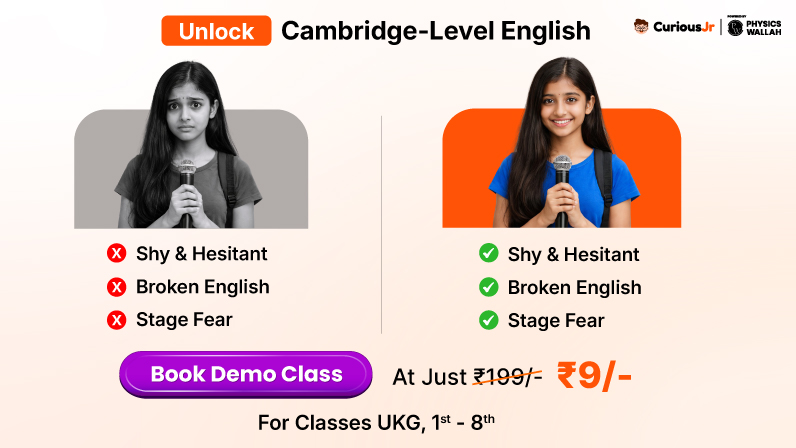
Give Your Child a Global Advantage with CuriousJr’s Cambridge-Certified English Program
Does your child struggle to speak or understand English with confidence at school or in daily conversations? CuriousJr helps children aged 6 to 14 strengthen their English skills through live online classes led by trained and experienced teachers.
Our English program is based on international Cambridge standards and is carefully adapted for Indian learners. It is structured across four levels—Pre A1, A1, A2, and B1—so children can learn step by step. The CuriousJr English Learning course focuses on all key language skills, including grammar, vocabulary, reading, writing, listening, and speaking.
To ensure effective learning, we maintain small class sizes where every child gets personal attention and encouragement. Lessons are interactive, engaging, and designed to build confidence along with strong language foundations.
Our aim is to help children use English naturally and confidently in academics as well as everyday situations. Book a demo session today and discover how CuriousJr’s Cambridge-certified English program can support your child’s learning journey.
| Related Articles | |
| Lines and Angles | Sources of Energy |
| Motion And Time | What is Quotient |
| Noun Phrase | How to Teach English to Kids |
English Poems for Kids FAQs
Why is it vital for toddlers to read an English poetry for kids in nursery?
How can I help my child remember things better by using an English poetry for kids with four lines?
What are the best moral subjects for an English poem for kids?
What are English poems for kids?










 Live & recorded classes available at easeDashboard for progress trackingMillions of practice questions at your fingertips

