Missing Numbers – Definition, Sequences & Examples
 Nivedita Dar19 Jan, 2026
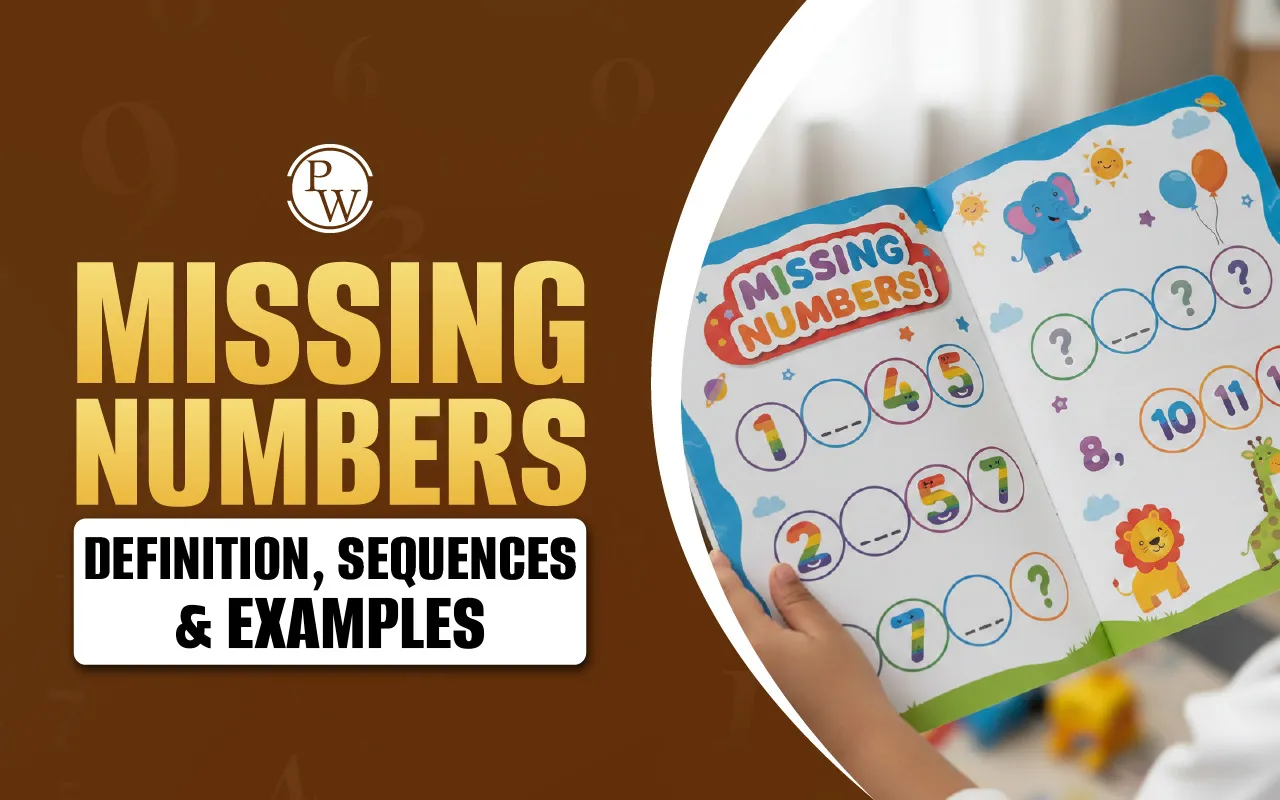
Missing numbers are simply the values left out of a series or a sequence that follows a specific logical rule. To find these values, you act like a detective—you have to figure out the "secret code" or pattern, such as adding, subtracting, or multiplying, that connects the numbers you can already see. Mastering this isn’t just about schoolwork; it’s about training your brain to spot patterns and solve problems in everyday life.
Read More: Number Name 1 to 20
How to Find the Missing Number in Maths
In the world of math, being able to find the missing number is the bridge between basic counting and the kind of "big kid" math like algebra. Whether you are helping a child with a missing numbers worksheet 1 to 20 or you're tackling a brain teaser yourself, the goal is always the same: find the rule and fill the gap.
When we ask, "What is the missing number?", we are looking for the logic behind the list. Missing numbers in maths pop up in all sorts of places—on number lines, in colorful grids, or even in simple tables. For beginners, it’s usually about missing numbers 1 to 100, where you’re just counting up or down by one. But as things get more interesting, you’ll see a missing number series where the "jump" between numbers might double or triple each time.
To get better at this, many students use a missing numbers worksheet or specific missing number questions to sharpen their skills. The trick is to stop guessing and start deducing. If you can find the missing number with answer keys to check your work, you’ll quickly build the confidence to handle any math puzzle thrown your way.
Patterns to Look For: Sequences and Rules
Finding missing numbers is all about understanding how a sequence is built. A sequence isn’t just a random pile of digits; it’s a path that follows a certain direction. To find the missing piece, you just have to look at its "neighbors."
The "Big Three" Patterns
Most missing number questions follow these simple rules:
-
The Plus Rule: In a series like 5, 10, 15, __, 25, you’re just adding 5 every time. The missing piece is 20.
-
The Minus Rule: In a series like 50, 40, 30, __, 10, you’re taking away 10. The missing piece is 20.
-
The Multiplier: In a series like 2, 4, 8, __, 32, you’re doubling the number before it. The missing piece is 16.
For young learners, a missing numbers worksheet 1 to 20 usually sticks to adding or subtracting 1. It’s a great way to show them that numbers have a specific order and "live" in certain spots.
Grids and "Magic" Boxes
Sometimes, the missing number is hidden in a square or a triangle rather than a straight line. In these cases, the rule might be horizontal (across) or vertical (up and down). You might need to add the first two numbers in a row to find the third one. It’s like a crossword puzzle, but with digits!
The Power of Mental Math and Estimation
One of the most overlooked benefits of finding missing numbers is how it sharpens your "mental math" muscles. When you work through missing number questions, you aren't just filling in a blank; you are learning to estimate and judge the value of numbers at a glance. For instance, if you are looking at a missing number series like 150, 200, __, 300, your brain quickly identifies the "midpoint." This ability to estimate is a vital life skill that helps with everything from grocery shopping to managing time.
By practicing with a missing numbers 1 to 100 chart, students learn to visualize the distance between numbers. They begin to realize that 75 is closer to 80 than it is to 50. This "number sense" makes it much easier to tackle harder math later on, like rounding or working with fractions. Instead of relying on a calculator, the student learns to trust their own logical deduction. It transforms math from a series of memorized steps into a flexible, intuitive tool that can be used to solve real-world problems quickly and accurately.
Read More: Roman Numerals 1 to 100
Why "Missing Number" Practice Actually Matters
Filling in a blank spot on a page might seem simple, but it’s actually a huge workout for the brain. When a student works through a missing numbers worksheet, they are learning to predict what comes next based on the evidence they have.
This is actually the first step toward algebra. In high school math, we call the missing number "x," but the logic is exactly the same as the puzzles you do in second grade. If you can solve "10, 20, __, 40," you’re already doing a form of an equation.
Plus, it makes you faster at life skills. If you’re used to seeing missing numbers 1 to 100, you’ll be much quicker at checking your change at the store, keeping track of time, or even following a recipe. It turns math from a scary subject into a predictable, fun system.
Help Your Child Succeed in Maths with CuriousJr!
Maths builds strong thinking skills, improves problem-solving ability, and boosts a child’s confidence. With CuriousJr’s Mental Maths Online Classes, your child will:
-
Learn 50+ smart mental maths tricks for faster calculations
-
Improve speed, accuracy, and logical thinking
-
Solve challenging problems with confidence
-
Enjoy fun, interactive lessons made especially for young learners
Enroll today and give your child the skills to excel in maths and succeed beyond the classroom!
| Related Articles | |
| Lines and Angles | Sources of Energy |
| Motion And Time | What is Quotient |
| Noun Phrase | How to Teach English to Kids |
Do you need help with your homework or preparing for exams?
Study without using the internet
Missing Numbers FAQs
What exactly is a "missing number"?
How do I figure out the rule in a series?
What are some common "missing number" tricks?
Why do we practice missing numbers 1 to 100?
How do I solve a grid-style puzzle?






 Live & recorded classes available at easeDashboard for progress trackingMillions of practice questions at your fingertips