







Newton’s Second Law : Law of Motion
 Vikalp Tiwari20 Nov, 2023
Newton’s Second Law: In engineering, some problems involve understanding what makes objects move and how they move. This falls under the branch of dynamics known as "kinetics." Kinetics is a branch of mechanics that deals with the study of forces and their effects on the motion of particles and rigid bodies. In engineering mechanics, understanding the kinetics of particles and rigid bodies is fundamental to solving practical engineering problems.
In the realm of engineering mechanics, one of the fundamental principles that serves as the cornerstone for understanding motion and its underlying causes is Newton's Second Law of Motion. This law is pivotal for comprehending how forces influence the motion of both particles and rigid bodies. We usually use Newton's laws of motion to solve these problems, but for some cases, other methods can provide a simpler solution.
Newton’s Second Law for a Particle
Newton's Second Law of Motion, as formulated by Sir Isaac Newton in 1687, applies to both particles and rigid bodies. Newton's second law establishes a quantitative relationship between force, mass, and acceleration. It states that “the rate of change of momentum is directly proportional to the impressed force and takes place in the same direction in which the force acts”.
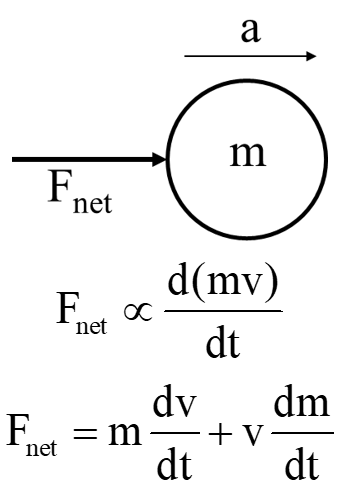
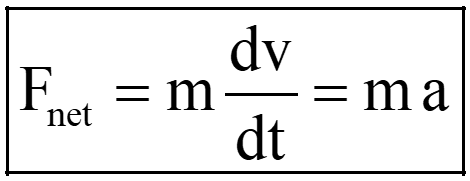 Where F
net
represents the net force acting on the object, m denotes the mass of the object, and a signifies the resulting acceleration.
Where F
net
represents the net force acting on the object, m denotes the mass of the object, and a signifies the resulting acceleration.
- From the above relation, it can be concluded that the acceleration of an object is directly proportional to the net force applied to it and inversely proportional to its mass.
- In simpler terms, this law explains that the more force applied to an object, the more it will accelerate, and the more massive the object is, the less it will accelerate for a given force.
Note: This law holds true when describing the behavior of objects within an inertial frame of reference.
Newton’s Second Law for a Curvilinear Motion
In the case of rectilinear motion, forces acting on the particle are generally resolved in the x and y directions, but in the case of particles undergoing curvilinear motion, forces are resolved in the tangential and normal directions. Let's take a moment to examine a particle with mass m as it traverses along a curvilinear path, as shown in Figure. Imagine the particle's current position is marked by point P, and it's travelling with a tangential velocity v. Now, consider a t as the tangential acceleration and a n as the normal acceleration of the particle. These accelerations are the result of a force 'F' acting on the particle.
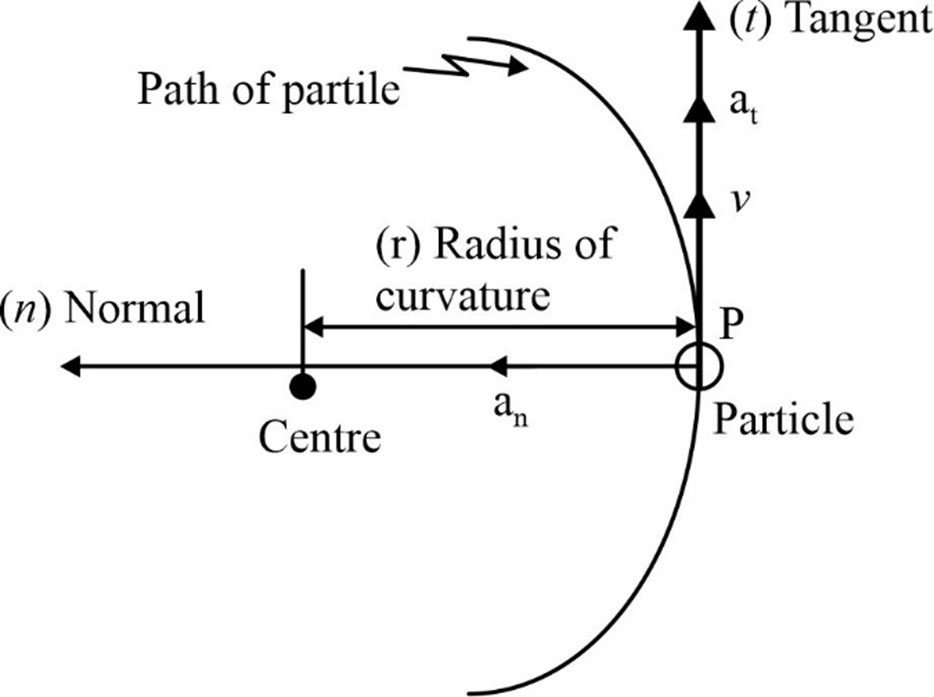 From Newton’s second law;
ΣF t = m a t
and ΣF n = m a n
here, ΣF t and ΣF n represents the net force on the particle in the tangential and normal directions of the path. The two components of the acceleration are given as: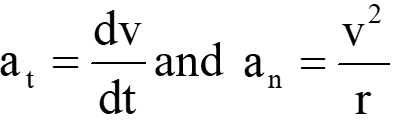
Newton’s Second Law for a Rigid Body
For a rigid body, Newton's Second Law still applies, but it is extended to consider the motion of the body as a whole and its rotation. It states that the total force and torque (angular force) acting on a rigid body are equal to the rate of change of linear momentum and angular momentum, respectively.
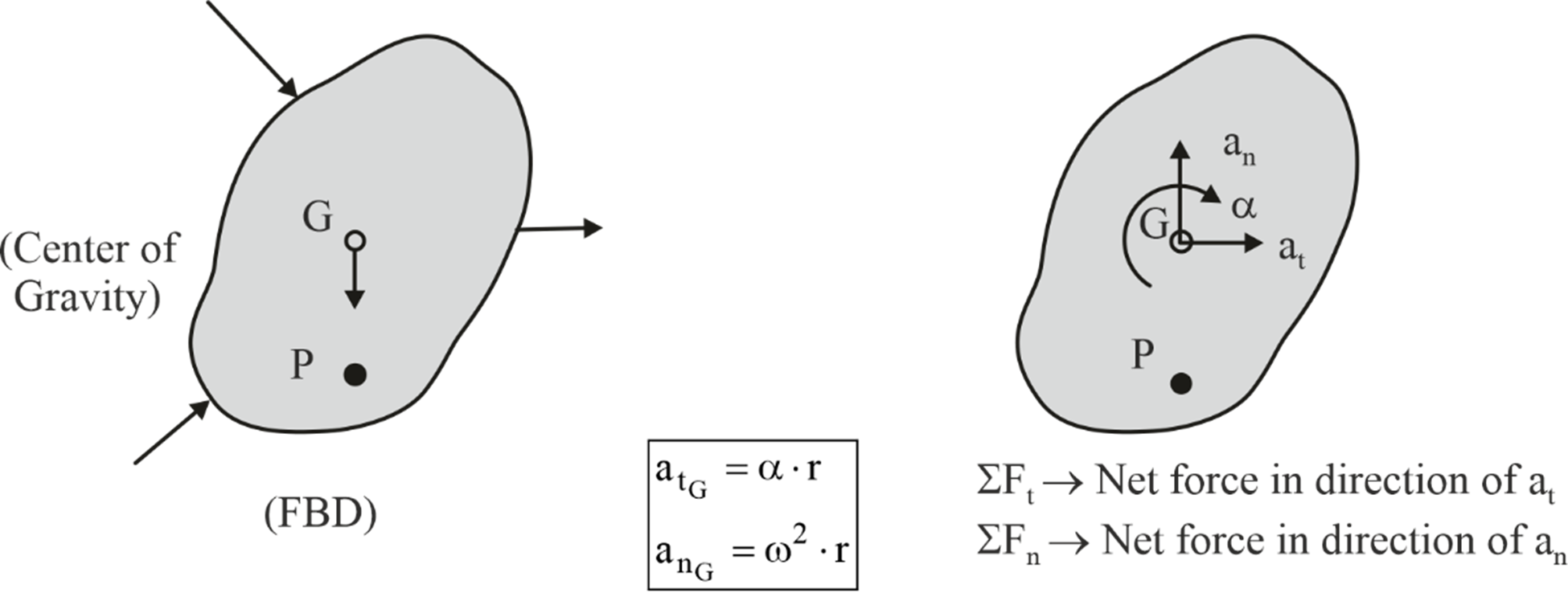 When a rigid body engages in motion, whether it's translation, rotation, or a combination of both, its dynamic behaviour is controlled by equations.
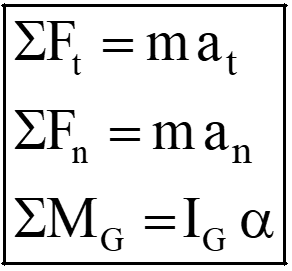
Here, ΣM G and a represent the net torque about the center of mass and the angular acceleration of the rigid body. Here, a t and a n represent the acceleration of the center of mass of the body in the tangential and normal directions to the curvature of the path.
Analyzing rigid bodies can be more complex than analyzing particles because you need to consider both translational and rotational aspects. This involves calculating the moments of inertia and angular accelerations in addition to linear forces and accelerations.













 Live & recorded classes available at easeDashboard for progress trackingMillions of practice questions at your fingertips

