







CLAT 2027: How to Revise Through PYQs in the Final Month

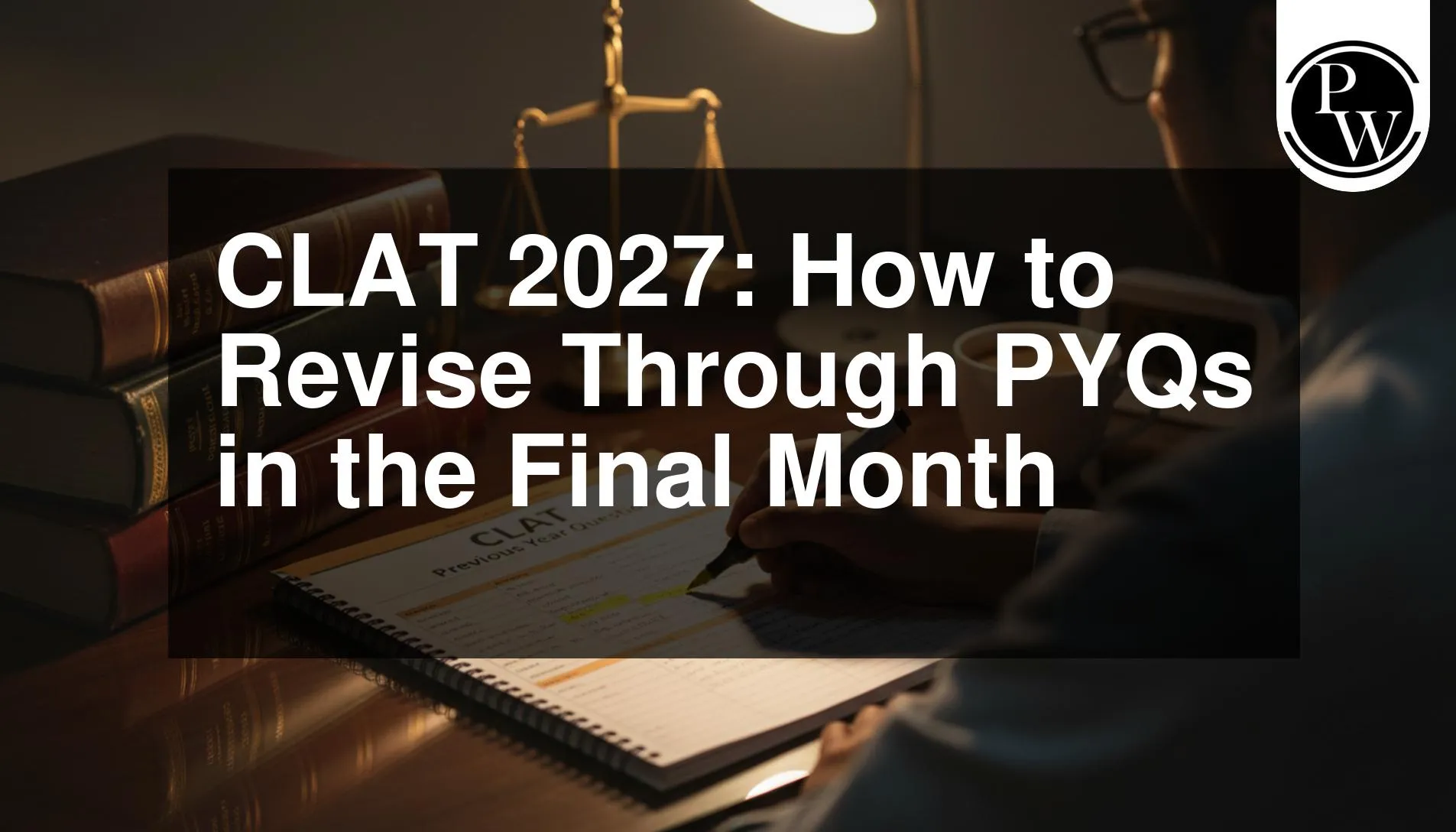
The final thirty days before a major law entrance exam can feel overwhelming for many aspirants. Completing a focused CLAT 2027 PYQ revision helps you shift away from bulky theory notes, test yourself with authentic questions, and identify your personal weak spots without last-minute panic.
Many candidates struggle to find verified answer keys and detailed reasoning for past tests. Physics Wallah helps solve this revision roadblock through dedicated mentors and exam-oriented resources, giving aspirants step-by-step clarity to build real test confidence.
Why Are PYQs Important for CLAT 2027 Revision?
Understanding the actual demands of the Common Law Admission Test requires more than memorising legal rules or vocabulary lists. Practising real questions shows you how examiners build reading comprehension passages and where they place tricky distractors among the answer options.
A regular routine of solving past tests turns raw preparation into reliable marks across all five sections. Here is why past questions play a major role in your final review:
-
Understanding Question Patterns: You see the exact mix of direct factual inquiries, inference questions, and main-idea questions tested over recent years on CLAT Exam Pattern & Syllabus Insights.
-
Mastering Passage-Based Reasoning: CLAT tests your ability to extract rules and logic directly from the given text rather than using outside assumptions.
-
Improving Test Time Management: Answering 120 questions within 120 minutes demands smooth pacing, which only comes from handling authentic test papers under a running timer.
-
Increasing Accuracy and Reducing Negatives: Working through actual answer keys teaches you how to eliminate two incorrect options quickly so you avoid negative penalties.
-
Identifying Weak Areas: Reviewing wrong answers reveals whether you lost marks due to poor concept understanding, hasty reading, or calculation slips in math caselets.
How to Revise for CLAT 2027 Through PYQs in the Final Month
A calm 30-day schedule prevents you from jumping randomly between different subjects. Dividing your final weeks into four distinct learning phases keeps your daily efforts organised and productive.
The plan outlined below shows how to distribute your study hours between analysing papers, subject-focused drills, full-length simulations, and error corrections.
|
Phase |
Main Activity |
Daily Target |
|
Week 1 |
Paper Pattern Analysis (2020–2022) |
Solve one paper every two days and review each explanation line by line. |
|
Week 2 |
Section-Wise Practice (2023–2024) |
Isolate weak sections like Quantitative Techniques or Critical Reasoning. |
|
Week 3 |
Combined PYQs and Mock Drills (2025–2026) |
Complete full-length papers strictly within the two-hour exam window. |
|
Week 4 |
Mistake Review & Final Refinement |
Re-solve marked errors and review short GK and math formula sheets. |
Week 1 – Analyse Previous Year Question Papers
The first week is about getting comfortable with the language and difficulty level of past test papers. Do not worry about extreme speed right away; focus on understanding how questions connect to the reading passages.
Begin with papers from 2020 through 2022. Read every passage carefully, locate where the correct information appears in the text, and note how wrong options try to mislead you. Making this the foundation of your CLAT revision strategy sets a realistic baseline for the rest of your CLAT 2027 PYQ revision.
Week 2 – Practise Section-Wise PYQs
Once you understand the general flow of the exam, shift your attention to individual subject areas. Grouping questions by section allows you to work through your weakest subjects without distractions.
Dedicate specific days to Legal Reasoning passages, Logical Reasoning arguments, English comprehension sets, and Quantitative Techniques caselets. Practising topic by topic helps you recognise repeating themes, such as contract principles, constitutional law basics, and percentage-based data charts.
Week 3 – Combine PYQs with Mock Tests
During the third week, transition from untimed practice to full exam simulations. You must train your body and eyes to sit at a desk and maintain sharp focus for two continuous hours.
Alternate between recent official papers from 2025 and 2026 and standard full-length mock tests. Always use an OMR sheet and a black ballpoint pen to fill bubbles by hand. Tracking your scores across full papers shows whether your pacing matches the real test conditions, which is critical for thorough CLAT final month preparation.
Week 4 – Revise Mistakes and Strengthen Accuracy
The final week before the test should not involve starting any new or unfamiliar chapters. Your main goal is to protect your accuracy and avoid repeating old errors during your CLAT 2027 PYQ revision.
Open your error notebook and re-read every question you missed over the past three weeks. Re-attempt tricky logical puzzles and legal fact situations to make sure the right logic is fresh in your mind. Review basic math formulas, divisibility rules, and recent current affairs summaries to enter the exam room with total clarity.
How to Use a CLAT PYQ Book for Effective Revision
Having past question papers is only helpful if the answers include clear, step-by-step reasoning. Many basic answer keys provide only option letters, leaving students confused about why a specific inference is correct.
A reliable solved question bank allows you to verify your thoughts immediately after finishing a practice set. Using a single comprehensive resource saves time and keeps your CLAT 2027 PYQ revision steady throughout the month.
PW’s 14 Years CLAT & AILET Book 2026 for CLAT 2027 Preparation
For CLAT 2027 preparation, practising previous years’ question papers helps candidates understand the exam pattern, question types, and difficulty level. The PW CLAT & AILET 14 Previous Years Solved Papers (2020–2026) brings solved papers for both major law entrance exams together in one place.
Key features of the book include:
-
14 Years of Solved Papers: Practise previous years’ CLAT and AILET questions for better exam familiarity.
-
Chapter-Wise Segregation: Revise questions according to syllabus topics.
-
Trend Analysis: Identify frequently tested areas and prioritise revision.
-
Detailed Solutions: Understand the reasoning behind correct answers to legal reasoning, logical reasoning, and other questions.
-
Difficulty-Level Analysis: Compare recent and older questions to understand changes in exam trends.
Regular practice with these CLAT and AILET solved papers can help candidates identify weak areas, improve accuracy, and strengthen their overall CLAT 2027 exam preparation.
Common Mistakes to Avoid While Revising Through PYQs
Many students spend hours working through question papers but fail to see their marks go up. This usually happens when past papers are treated like simple reading exercises rather than diagnostic tools.
Being aware of standard preparation traps helps you keep your study hours effective and score-oriented:
-
Solving Papers Without Analysing Answers: Simply checking your final score and closing the book wastes the entire test. You must spend equal time reviewing why you chose incorrect options during your CLAT 2027 PYQ revision.
-
Ignoring Weak Sections: Skipping Quantitative Techniques or difficult Critical Reasoning passages because they feel uncomfortable will hurt your overall rank on exam day.
-
Memorising Solutions Instead of Logic: CLAT never repeats identical passages. Memorising specific facts from old passages is useless; focus on the reasoning method used to reach the right choice.
-
Neglecting Full Mock Tests: Solving questions in small 10-minute bursts does not build the physical and mental stamina needed to read 20 long passages in one continuous sitting.
Regular practice with CLAT previous year question papers, honest mistake analysis, and disciplined time drills turn a stressful final month into a confident revision period. For aspirants who want live classroom guidance, regular doubt sessions, and expert test mentorship, exploring specialised Law Online Coaching by Physics Wallah offers a proven path toward securing admission to a top National Law University.
Related Resource
CLAT Previous Year Question Paper.
CLAT 2027: How to Revise Through PYQs in the Final Month FAQs
How many years of PYQs should I solve for CLAT 2027?
Is solving PYQs enough to prepare for CLAT 2027?
How should I analyse CLAT previous year question papers?
Which book can I use for CLAT 2027 PYQ practice?
Should I prioritise PYQs or mock tests in the final month?




Have questions about your prep?
Our experts can answer all your questions





 Live & recorded classes available at easeDashboard for progress trackingMillions of practice questions at your fingertips

