







Is AI Making It Harder for Fresh Graduates to Find Their First Job?
AI exposure among young workers varies sharply by region, with 37% of workers aged 15–24 globally employed in occupations facing medium-to-high AI-driven task changes. The WEF report reveals a growing entry-level hiring squeeze, faster-changing skill requirements, and rising productivity expectations, making AI literacy and practical experience increasingly important for graduates entering the job market.

Landing your first job is becoming more challenging as artificial intelligence (AI) changes hiring patterns, workplace responsibilities, and the skills employers expect from fresh graduates. As businesses automate routine tasks and adopt AI tools, young professionals must rethink whether their existing skills are enough to meet changing workplace demands.
A June 2026 report by the World Economic Forum (WEF), Artificial Intelligence and the Future of Entry-Level Work, developed in partnership with PwC, highlights the growing impact of AI on early-career opportunities.
37% of young workers aged 15–24 globally are employed in occupations with medium-to-high exposure to AI-driven task changes, according to the WEF report.
The impact varies across regions and industries, with implications for entry-level hiring, productivity, and the skills graduates need to build.
Global AI Exposure: Which Regions Are Most Affected?
The global figure of 37% only tells part of the story.
AI exposure varies significantly across regions, largely because of differences in the types of jobs people do.
Economies with a greater focus on services and knowledge-based work tend to have higher exposure, while regions with more workers in physical industries generally experience lower direct exposure.
| Region | Medium-to-High AI Exposure |
| Eastern Asia | 75% |
| Northern America | 69% |
| Europe | 63% |
| Developing Regions (e.g., Sub-Saharan Africa, Southern Asia) | Substantially Lower |
Preparing for AI-driven changes in knowledge-based industries? Build relevant expertise through PW's online degree programmes in AI and Machine Learning.
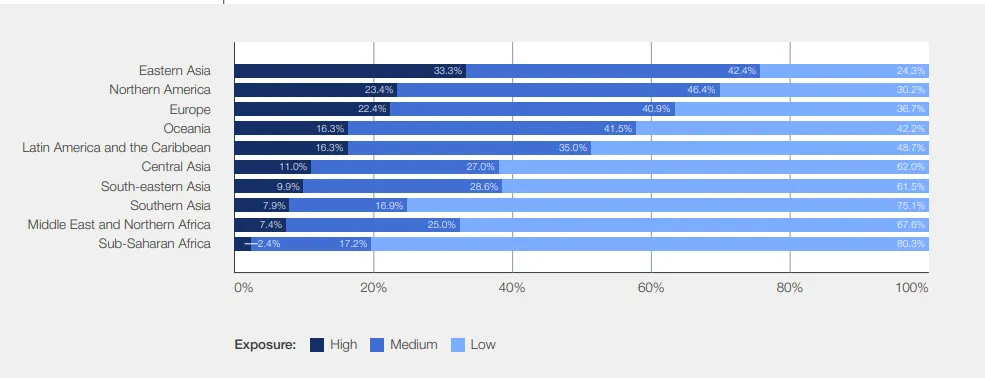
Data Credit: Artificial Intelligence and the Future of Entry-Level Work. (The World Economic Forum (WEF), in partnership with PwC)
Two Distinct Realities for Early-Career Job Seekers
Analyzing exposure alongside young worker volume highlights a crucial structural divide in how AI impacts early-career pathways:
-
The High-Exposure Knowledge Hub: Sectors like Finance, IT, Professional Services, and Education account for over 42 million young workers. In these industries, entry-level tasks—such as preliminary research, basic coding, data entry, and document generation—are highly susceptible to AI automation. Fresh graduates entering these fields face an immediate requirement to demonstrate higher-level critical thinking and AI orchestration from day one.
-
The High-Volume Physical & Service Anchor: Combined, Agriculture, Wholesale/Retail, Manufacturing, and Accommodation employ over 347 million young workers globally. While their direct exposure ranks are lower, the sheer scale of youth employment means even subtle shifts in logistics, point-of-sale automation, or automated management tools will impact millions of early-career workers who may lack formal digital training.
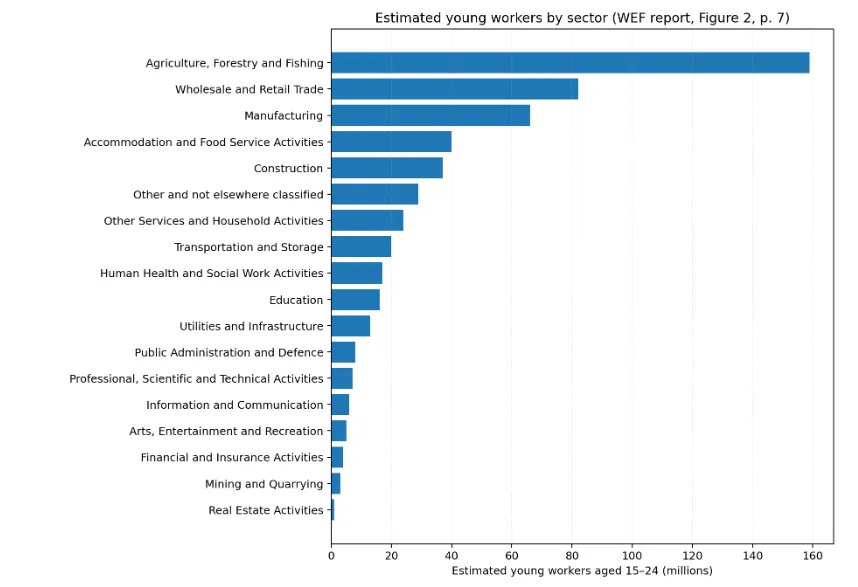
For students and early-career professionals, this means that the impact of AI will largely depend on the field they choose.
Those targeting corporate, finance, or technology roles need to understand how AI is changing work in these fields. The growing focus on these areas is also reflected in IIM executive education programmes covering AI, finance, technology and leadership.
Why Getting Your First Job Is Becoming Harder: The Entry-Level Hiring Squeeze
AI is adding to entry-level hiring pressures, alongside economic uncertainty, cost-cutting and changing employer needs.
According to the WEF report, entry-level job vacancies in occupations with the highest AI exposure have flatlined or declined. In the United States, entry-level hiring in these fields has fallen by 16% since late 2022.
However, AI is not the sole cause. Job postings began declining nearly a year before ChatGPT launched in November 2022, indicating that broader economic pressures and corporate cost-cutting also contribute to the slowdown.
The impact also varies across worker groups:
-
Age and AI adoption: Around 20% of entry-level workers are Gen X professionals aged 45–60 who are switching careers or re-entering the workforce. The report also highlights an age-based difference in AI adoption, finding that 84% of Baby Boomers had not used AI agents in the past 12 months, compared with 57% of Gen Z.
-
Gender and AI exposure: Women are more likely to work in occupations with higher generative AI exposure, particularly clerical and administrative roles, which face nearly twice the exposure of male-dominated occupations.
The challenge is not just whether AI will replace jobs, but how hiring pressures and changing skill requirements affect different groups of workers.
As entry-level hiring becomes more competitive, find out which AI skills employers expect from fresh graduates
How Is AI Changing the Way Young Professionals Work?
Knowing how to use AI is not enough; workers also need to check its outputs and apply independent judgement.
While AI is reshaping entry-level hiring, its impact extends beyond the number of jobs available. For young professionals entering the workforce, generative AI tools promise to reduce repetitive tasks, save time, and improve productivity. However, greater efficiency does not always translate into better work or a lighter workload.
According to the WEF report,
“68% of entry-level workers report increased productivity from using generative AI tools. Yet, 45% also report spending more time working overall, driven by rising output expectations and work intensification.”
This suggests that while AI can help employees complete tasks faster, organizations may respond by expecting them to produce more rather than allowing them to work less.
The challenge lies in how companies integrate AI into their existing workflows. Simply introducing AI tools without rethinking how work is structured can create new problems, particularly for employees at the beginning of their careers.
Explore the Postgraduate Certificate Programme in Business Analytics and Generative AI to develop in-demand analytical skills, gain practical insights, and strengthen your ability to make data-driven business decisions.
Bridging the Education Gap: Adaptability Over Traditional Degrees
A university degree can provide a strong foundation, but it may no longer be enough on its own. Employers increasingly need people who can apply their knowledge, solve real-world problems, and adapt as job requirements evolve.
According to the WEF report,
skills in entry-level roles with the highest AI exposure are changing at nearly twice the rate observed in non-entry-level roles.
This rapid shift is creating uncertainty among young professionals about whether their current skills will remain relevant.
These findings point to a growing need for continuous learning and practical skill development.
The need of the hour is:
Combine formal education with practical experience, AI literacy, and skills that remain useful across roles.
This is why IITs are expanding AI programmes that help students develop AI literacy, practical skills, and adaptability to prepare for the evolving demands of the job market.
How Can You Prepare for an AI-Driven Job Market? 4 Practical Steps
Focus on working effectively alongside AI, while building the human judgement and practical experience that technology cannot replace on its own.
Here are four practical steps to prepare for the changing world of work:
-
Learn to Orchestrate AI Tools: Go beyond basic prompting. Learn to integrate AI into workflows, verify its outputs, and use human judgment to ensure quality. AI-Driven General Management, AI-Driven Human Resource Management, and Business Analytics & Generative AI can help professionals apply AI strategically, make data-driven decisions, and adapt to evolving workplace demands.
-
Build a Portfolio of Real-World Projects: Showcase practical projects that demonstrate your problem-solving abilities, subject knowledge, and ability to handle complex challenges.
-
Choose Employers That Support Growth: During interviews, ask how the company uses AI, trains employees, and encourages continuous learning. Look for workplaces that value quality, employee development, and skill-building alongside productivity. Adopt a Mosaic Career Mindset: Focus on transferable skills, cross-functional experience, and continuous learning rather than relying solely on traditional promotions. The ability to adapt across roles can help you navigate changing job requirements.
AI is changing early-career jobs at different rates across regions and industries, with knowledge-based economies facing greater exposure than many physical-work sectors. However, the divide extends beyond automation to hiring opportunities, skill requirements, and access to career growth.
As AI adoption accelerates, preparing young professionals will require a combination of AI literacy, practical experience, and adaptable human skills, alongside employer support to ensure that the next generation can enter, learn, and thrive in the evolving world of work.


Have questions about your prep?
Our experts can answer all your questions







 Live & recorded classes available at easeDashboard for progress trackingLakhs of practice questions


