






RS Aggarwal Solutions for Class 10 Maths Chapter 19 Exercise 19.4 Volume and Surface Areas of Solids
 Neha Tanna30 Jul, 2024
Share
RS Aggarwal Solutions for Class 10 Maths Chapter 19 Exercise 19.4: The Entrancei academic team has produced a comprehensive answer for Chapter 19 Volume and Surface Area of Solids in the RS Aggarwal textbook for Class 10. Complete the NCERT exercise questions and utilise them as a guide. Solutions for Entrancei NCERT Class 10 Maths problems in the exercise require assistance to be completed. For maths in class 10, Entrancei published NCERT answers.
The RS Aggarwal class 10 solution for chapter 19 Volume and Surface Area of Solids Exercise-19D is uploaded for reference only. Before going through the solution of chapter-19 Volume and Surface Area of Solids Exercise-19D, one must have a clear understanding of the chapter-19 Volume and Surface Area of Solids. Read the theory of chapter-19 Volume and Surface Area of Solids and then try to solve all numerical of exercise-19D.RS Aggarwal Solutions for Class 10 Maths Chapter 19 Exercise 19.4(D) Volume and Surface Areas of Solids Overview
RS Aggarwal Solutions for Class 10 Maths Chapter 19 Exercise 19.4 focuses on the volume and surface areas of solids. This chapter provides comprehensive problems that help students understand the calculations involved in determining the volume and surface area of various geometric shapes like spheres, cylinders, cones, and cuboids. The exercise emphasizes practical application, making it easier for students to grasp the concepts by solving real-world problems. The solutions provided in this exercise are step-by-step, ensuring that students can follow along and understand each calculation's rationale. This approach helps reinforce the learning process and builds a solid foundation for solving more complex problems in geometry. Overall, Exercise 19.4 is crucial for mastering the concepts of volume and surface areas of solids, which are fundamental in higher mathematics and practical applications.RS Aggarwal Solutions for Class 10 Maths Chapter 19 Exercise 19.4 PDF
RS Aggarwal Solutions for Class 10 Maths Chapter 19 Exercise 19.4 provides a comprehensive learning experience that equips students with the necessary knowledge and skills to tackle questions confidently. Here we have provided RS Aggarwal Solutions for Class 10 Maths Chapter 19 Exercise 19.4 for the ease of students so that they can prepare better for their upcoming exams –RS Aggarwal Solutions for Class 10 Maths Chapter 19 Exercise 19.4 PDF
RS Aggarwal Solutions for Class 10 Maths Chapter 19 Exercise 19.4
Below we have provided RS Aggarwal Solutions for Class 10 Maths Chapter 19 Exercise 19.4 for the ease of the students –4.2 c m
Question
From a solid cylinder whose height is 2.4 cm and diameter is 1.4 cm, a conical cavity of the
same height and same diameter is hollowed out. Find the total surface area of the
remaining solid to the nearest cm 2 .
Solution
From the question, we know the following: The diameter of the cylinder = diameter of conical cavity = 1.4 cm So, the radius of the cylinder = radius of the conical cavity = 1.4/2 = 0.7 Also, the height of the cylinder = height of the conical cavity = 2.4 cm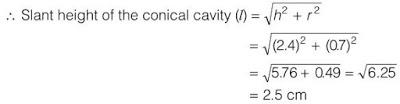 Now, the TSA of the remaining solid = surface area of conical cavity + TSA of the cylinder
= πrl+(2πrh+πr
2
)
= πr(l+2h+r)
= (22/7)× 0.7(2.5+4.8+0.7)
= 2.2×8 = 17.6 cm
2
So, the total surface area of the remaining solid is 17.6 cm
2
Now, the TSA of the remaining solid = surface area of conical cavity + TSA of the cylinder
= πrl+(2πrh+πr
2
)
= πr(l+2h+r)
= (22/7)× 0.7(2.5+4.8+0.7)
= 2.2×8 = 17.6 cm
2
So, the total surface area of the remaining solid is 17.6 cm
2
Question
Metallic spheres of radii 6 cm, 8 cm and 10 cm, respectively, are melted to form a single solid sphere. Find the radius of the resulting sphere.
Solution
For Sphere 1:
Radius (r 1 ) = 6 cm ∴ Volume (V 1 ) = (4/3)×π×r 1 3For Sphere 2:
Radius (r 2 ) = 8 cm ∴ Volume (V 2 ) = (4/3)×π×r 2 3For Sphere 3:
Radius (r 3 ) = 10 cm ∴ Volume (V 3 ) = (4/3)× π× r 3 3 Also, let the radius of the resulting sphere be “r” Now, The volume of the resulting sphere = V 1 +V 2 +V 3 (4/3)×π×r 3 = (4/3)×π×r 1 3 +(4/3)×π×r 2 3 +(4/3)×π×r 3 3 r 3 = 6 3 +8 3 +10 3 r 3 = 1728 r = 12 cmQuestion
How many silver coins, 1.75 cm in diameter and of thickness 2 mm, must be melted to form a cuboid of dimensions 5.5 cm × 10 cm × 3.5 cm?
Solution
It is known that the coins are cylindrical in shape. So, height (h 1 ) of the cylinder = 2 mm = 0.2 cm Radius (r) of circular end of coins = 1.75/2 = 0.875 cm Now, the number of coins to be melted to form the required cuboids be “n” So, Volume of n coins = Volume of cuboids n × π × r 2 × h 1 = l × b × h n×π×(0.875) 2 ×0.2 = 5.5×10×3.5 Or, n = 400Question
Water in a canal, 6 m wide and 1.5 m deep, flows at a speed of 10 km/h. How much area will it irrigate in 30 minutes if 8 cm of standing water is needed?
Solution
It is given that the canal is the shape of a cuboid with dimensions as: Breadth (b) = 6 m and Height (h) = 1.5 m It is also given that The speed of canal = 10 km/hr Length of canal covered in 1 hour = 10 km Length of canal covered in 60 minutes = 10 km Length of canal covered in 1 min = (1/60)x10 km Length of canal covered in 30 min (l) = (30/60)x10 = 5km = 5000 m We know that the canal is cuboidal in shape. So, The volume of the canal = lxbxh = 5000x6x1.5 m 3 = 45000 m 3 Now, The volume of water in the canal = Volume of area irrigated = Area irrigated x Height So, Area irrigated = 56.25 hectares ∴ The volume of the canal = lxbxh 45000 = Area irrigatedx8 cm 45000 = Area irrigated x (8/100)m Or, Area irrigated = 562500 m 2 = 56.25 hectares.Question
The slant height of a frustum of a cone is 4 cm, and the perimeters (circumference) of its circular ends are 18 cm and 6 cm. Find the surface area of the frustum.
Solution
Given, Slant height (l) = 4 cm Circumference of upper circular end of the frustum = 18 cm ∴ 2πr 1 = 18 Or, r 1 = 9/π Similarly, the circumference of the lower end of the frustum = 6 cm ∴ 2πr 2 = 6 Or, r 2 = 3/π Now, the surface area of the frustum = π(r 1 +r 2 ) × l = π(9/π+3/π) × 4 = 12×4 = 48 cm 2Benefits of RS Aggarwal Solutions for Class 10 Maths Chapter 19 Exercise 19.4
The RS Aggarwal Solutions for Class 10 Maths Chapter 19 Exercise 19.4, focusing on Volume and Surface Areas of Solids, offer several benefits to students:Comprehensive Understanding : The solutions provide detailed step-by-step explanations, helping students understand the principles behind calculating volume and surface areas of various solids such as spheres, cylinders, cones, and cuboids.
Problem-Solving Skills : By working through these problems, students enhance their problem-solving abilities, learning how to approach and solve complex geometry problems systematically.
Concept Clarity : The solutions clarify fundamental concepts by breaking down complicated problems into manageable steps, ensuring that students grasp the underlying mathematical principles.
Exam Preparation : Practicing these exercises prepares students for exams by familiarizing them with the types of questions that may appear, improving their speed and accuracy.
Confidence Building : Successfully solving these problems boosts students' confidence in their mathematical abilities, encouraging them to tackle more challenging problems.
RS Aggarwal Solutions for Class 10 Maths Chapter 19 Exercise 19.4 FAQs
What topics are covered in Exercise 19.4 of RS Aggarwal Class 10 Maths?
How can RS Aggarwal Solutions help in understanding volume and surface areas of solids?
Are the RS Aggarwal Solutions useful for board exam preparation?
Is RS Aggarwal Solutions for Class 10 Maths Chapter 19 Exercise 19.4 Volume and Surface Areas of Solids helpful?










 Live & recorded classes available at easeDashboard for progress trackingMillions of practice questions at your fingertips

