







PW Class 7 Social Science Chapter 11 Notes: From Barter to Money

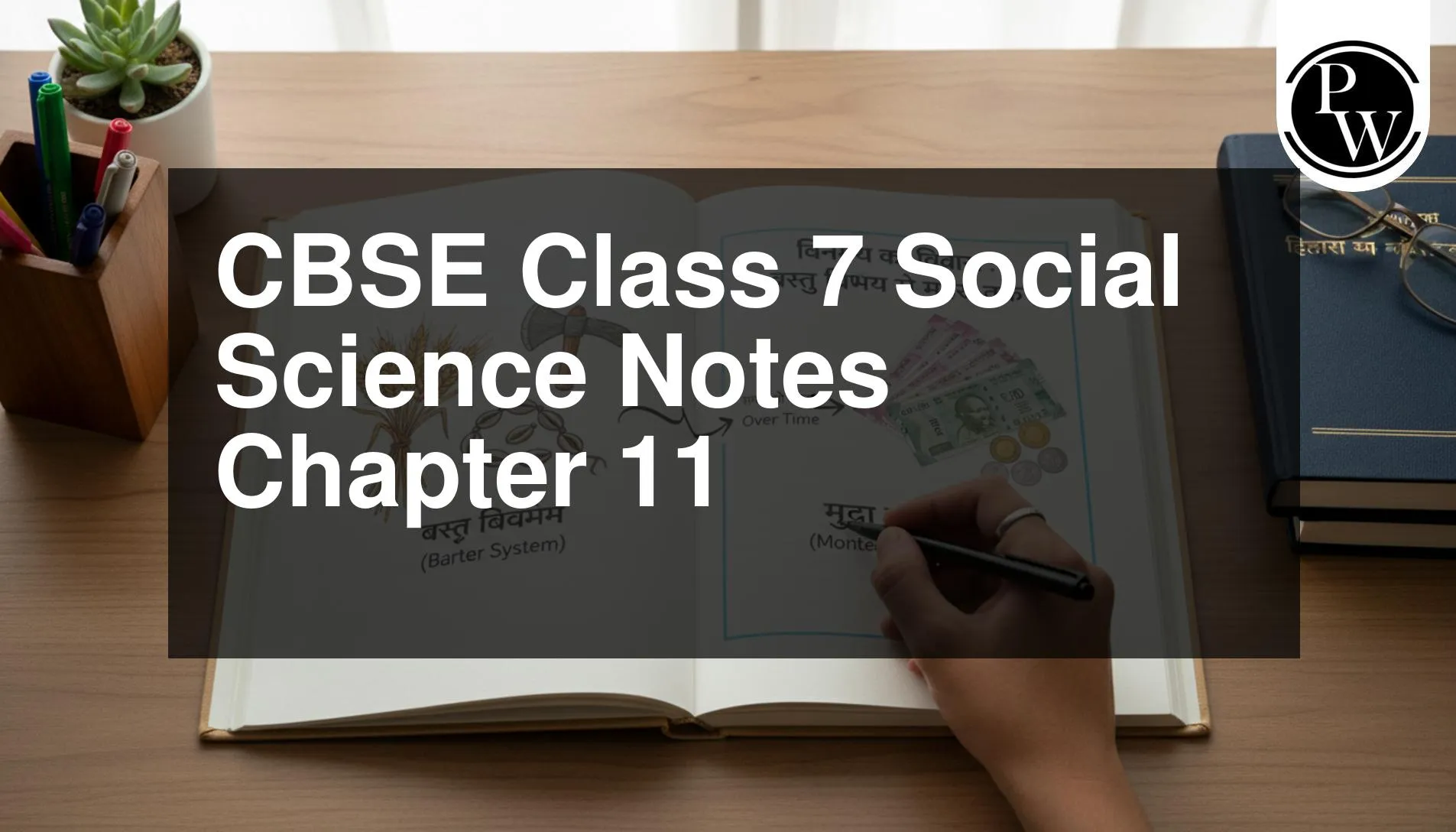
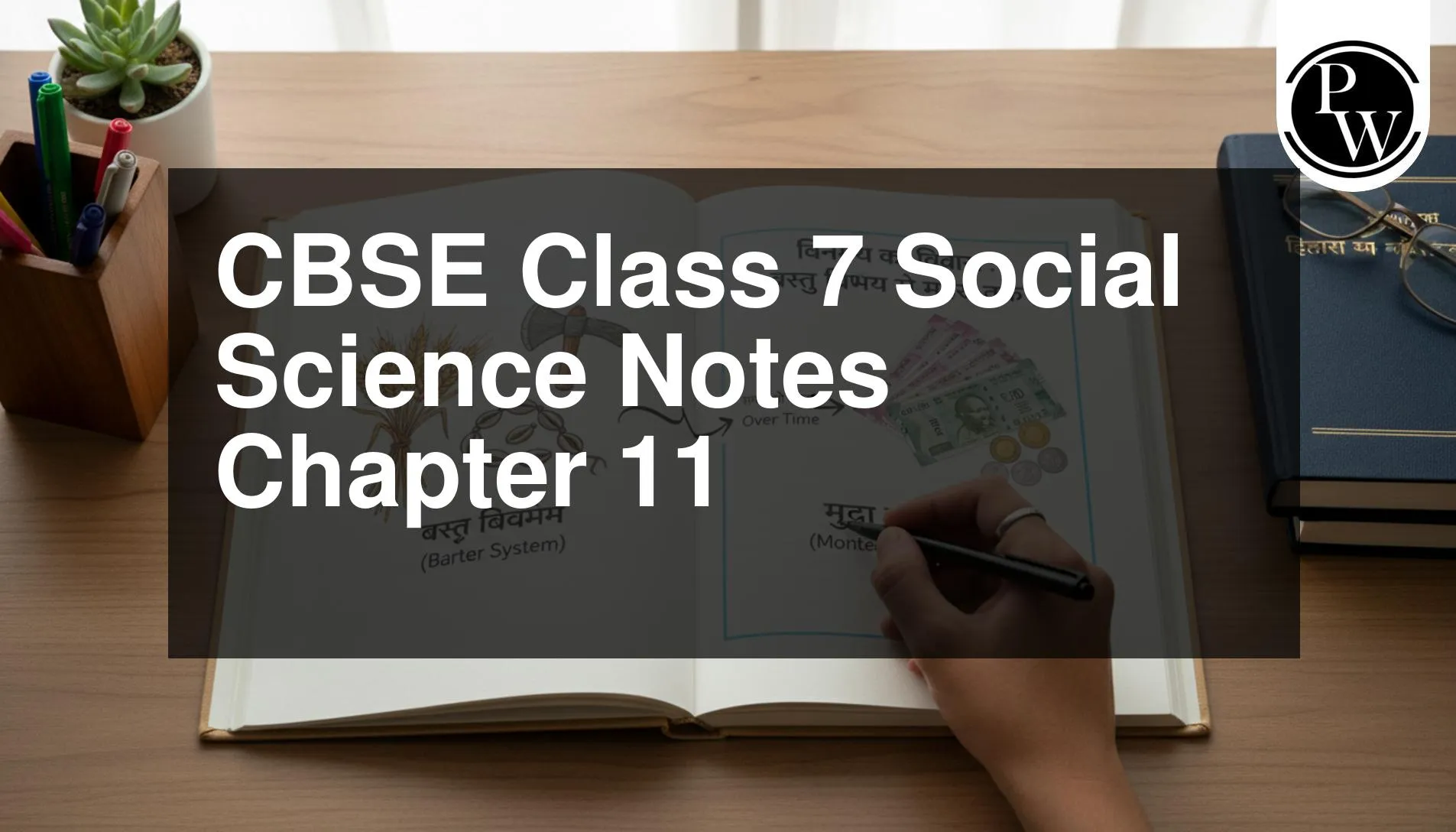
Trade has changed significantly from the exchange of goods to the use of coins, paper currency, and digital payments. This chapter explains how people bought and sold goods before money, why the barter system became difficult to use, and how different forms of money developed over time. Revising these connected ideas can be challenging because the chapter combines history with basic economic concepts.
PW Class 7 Social Science Chapter 11 Notes present From Barter to Money in a simple and organised format for quick revision. You can revisit the barter system, its limitations, early forms of money, the functions of money, coinage, paper currency, digital transactions, and key economic terms before textbook exercises and school assessments.
What Is the Barter System?
Barter is the exchange of goods or services without using money. People directly traded one item for another according to their needs.
Examples of Barter
-
Exchanging wheat for rice
-
Trading an eraser for a pencil
-
Exchanging handmade goods for food
Barter was widely used before money became a common medium of exchange.
What Were the Limitations of Barter?
Although barter helped people exchange goods, it had several practical problems.
Major Limitations
-
Double coincidence of wants: Both people had to want what the other offered.
-
No common measure of value: It was difficult to decide equal value between different goods.
-
Indivisibility: Items like cattle could not be divided easily for smaller exchanges.
-
Lack of portability: Carrying goods over long distances was difficult.
-
Lack of durability: Perishable goods could spoil before being exchanged.
These limitations led to the development of money.
Why Did Money Emerge?
Money became a widely accepted medium of exchange because it solved many problems of the barter system.
Advantages of Money
-
Accepted by everyone
-
Easy to carry and store
-
Helps compare the value of goods
-
Makes buying and selling more convenient
-
Supports saving and future payments
What Were the Early Forms of Money?
Different societies used various objects as money before coins and paper currency became common.
Examples
-
Cowrie shells
-
Salt
-
Tobacco
-
Cloth
-
Seeds
-
Cattle
-
Stone and feather coins
These items served as mediums of exchange in different regions and cultures.
What Is Junbeel Mela?
Junbeel Mela is a traditional barter fair held in Assam and Meghalaya where communities continue exchanging goods without using money.
It demonstrates that barter still survives as a cultural and economic tradition in some parts of India.
What Are the Main Functions of Money?
Money performs several important functions in everyday economic life.
|
Function |
Purpose |
|
Medium of exchange |
Used to buy and sell goods and services |
|
Store of value |
Preserves wealth for future use |
|
Standard of deferred payment |
Enables future payments and credit |
|
Common measure of value |
Helps compare prices of different goods |
How Did Money Evolve in India?
The forms of money changed gradually as trade and commerce developed.
|
Period |
Type of Money |
|
6000 BCE |
Barter system |
|
1000 BCE |
Cowrie shells |
|
600 BCE |
Metal coins |
|
1861 |
Official paper money |
|
1980s–2016 |
Debit and credit cards |
|
Present day |
UPI, QR codes, and digital payments |
How Did Coins and Paper Money Develop?
Early Indian coins were made from metals, and later paper currency made transactions easier.
Coinage
-
Coins were made from gold, silver, and copper alloys.
-
They carried symbols of kings, deities, and nature.
-
Metal coins became an important medium of trade.
Paper Currency
-
Reduced the need to carry heavy coins.
-
Became an official form of money in India.
-
Today, the Reserve Bank of India (RBI) issues and regulates currency.
What Are Modern Forms of Money?
Technology has introduced new ways of making payments without using physical cash.
Digital Payment Methods
-
UPI
-
QR codes
-
Debit cards
-
Credit cards
-
Net banking
For example, a fruit seller can receive payment instantly through a QR code.
Important Vocabulary |
|
|---|---|
|
Term |
Meaning |
|
Barter |
Exchange of goods without money |
|
Money |
Accepted medium of exchange |
|
Coinage |
Minted metallic money |
|
Currency |
Paper and coin money of a country |
|
UPI |
Unified Payments Interface for digital transactions |
|
QR Code |
Digital payment method using a scannable code |
How Can Physics Wallah Class 7 Social Science Chapter 11 Notes Help You?
These notes simplify the evolution of money and help you revise important economic concepts quickly.
-
Understand the Barter System: Learn how goods and services were exchanged before money.
-
Revise Barter Limitations: Recall the problems that made barter inconvenient.
-
Explore the Evolution of Money: Study how money developed from cowrie shells to digital payments.
-
Learn the Functions of Money: Understand exchange, value storage, deferred payment, and value measurement.
-
Understand Coinage and Currency: Revise the development of coins and paper money in India.
-
Explore Digital Payments: Learn how UPI, QR codes, and banking have changed transactions.
-
Remember Key Vocabulary: Revise important economic terms and their meanings.
-
Prepare for Assessments: Strengthen chapter concepts before textbook exercises and school examinations.
The journey from barter to digital payments shows how trade has become more convenient and efficient over time. Understanding the limitations of barter, the functions of money, and the evolution of currency helps explain how modern economic transactions work and strengthens your understanding of everyday financial concepts.
Related Resources
-
CBSE Class 7 Social Science Important Questions
-
CBSE Class 7 Social Science Sample Paper
CBSE Class 7 Social Science Notes Chapter 11 FAQs
What are From Barter to Money Class 7 Notes?
Why is the barter system important in history?
What are the limitations of the barter system?
Why was money introduced?









 Live & recorded classes available at easeDashboard for progress trackingMillions of practice questions at your fingertips

