Physics Wallah
banner

CBSE Class 8 Science Notes Chapter 4, Download PDF

CBSE Class 8 Science Notes Chapter 4 covers the Magnetic and Heating Effects of Electric Current, Electromagnets, Electric Bells, Circuit Breakers, and Fuse wires. These notes simplify important concepts, making revision easier and helping students prepare effectively for exams.
authorImageNeha Tanna20 Jun, 2026
CBSE Class 8 Science Notes Chapter 4

CBSE Class 8 Science Notes Chapter 4 provides a simplified explanation of Electricity: Magnetic and Heating Effects, one of the most important chapters in the Class 8 Science syllabus. These notes cover all key concepts, definitions, diagrams, and applications in a concise format, making them useful for quick revision before tests and exams.

In this chapter, students learn how electric current produces magnetic and heating effects and how these principles are used in devices such as electric bells, electromagnets, fuse wires, and MCBs. The notes are designed to help students understand the chapter easily while improving concept clarity and exam preparation.

Electricity: Magnetic and Heating Effects Class 8 Notes

Electricity: Magnetic and Heating Effects Class 8 Notes explain two important applications of electric current—the heating effect and the magnetic effect of electricity. 

Electric Current

  • Electric current is the flow of electric charges (electrons) through a conductor.

  • Electric current is measured in Ampere (A) using an Ammeter (always connected in series).

  • Potential difference is measured in Volts (V) using a Voltmeter (connected in parallel).

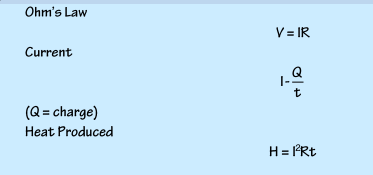
Formula:

  • Where I = current, V = voltage, R = resistance

  • This is Ohm’s Law.

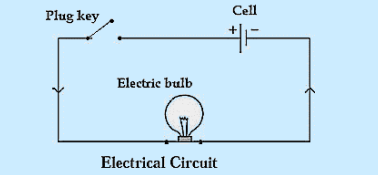
Electric Circuit

  • Electric circuit is a complete path for current to flow.

  • Circuit components: cell, battery, wires, switch, bulb, resistor.

  • Closed circuit → current flows

  • Open circuit → current does not flow

Electrical Circuit Diagram Components:

  • Plug key

  • Cell (+, −)

  • Electric bulb

Magnetic Effect of Electric Current

  • Discovered by Hans Christian Oersted.

  • When electric current passes through a conductor, a magnetic field is produced around it.

Important Points

  • Magnetic field is stronger near the wire and decreases with distance.

  • The field around a straight wire forms concentric circles.

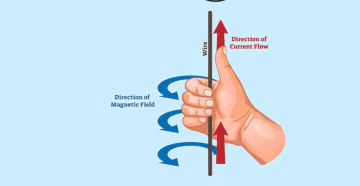
  • Right-hand Thumb Rule
    → Thumb = direction of current
Electromagnet

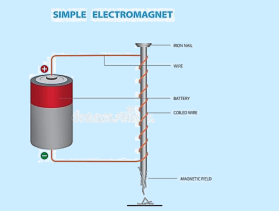
A temporary magnet created when current flows through a coil wire (solenoid) wrapped around a soft iron core.
Factors Affecting Strength of an Electromagnet

  1. Increasing number of turns of coil

  2. Increasing current

  3. Using soft iron core

  4. Thick, uniform coil

Uses of Electromagnets

  • Electric bell

  • MRI machines

  • Cranes (lifting scrap iron)

  • Motors

  • Relays

Electric Bell (Working)

  • Contains an electromagnet.

When current flows:

  1. Electromagnet attracts the iron armature.

  2. Hammer hits the bell.

  3. Contact breaks → current opens → magnet loses magnetism.

  4. Spring pulls armature back → contact is restored.

  5. Cycle repeats rapidly creating ringing sound.

Heating Effect of Electric Current
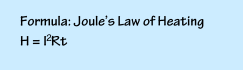
  • When electric current flows through a conductor, it produces heat.

Where

  • H = heat produced

  • I = current

  • R = resistance

  • t = time

More Current = More Heat

  • More resistance = more heat

Applications of Heating Effect

  1. Electric iron, toaster, geyser, heater

    • Work on heating effect

  2. Electric bulb (Filament)

    • Has a tungsten filament

    • High melting point → glows without melting

  3. Fuse

    • Is a safety device

    • Made of low melting point metal

    • Prevents overheating by breaking the circuit when excessive current flows

CFL, LED (Energy Efficient Devices)

  • CFL uses less electricity than filament bulbs

  • LED uses even less energy, produces less heat

  • Long-lasting and eco-friendly

Difference Between Magnetic & Heating Effect

Magnetic Effect

Heating Effect

Current produces magnetic field

Current produces heat

Basis of electromagnets, motors

Basis of heaters, bulbs

Discovered by Oersted

Explained by Joule

Important Formulas

Electricity: Magnetic and Heating Effects Notes PDF by PW

The Electricity: Magnetic and Heating Effects PDF by Physics Wallah provides a concise summary of all important concepts covered in Chapter 4. It includes definitions, diagrams, working principles, applications, and key exam-oriented points that help students revise the chapter efficiently.

Students can use the PDF for quick revision before tests and exams, making it easier to understand concepts such as electromagnets, electric bells, fuse wires, MCBs, and the heating effect of electric current without referring to lengthy textbook explanations.

Electricity: Magnetic and Heating Effects PDF

How PW Class 8 Science Notes Help in Exam Preparation?

PW Class 8 Science Notes are designed to simplify complex concepts and help students revise the syllabus efficiently. These notes present important definitions, diagrams, examples, and key points in a structured format, making learning more effective.

  1. Simplified Explanations

Concepts such as electromagnets, electric bells, fuse wires, and MCBs are explained in easy-to-understand language, helping students grasp the fundamentals quickly.

  1. Quick Revision Resource

The notes combine the entire chapter into concise points, allowing students to revise important topics in less time before exams.

  1. Focus on Important Concepts

Key topics like the magnetic effect of current, heating effect of current, and electrical safety devices are highlighted to help students focus on exam-relevant content.

  1. Better Concept Retention

Organized explanations and examples make it easier to remember important concepts and their real-life applications.

  1. Useful for School Exams and Assessments

The notes cover all major topics from the CBSE syllabus, making them ideal for periodic tests, unit tests, and final examinations.


CBSE Class 8 Science Notes Chapter 4 FAQs

What is the magnetic effect of electric current?

The magnetic effect of electric current is the phenomenon in which a magnetic field is produced around a conductor carrying electric current.

What is an electromagnet?

An electromagnet is a temporary magnet formed when electric current passes through a coil wound around a soft iron core.

Why is a fuse used in electrical circuits?

A fuse protects electrical appliances and circuits from damage caused by excessive current or short circuits.

What is the difference between a fuse and an MCB?

A fuse melts and needs replacement after use, whereas an MCB automatically trips during overload and can be reset for reuse.

What are the applications of the heating effect of electric current?

The heating effect is used in electric irons, heaters, kettles, toasters, water heaters, and electric bulbs.
Join 15 Million students on the app today!
Point IconLive & recorded classes available at ease


Point IconDashboard for progress tracking
Point IconMillions of practice questions at your fingertips
Download ButtonDownload Button
Banner Image
Banner Image
Free Learning Resources
Know about Physics Wallah
Physics Wallah is an Indian edtech platform that provides accessible & comprehensive learning experiences to students from Class 6th to postgraduate level. We also provide extensive NCERT solutions, sample paper, NEET, JEE Mains, BITSAT previous year papers & more such resources to students. Physics Wallah also caters to over 3.5 million registered students and over 78 lakh+ Youtube subscribers with 4.8 rating on its app.
We Stand Out because
We provide students with intensive courses with India’s qualified & experienced faculties & mentors. PW strives to make the learning experience comprehensive and accessible for students of all sections of society. We believe in empowering every single student who couldn't dream of a good career in engineering and medical field earlier.
Our Key Focus Areas
Physics Wallah's main focus is to make the learning experience as economical as possible for all students. With our affordable courses like Lakshya, Udaan and Arjuna and many others, we have been able to provide a platform for lakhs of aspirants. From providing Chemistry, Maths, Physics formula to giving e-books of eminent authors like RD Sharma, RS Aggarwal and Lakhmir Singh, PW focuses on every single student's need for preparation.
What Makes Us Different
Physics Wallah strives to develop a comprehensive pedagogical structure for students, where they get a state-of-the-art learning experience with study material and resources. Apart from catering students preparing for JEE Mains and NEET, PW also provides study material for each state board like Uttar Pradesh, Bihar, and others

Copyright © 2026 Physicswallah Limited All rights reserved.