







Class 10 Science Chapter 9 Light Reflection and Refraction is an important chapter for CBSE board exams as it introduces concepts like reflection of light, spherical mirrors, refraction, lenses, image formation, and related numericals. To score well in this chapter, regular practice of important questions and diagrams is essential.
Physics Wallah provides most important questions with solutions to help you strengthen concepts, improve problem-solving accuracy, and prepare effectively for board exams. These questions are designed according to the latest CBSE pattern and help you focus on the most exam-relevant topics.
Multiple Choice Questions [1 Mark]
1. A spherical mirror and a thin lens have each a focal length of –20 cm.
(A) both are concave
(B) both are convex
(C) mirror is concave, lens is convex
(D) mirror is convex, lens is concave
Ans. (A) both are concave
2. A student traces the path of a ray of white light through a rectangular glass slab and marks the angles of incidence (∠i), refraction (∠r) and emergence (∠e) as shown.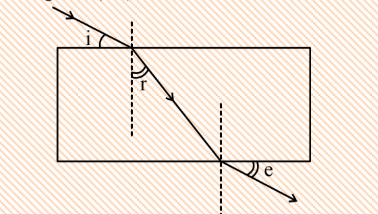
Which angle or angles have not been marked correctly?
(A) ∠i only
(B) ∠i and ∠r
(C) ∠r and ∠e
(D) ∠i and ∠e
Ans. (D) ∠i and ∠e
3. In which of the following is a concave mirror used?
(A) A solar cooker
(B) A rear view mirror in vehicles
(C) A safety mirror in shopping malls
(D) In viewing full size image of distant tall buildings
Ans. (A) A solar cooker
4. A ray of light starting from air passes through medium A (n = 1.50), medium B (n = 1.33) and medium C (n = 2.42). If this ray emerges out in air from C, then for which pair of media is the bending of light least?
(A) air – A
(B) A – B
(C) B – C
(D) C – air
Ans. (B) A–B
5. If a lens converges the Sun’s rays at a point 20 cm away from its optical centre, the power of this lens is—
(A) +2D
(B) –2D
(C) +5D
(D) –5D
Ans. (C) +5D
6. A mirror produces a real, inverted and highly enlarged image. The mirror is—
(A) Concave mirror
(B) Convex mirror
(C) May be concave or convex
(D) Plane mirror
Ans. (A) Concave mirror
7. Magnification produced by a rear-view mirror fitted in vehicles—
(A) is less than one
(B) is more than one
(C) is equal to one
(D) can be more than or less than one depending on object position
Ans. (A) is less than one
8. Statement I: If the angle of reflection is 45°, then the angle of incidence is 45°.
Statement II: Angle of incidence is equal to angle of reflection.
(A) Both Statements are true, Statement-II is the correct explanation of Statement-I.
(B) Both Statements are true, but Statement-II is not the correct explanation of Statement-I.
(C) Statement-I is true, Statement-II is false.
(D) Statement-I is false, Statement-II is true.
Ans. (A) Both Statements are true, Statement-II is the correct explanation of Statement-I.
9. Statement I: Image formed by a plane mirror is as far behind the mirror as the object is in front.
Statement II: A virtual image cannot be taken on a screen.
(A) Both Statements are true, Statement-II is the correct explanation of Statement-I.
(B) Both Statements are true, but Statement-II is not the correct explanation of Statement-I.
(C) Statement-I is true, Statement-II is false.
(D) Statement-I is false, Statement-II is true.
Ans. (B) Both Statements are true, Statement-II is not the correct explanation of Statement-I.
10. In a concave mirror, an erect and virtual image is formed when the object is placed—
(A) Between C and F
(B) Beyond C
(C) Between P and F
(D) At C
Ans. (C) Between P and F
11. Assertion (A): Higher refractive index → lower velocity of light.
Reason (R): Refractive index is inversely proportional to velocity.
(A) Both A and R are true, and R is the correct explanation.
(B) Both A and R are true, but R is not the correct explanation.
(C) A is true, R is false.
(D) A is false, R is true.
Ans. (A) Both A and R are true, and R is the correct explanation.
12. Assertion (A): Refractive index has no unit.
Reason (R): It is a ratio of two similar quantities.
(A) Both A and R are true, and R is the correct explanation.
(B) Both A and R are true, but R is not the correct explanation.
(C) A is true, R is false.
(D) A is false, R is true.
Ans. (A) Both A and R are true, and R is the correct explanation.
13. Assertion (A): A ray passing through the centre of curvature of a spherical mirror retraces its path after reflection.
Reason (R): Such a ray is incident normally on the mirror surface.
(A) Both A and R are true, and R is the correct explanation.
(B) Both A and R are true, but R is not the correct explanation.
(C) A is true, R is false.
(D) A is false, R is true.
Ans. (A) Both A and R are true, and R is the correct explanation.
14. Assertion (A): A convex lens forms a virtual, erect and enlarged image when the object lies between the lens and its principal focus.
Reason (R): A convex lens is a diverging lens.
(A) Both A and R are true, and R is the correct explanation.
(B) Both A and R are true, but R is not the correct explanation.
(C) A is true, R is false.
(D) A is false, R is true.
Ans. (C) A is true, but R is false.
15. Assertion (A): Mirrors used in searchlights are concave spherical.
Reason (R): In concave mirrors, the image formed is always virtual.
(A) Both A and R are true, and R is the correct explanation.
(B) Both A and R are true, but R is not the correct explanation.
(C) A is true, R is false.
(D) A is false, R is true.
Ans. (C) A is true, but R is false.
Very Short Answer Type Question [1 Mark]
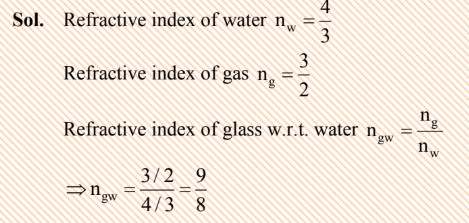
16. Refractive index of water is 4/3 and that of glass is 3/2 with respect to air. What is the refractive index of glass with respect to water?
17. Distinguish between real and virtual image.
Sol. The following are the differences between a real image and virtual image:
-
A real image can be caught on a screen whereas a virtual image cannot be caught on a screen.
-
A real image is always inverted whereas a virtual image is always erect.
-
A real image is formed when the rays of light after reflection or refraction actually meet at some point whereas a virtual image is formed when the rays of light after reflection or refraction appear to meet at a point.
-
A real image is formed by the actual intersection of light rays whereas a virtual image is formed by the imaginary intersection of light rays.
-
A real image can be formed in a screen but a virtual image can be only seen in the mirror.
-
A real image is formed by only concave mirror however a virtual image can be formed by concave, convex and plane mirror also.
18. Name the type of mirror used in the following situations:
a) Headlights of car
b) Rear–view mirror of vehicles
Sol.
a) Concave mirror
b) Convex mirror
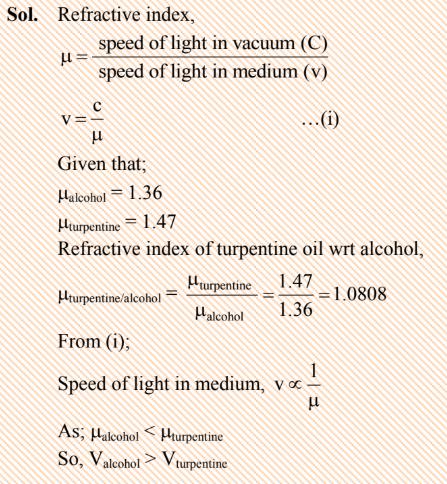
19. The refractive index of alcohol and turpentine oil with respect to air are 1.36 and 1.47, respectively. Find the refractive index of turpentine oil with respect to alcohol. In which of the two media will the speed of light be more?
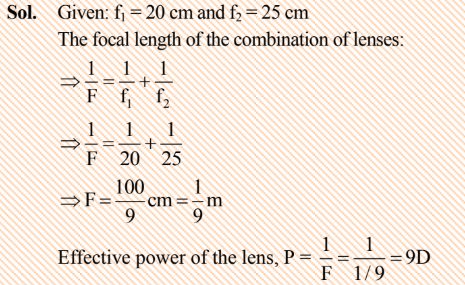
20. Two thin lenses of focal lengths 20 cm and 25 cm are placed in contact. What is the effective power of the combination of these lenses?
Sol.
Given:
21. A 6 cm object is placed perpendicular to the principal axis of a convex lens of focal length 15 cm. The distance of the object from the lens is 10 cm. Find the position, size and nature of the image formed, using the lens formula.
[4 Marks]
Sol.
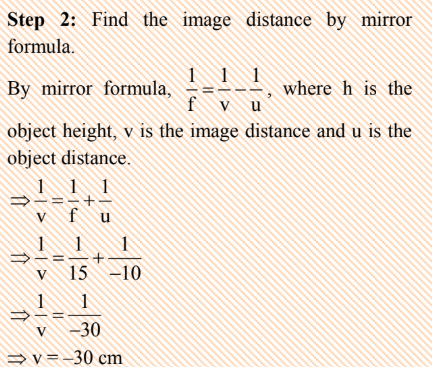
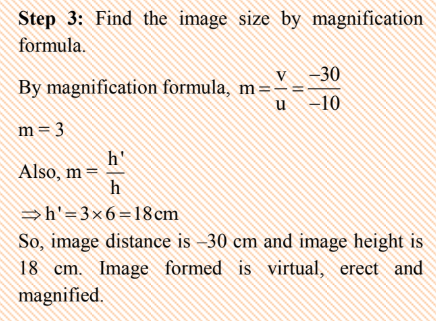
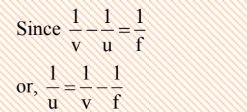
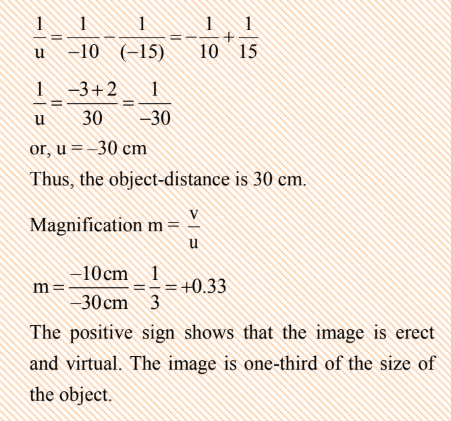
22. A concave lens has a focal length of 15 cm. At what distance should the object be placed from the lens so that it forms an image at 10 cm from the lens? Also, find the magnification produced by the lens.
Sol.
A concave lens always forms a virtual, erect image on the same side of the object.
Given:
Sol. A concave lens always forms a virtual, erect
image on the same side of the object.
Image-distance v = –10 cm;
Focal length f = –15 cm;
Object-distance u =?
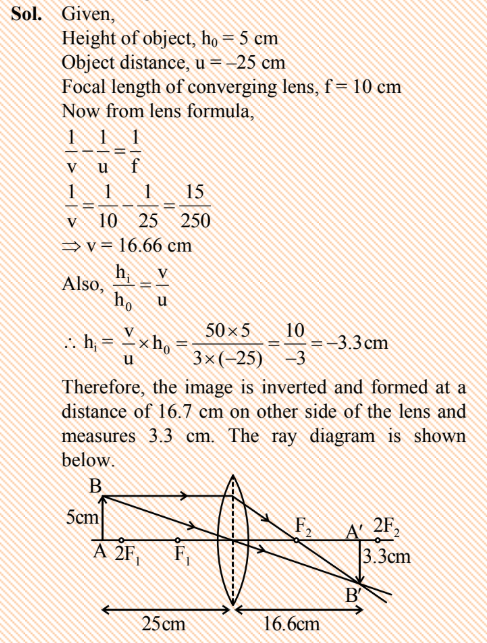
23. An object 5cm in length is held 25cm away from a converging lens of focal length 10cm. Draw the ray diagram and find the position, size, and nature of the image formed.
Sol. Given,
Height of object, h0 = 5 cm
Object distance, u = –25 cm
Focal length of converging lens, f = 10 cm
Now from lens formula,
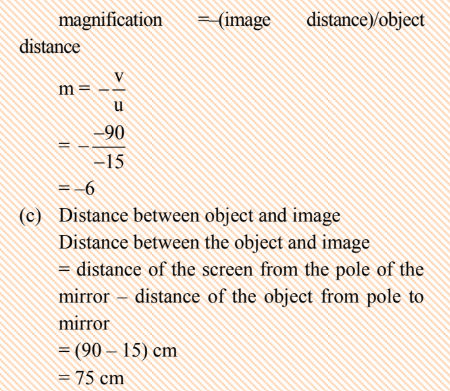
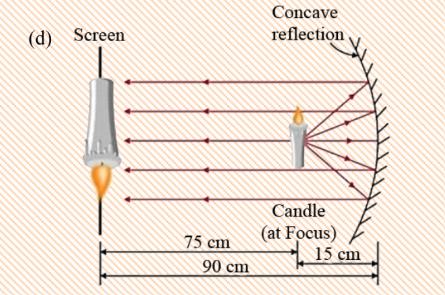
24. A student wants to project the image of a candle flame on a screen 90 cm in front of a mirror by keeping the flame at a distance of 15 cm from its pole.
(a) Suggest the type of mirror he should use
(b) Determine the linear magnification in this case
(c) Find the distance between the object and its image
(d) Draw ray diagram to show the image formation in this case
Sol. (a) The image is to be taken on the screen. So, the mirror to be used is a concave mirror.
(b) Given
Object distance, u = –15 cm
Image distance, v = –90 cm
The formula used and the calculation
PW Class 10 Science Chapter 9 Light Reflection and Refraction PDF
PW provides a downloadable PDF featuring important questions and their solutions for CBSE Class 10 Science Chapter 9 Light Reflection and Refraction, which is attached below. You can use this resource for offline study, quick revision, and board exam preparation.
Science Chapter 9 Light Reflection and Refraction PDF Download
Related Links
Light Reflection and Refraction Most Important Questions PDF
Study without using the internet
CBSE Important Questions for Class 10 Science Chapter 9 FAQs
What is the difference between reflection and refraction of light?
What are real and virtual images?
Which mirrors and lenses are used to form magnified or diminished images?
Why does light bend when it passes from one medium to another?







Get Free Counselling Today
and Clear up all your Doubts
 Live & recorded classes available at easeDashboard for progress trackingLakhs of practice questions

