

Class 10 Science Chapter 7 How Do Organisms Reproduce? can be difficult to organise during revision, as it brings together multiple processes, diagrams, and terminologies within the CBSE Class 10 Science syllabus. Shifting between different types of reproduction and systems often makes retention harder, making CBSE Class 10 Science important questions essential for focused preparation.
With Physics Wallah’s carefully selected questions, you can revise key topics such as asexual and sexual reproduction, the human reproductive system, reproductive health, and flowering plants systematically. This helps improve conceptual clarity, strengthen diagram-based answers, and approach CBSE board questions with greater accuracy and confidence.
How Do Organisms Reproduce Class 10 Most Important Questions Answers
Strengthen your understanding of Class 10 Science Chapter 7: How Do Organisms Reproduce with these high-yield questions and answers.
Practice concepts like asexual and sexual reproduction, reproductive organs, fertilization, pollination, and heredity. Solving how do organisms reproduce class 10 important questions helps you revise effectively, understand key mechanisms of reproduction in plants and animals, and improve accuracy in exams.
Multiple Choice Question (1 Mark)
-
In vegetative reproduction, the new individuals are genetically:
(A) Similar (B) Dissimilar (C) Abnormal (D) None of the above
Ans. (A) Similar -
When an organism breaks into several parts and each part develop into an individual, it is called:
(A) Budding (B) Binary fission (C) Regeneration (D) Spore formation
Ans. (C) Regeneration -
In females, fertilization of the ovum takes place in:
(A) Vagina (B) Ovary (C) Uterus (D) Fallopian tubes
Ans. (D) Fallopian tubes -
Which part of the flower forms the fruit?
(A) Whole flower (B) Only stamens and carpel (C) Only ovary (D) Only carpel
Ans. (C) Only ovary -
Anemophily is the pollination by:
(A) Birds (B) Rain (C) Insects (D) Wind
Ans. (D) Wind -
A common feature of reproduction in Amoeba, Spirogyra and Yeast is that:
(A) Asexual reproduction occurs after sexual reproduction.
(B) Asexual reproduction occurs before sexual reproduction.
(C) Asexual reproduction does not involve gametes.
(D) Asexual reproduction involves only one parent.
Ans. (D) Asexual reproduction involves only one parent. -
The normal duration of the menstrual cycle is:
(A) 7 – 8 days (B) 13 – 15 days (C) 3 – 4 days (D) 28 days
Ans. (D) 28 days -
Which of the following is an IUCD?
(A) Copper – T (B) Diaphragm (C) Oral pills (D) Tubectomy
Ans. (A) Copper-T -
Fertilization in plants occurs in the:
(A) embryo sac (B) style (C) pollen tube (D) stigma
Ans. (A) Embryo sac -
Define syngamy.
Sol. Fusion of the male gamete with the egg cell is called syngamy.
Section C (1 Mark)
-
Explain the role of the ovary and testis in humans during sexual reproduction.
Sol.
OVARY:
-
Produces female sex cells called eggs (ova).
-
Releases a mature egg every month during the menstrual cycle.
-
Produces hormones like estrogen and progesterone, which regulate the menstrual cycle and prepare the body for pregnancy.
TESTIS:
-
Produces male sex cells called sperm.
-
Continuously produces sperm from puberty onwards.
-
Produces testosterone, the male sex hormone responsible for secondary sexual characteristics.
-
Describe the process of fertilization in humans. Where does it occur?
Sol. Fertilization is the fusion of a sperm and an egg to form a zygote, the first cell of a new individual. It takes place in the fallopian tube of the female reproductive system.
(i) A sperm swims up the vagina and cervix, entering the fallopian tube.
(ii) If a sperm encounters an egg, it breaks through the egg’s protective layers using enzymes.
(iii) The nucleus of the sperm and the nucleus of the egg fuse, forming a zygote with a complete set of chromosomes.
-
Distinguish between external and internal fertilization. Give examples of each.
Sol.
| Feature | External fertilization | Internal fertilization |
| Location of fertilization | Outside the body | Inside the body |
| Adaptations | Aquatic environment, external gametes, large number of gametes | Land environment, internal gametes, fewer gametes, specialized reproductive organs |
| Examples | Fish, amphibians, some invertebrates | Mammals, birds, reptiles, some insects |
-
What is a callus?
Sol. Explants, or isolated plant structures, are grown in a glass container with the right nutrient media and aseptic conditions in artificial vegetative propagation. The explants develop into uniform cell aggregates known as callus. -
What happens if the mature ovum is not fertilized in a female? Name the process.
Sol. If a mature ovum is not fertilized in a female, it gets released into the fallopian tubes. This process is known as menstruation. -
Give two examples, each of IUCD and STD.
Sol. Examples of IUCD are Copper–T and loops. Examples of STDs are syphilis and gonorrhea. -
What is the difference between binary fission and multiple fission?
Sol.
| Binary fission | Multiple fission |
| In binary fission, the organism divides into two cells. | In multiple fission organisms divide into many daughter cells simultaneously. |
| Binary fission occurs in Amoeba and Leishmania. | Multiple fission occurs in Plasmodium. |
-
What are the basic features of asexual reproduction?
Sol. Basic features of asexual reproduction are as follows:
-
In asexual reproduction, only one organism is involved.
-
In asexual reproduction, cell divisions are either amitotic or mitotic.
-
Formation of gametes and their fertilization does not occur in asexual reproduction.
-
The process takes a short time, and new organisms are naturally alike to their parents.
-
List various reproductive parts of the flower.
Sol. The reproductive organs of flowers are stamens and pistils. Stamen is the male reproductive part also known as androecium. Pistil is the female reproductive part and made up of three parts named ovary, style and stigma. Pistils are also known as carpel and collectively known as gynoecium. -
Name the type of reproduction involved in the following:
(i) A slice of bread has greenish – yellow patches.
Sol. Greenish yellow patches on a slice of bread are due to spore formation.
(ii) Potato in the storeroom starts sprouting.
Sol. Potato in the storeroom starts sprouting due to vegetative propagation. -
Give two reasons for the appearance of variations among the offspring formed by sexual reproduction.
Sol. An offspring formed by sexual reproduction has variations because it involves two parents; therefore, the offspring has some characteristics of male and a few of female. Copying DNA isn't exactly the same as a parent. -
How does a human foetus derive nutrition?
Sol. A special disc-like structure is made between the embryo and the uterus wall called the placenta. It is a link between the mother and the foetus. This disc remains embedded within the uterine wall. It has villi on the embryo’s side of the tissue. On the mother’s side are blood spaces, which surround the villi. This provides an outsized area for the transfer of nutrients from mother to foetus. -
What is the difference between fission and budding?
Sol.
| Fission | Budding |
| In fission, the parent organism divides into two or multiple new cells. It is a kind of asexual reproduction. | In budding, a bud is developed as an outgrowth due to repeated cell division. This bud develops as individuals and separates from the parent when matured. |
| In fission, the parental identity is lost. | In budding, parental identity is preserved. |
-
Mention the function of the testis in humans?
Sol. The function of the testes is as follows:
-
Testes produce male gametes, sperm, by a process known as spermatogenesis.
-
Testes secrete male sex hormone testosterone, which helps in regulation of spermatogenesis and also keeps structure and function of secondary sex types like facial, axial and pubic hair, voice, moustache, etc.
-
Why does menstruation occur?
Sol. When the egg is not fertilized and the uterus has not received a fertilized egg, the lining becomes thick. The thick and soft inner lining of the uterus along with the blood vessels and the dead egg comes out of the vagina in the form of blood. This cycle is known as menstruation. -
How is the process of pollination different from fertilization?
Sol.
| Pollination | Fertilization |
| Pollination process takes place when pollen grains are transferred from anther to the stigma. | Fertilization process takes place when male and female gametes combine together and form a zygote. |
-
What is the role of the seminal vesicles and the prostate gland?
Sol. Seminal vesicles and prostate gland secretions provide fluid medium to sperm, which makes the transport easy and also provide nutrition to sperms. -
What are the changes seen in girls at the time of puberty?
Sol. During Puberty in girls, the following changes occurs:
1- Sharpening of voice.
2- Enlargement of the breast and the sex organ.
3 – The start of menstruation. -
If a woman is using a copper-T, will it help in protecting her from sexually transmitted diseases?
Sol. Copper-T is used to prevent pregnancy. It cannot protect the woman from obtaining sexually transmitted diseases. -
How does reproduction help in providing stability to populations of species?
Sol. To maintain the body design features the consistency of DNA copying during reproduction is important that allow the organism to use the particular function. Reproduction is, therefore, helps in providing stability to the population of a species. -
A pregnant woman visits a doctor to determine the sex of her child. The doctor refused to perform the test. Why is she being denied?
Sol. Sex determination is a crime in India. The doctor refused to perform the test to prevent female foeticide which leads to a shocking drop in child sex ratio. -
Blueprints of body design are stored in the DNA. Why?
Sol. The chromosomes present within the nucleus of a cell contain information for the inheritance of features from parents to child in the form of DNA molecules. DNA is the information basis for creating proteins. Thus, blueprints of the body design are stored in the DNA. -
Protozoa reproduce by binary fission as well as by multiple fission. In your opinion, which process is better and why?
Sol. Multiple fission is better than binary fission because in multiple fission organisms divides into multiple individuals. It helps to tide over unfavorable conditions. -
Why is it said that “sexual reproduction promotes diversity of characters in the offspring”?
Sol. Sexual reproduction promotes diversity because it results from the separation of two gametes from two different and sexually distinct individuals. This leads to variation, which is necessary for development. -
Name the causative organism of syphilis and gonorrhea.
Sol. The causative organism of syphilis is Treponema pallidum and the causative organism of gonorrhea is Nisseria gonorrhoeae.
-
People should be aware about the sexually transmitted diseases.
-
Extra–marital relations should be avoided.
-
Sex without proper precaution should be avoided.
-
High standard of moral education should be given to the people
-
Why is variation possible in the progeny of sexually reproductive individuals?
Sol. Variations are possible in progeny of sexually reproductive individuals because copy of DNA in newly formed cells is not like the copy of DNA of the original cell. -
Name the surgical methods of birth control in human males and females respectively.
Sol. Surgical methods of birth control in male is vasectomy. In vasectomy small pieces of both the vas deferens are cut and removed. Surgical methods of birth control in female are ovariectomy, tubectomy etc. In ovariectomy, ovaries are removed from the body. In tubectomy small pieces of both the fallopian tubes are removed. -
Mention the events taking place when the ovum is fertilized in fallopian tube till it is implanted in the uterus of human female.
Sol. When the ovum is fertilized, it starts dividing in the form of a ball of cells, also known as embryo. After 4–5 days the zygote becomes a multicellular structure called blastocyst. The blastocyst gets attached to the lining of the uterus during implantation. -
What are the post-fertilizational changes in the flower?
Sol. After fertilization, the egg divides to form an embryo in the ovule. The ovule grows a coat and gradually converts into a seed. The ovaries grow rapidly and ripen to form a fruit. The sepals, petals and stamens wither off, style and stigma degenerate. The seed contains the embryo which germinates to produce a new plant. -
What are the advantages of vegetative propagation?
Sol. Advantages of vegetative propagation are as follows:
-
It is a speedy, inexpensive and easy method of reproduction of multiple numbers of plants.
-
Plants produced are genetically identical plants (clones) that have similar characteristics to the parent.
-
Plants arose by vegetative propagation earlier produce fruits and flowers and have superior quality fruits or flowers.
-
Disease free plants can be produced by vegetative propagation.
-
Describe any 3 methods of asexual reproduction.
Sol. Three methods of asexual reproduction are binary fission, spore formation and fragmentation.
-
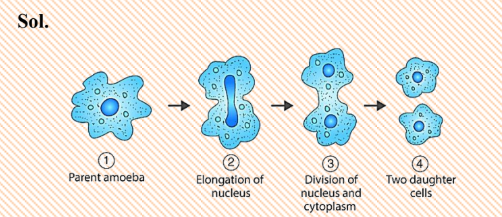
Binary fission – In binary fission organisms divide into two cells to produce new individuals. In a unicellular organism, the organism divides into two equal halves.
-
Spore formation – A spore may be a small microscopic structure with a thick wall. Spores are formed during a structure called sporangium. Nucleus inside the sporangium divides repeatedly and produces many nuclei. Each nucleus is surrounded by cytoplasm and called a spore.
-
Fragmentation – Multi-cellular organisms with simple body structure simply break into two or more parts upon maturation. These parts or fragments grow to form new individuals.
-
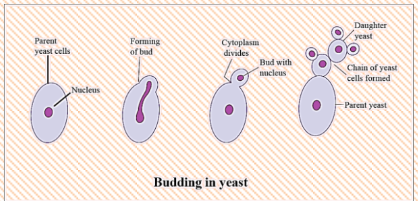
Describe budding in yeast, a fungus.
Sol. Organisms such as yeast use asexual reproduction processes known as budding to reproduce new cells. In this process, a bud develops as an outgrowth on the parent organism due to single cell division. The bud gradually grows in size and gets detached from the parent when fully matured and develops into an adult organism, similar to the parent.
-
Diagrammatically represent binary fission in Amoeba.
-
What are the different methods of contraception?
Sol. Different methods of contraception are barrier method, chemical method and intrauterine contraceptive device method.
-
Barrier method – In this method, a device is used to stop the entry of sperms in the female genital tract. Condoms, Diaphragm, Cervical caps are used in this method.
-
Chemical method – In this method, certain drugs (containing hormones) are used by the females. These drugs are available in the form of pills. There are two types of pills generally used for preventing pregnancies i.e oral pills and vaginal pills or creams.
-
Intrauterine contraceptive devices (IUCDs) – IUCD like copper-T is placed in the uterus to prevent implantation of the fertilized egg inside the uterus.
-
What is AIDS? Name its causative organism. Mention its symptoms.
Sol. AIDS is a sexually transmitted disease. AIDS is caused by HIV virus and can be transmitted through infected blood, semen or vaginal fluid. Its full form is acquired immune deficiency syndrome. It destroys the immune system of body. Some common symptoms of AIDS are fever, sore throat, weight loss, fatigue. Also, the body can be attacked by other diseases like pneumonia, TB and certain cancers. -
What is the importance of DNA copying in reproduction?
Sol. DNA copying in reproduction is the basic event. DNA contains information for the inheritance of features from parents to children. DNA present in the nucleus of cells is the information source for creating protein. If information is changed, altered protein will be made that lead to different body designs. -
Why is variation beneficial to the species but not necessarily for the individual?
Sol. Variations are useful for the existence of species in different environment conditions. If a population of reproducing organisms were suited to a specific niche and if the niche is drastically altered the population might be exhausted. However, some differences are present and some species will survive. Thus, variation is beneficial to species but not for the individual. -
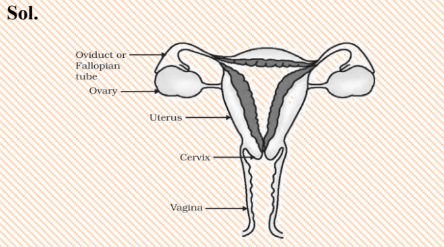
Draw a well labeled diagram of the female reproductive system and mention its parts.
-
A pair of ovaries – Ovaries produce eggs and female sex hormones. One egg is produced every month by one of the ovaries.
-
Fallopian tubes – There are two fallopian tubes. They carry the egg from the ovary to the womb. Fertilization happens in the fallopian tubes.
-
Uterus – It is a pear-shaped hollow muscular structure. The fertilized egg remains attached to the uterus wall.
-
Vagina – It is a thin muscular tube. Its upper end is connected to the cervix of the uterus and the lower end opens outside through an opening. It is a place for copulation.
-
Draw a well-labeled diagram of the male reproductive system and describe its parts.
Sol. The male reproductive system includes the following parts:
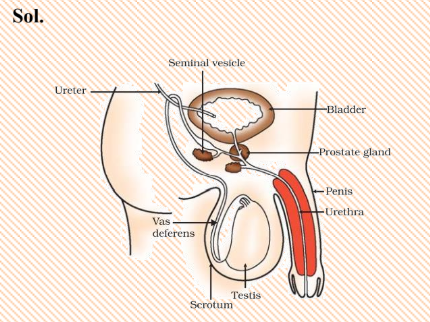
Various parts of a male reproductive system are as follows:
-
A pair of testes – Testes secrete male sex hormone testosterone which helps in regulation of spermatogenesis and also keeps structure and function of secondary sex types like facial, axial and pubic hair, voice, moustache, etc. Testes are present in a small pouch called scrotum.
-
Epididymis – It is a long spiral tube. The head is linked with testis and tail is linked with vas deferens.
-
Vas deferens – It is a long tube which begins from the tail of epididymis. The sperms formed are transported through vas deferens.
-
Urethra – It receives the vas deferens from both the testes. It opens outside through penis. It carries both sperms and urine.
-
Prostate gland – Prostate gland secretions provide a fluid medium for sperm, which facilitates transport, and also provide nutrition to sperm.
PW Class 10 Science Chapter 7: How do Organisms Reproduce? PDF
PW provides a downloadable PDF featuring important questions and their solutions for CBSE Class 10 Science Chapter 7:How do Organisms Reproduce, which is attached below. You can use this resource for offline study, quick revision, and exam preparation.
Science Chapter 7: How do Organisms Reproduce PDF Download
Explore New Chapters: