

Class 10 Science Chapter 6 Control and Coordination often feels challenging because it combines multiple concepts like the nervous system, hormones, and plant responses within the CBSE Class 10 Science syllabus. You may find it difficult to connect processes such as reflex actions, brain functions, and chemical coordination, making revision confusing and retention harder during exams.
With Physics Wallah’s Class 10 Science important questions, you concentrate on high-weightage areas such as reflex actions, brain structure, neurons, and plant hormones. The emphasis is on strengthening conceptual clarity while improving how you present answers. With regular practice, recalling diagrams becomes quicker, processes become easier to interpret, and tackling CBSE board questions feels more precise and manageable.
Class 10 Science Control and Coordination Most Important Question Answers
Strengthen your understanding of Control and Coordination Class 10 Important Questions with the Answers given below. Practice concepts like the nervous system, hormones, plant and animal responses, reflex actions, and coordination mechanisms to boost your exam score.
Multiple Choice Question (1 Mark)
1. Junctions of two neurons are called.
(A) Synapse (B) Synapsis
(C) Joint (D) Junction
Ans. (A) Synapse
2. Which of the following is a plant hormone?
(A) Insulin (B) Thyroxine
(C) Oestrogen (D) Cytokinin
Ans. (D) Cytokinin
3. When a person is suffering from severe cold, he or she cannot –
(A) Differentiate the taste of an apple from that of an ice–cream.
(B) Differentiate red light from the green light.
(C) Differentiate a hot object from a cold object.
(D) Differentiate the smell of perfume from that of an agarbatti
Ans. (D) Differentiate the smell of perfume from that of an agarbatti.
4. Medulla oblongata of hindbrain controls
(A) Rate of heartbeat (B) Posture
(C) Thinking (D) Vision
Ans. (A) Rate of heartbeat
5. Due to stimulation of the sympathetic nervous system
(A) Rate of heartbeat increases
(B) Saliva secretion decreases
(C) Gastric secretion decreases
(D) All of these
Ans. (D) All of these
6. Which among the following hormones is associated with closure of stomata to prevent transpiration.
(A) ABA (B) Cytokinin
(C) Gibberellins (D) Auxin
Ans. (A) ABA
7. Which hormone plays a crucial role in apical dominance in plants?
(A) ABA (B) Cytokinin
(C) Gibberellins (D) Auxin
Ans. (D) Auxin
8. Seismonastic movements are shown by which plant?
(A) Indian telegraph plant
(B) Touch-me-not plant
(C) Cucumber plant
(D) Rose plant
Ans. (B) Touch-me-not plant
9. Assertion: Nerve impulses are carried from gustatory cells of taste buds to the brain.
Reason: The Taste center in the brain is responsible for perceiving the taste sensation.
(A) Both Assertion and Reason are true and Reason is the correct explanation for Assertion.
(B) Both Assertion and Reason are true and Reason is not the correct explanation for Assertion.
(C) Assertion is true but Reason is false.
(D) Assertion is false but Reason is true.
Ans. (A) Both Assertion and Reason are true and Reason is the correct explanation for Assertion.
10. Assertion: Adrenal medulla and sympathetic nervous system are said to function in a closely integrated system.
Reason: Both Adrenal medulla and sympathetic nervous system gets stimulated in physical and emotional stress conditions.
(A) Both Assertion and Reason are true and Reason is the correct explanation for Assertion.
(B) Both Assertion and Reason are true and Reason is not the correct explanation for Assertion.
(C) Assertion is true but Reason is false.
(D) Assertion is false but Reason is true.
Ans. (A) Both Assertion and Reason are true and Reason is the correct explanation for Assertion.
Also, CBSE Class 10 Science Sample Papers help students practise board-level questions, understand the exam format, and identify preparation gaps. Regular practice enhances accuracy, time management, problem-solving skills, and confidence.
Very Short Answer Type Question [1 Mark]
11. Why is it advised to use iodised salt in our diet?
Sol. Iodine stimulates the thyroid gland to produce thyroxine hormone. Deficiency of this hormone results in the enlargement of the thyroid gland. This can lead to goitre.
12. What do you mean by geotropism?
Sol. The growth of a plant due to gravitational force is called geotropism. Growth in the direction of the force (downward) is known as positive geotropism and the growth in the direction opposite to the force (upward) is known as negative geotropism.
13. Name the two sets of nerves that constitute the peripheral nervous system.
Sol. The two sets of nerves that constitute the peripheral nervous system are:
I. Spinal nerves – 12 pairs
II. Cranial nerves – 31 pairs
14. Give an example of a plant hormone that promotes its growth. Where is it synthesized?
Sol. Plant hormone that promotes growth is auxin. It is synthesized at the tip of the plant stem.
15. State the function of:
(i) gustatory receptors, and
(ii) olfactory receptors.
Sol. (i) Gustatory receptors – These are sensitive to taste.
(ii) Olfactory receptors – These are sensitive to smell.
16. Name the part of the brain which controls posture and balance of the body.
Sol. Cerebellum in hind-brain controls the posture and balance of the body.
17. How is the spinal cord protected in the human body?
Sol. The spinal cord is enclosed in a bony cage called the vertebral column.
18. A young green plant receives sunlight from one direction only. What will happen to its shoots?
Sol. Shoots will bend towards the light and roots away from the light.
Short Answer Type Question [2 Marks]
19. (i) Name the hormones that are released in human males and females when they reach puberty.
(ii) Name a gland associated with brain. Which problem is caused due to the deficiency of the hormone released by this gland?
Sol..
(i) Testes in males produce the hormone testosterone. Ovaries in females produce the hormone estrogen.
(ii) The pituitary gland is a gland associated with the brain. It is often called the “master gland” because it controls the function of many other endocrine glands. A problem caused by the deficiency of the hormone released by the pituitary gland is dwarfism, which occurs due to a deficiency of growth hormone (GH). This hormone deficiency results in stunted growth and delayed development in children.
20. Name the two main organs of our central nervous system. Which one of them plays a major role in sending command to muscles to act without involving the thinking process? Name the phenomenon involved.
Sol. The two main organs of the CNS are brain and spinal cord. Spinal cord plays a major role in sending commands to muscles to act without involving the thinking process. This phenomenon is called reflex action.
21. Name the hormone secreted by human testes. State its functions.
Sol. Testes secrete a male sex hormone called testosterone. The function of testosterone is to stimulate spermatogenesis during puberty and also stimulate muscular growth, growth of facial and axillary hair, aggressiveness, low pitch of voice etc.
22. Name and explain the function of any two hormones secreted by the pituitary gland in humans.
Sol.
-
Growth hormone: It regulates growth and development of bones and muscles.
-
Oxytocin hormone: It stimulates ejection of milk during lactation.
23. What are ‘nastic’ and ‘curvature’ movements? Give one example of each.
Sol. Nastic movements: These are non-directional movements which are neither towards nor away from the stimulus. Example: Dropping of leaves.
Curvature movements: Curvature movements are directional changes in the orientation of plant parts in response to stimuli. Example: Bending of the shoot towards a source of light.
24. Write the name and functions of any two parts of the human hind-brain.
Sol.
(i) Cerebellum: Controls coordination of body movement and posture.
(ii) Medulla oblongata: Contains the centres of swallowing, coughing, sneezing and vomiting.
25. What are plant hormones? Write two important functions of auxin.
Sol. Plant hormones are chemical substances produced naturally in plants that regulate physiological processes.
Two functions of auxin:
-
Initiates rooting in stem cuttings.
-
Prevents early fruit/leaf drop and promotes shedding of older leaves/fruits.
26. What causes a tendril to encircle or coil around the object in contact with it? Explain the process involved.
Sol. When a tendril comes in contact with any support, the part in contact grows slower than the part away from the object. This causes the tendril to circle around and cling to it.
Short Answer Type Question [3 Marks]
27. State how the concentration of auxin stimulates the cells to grow longer on the side of the shoot which is away from light?
Sol.
I. Auxin accumulates on the shaded side.
II. Auxin promotes cell elongation by loosening cell walls.
III. Cells on shaded side elongate more, bending the shoot toward light (phototropism).
28. What is synapse? In a neuron cell, how is an electrical impulse created, and what is the role of a synapse in this context?
Sol. A synapse is the gap between two neurons.
Electrical impulse creation:
-
Stimulus triggers chemical reaction in cell body.
-
Ions redistribute, creating voltage difference.
-
Impulse travels along axon.
Role of synapse: -
Neurotransmitters released into synaptic gap.
-
The next neuron receives signal and continues impulse transmission.
29. Write one example each of the following tropic movements:
(i) Positive phototropism – shoots growing towards light
(ii) Negative phototropism – roots growing away from light
(iii) Positive geotropism – growth of roots towards earth
(iv) Negative geotropism – shoots growing away from earth
(v) Hydrotropism – roots growing towards water
(vi) Chemotropism – pollen tubes growing towards ovules
30. (a) Explain any three directional movements in plants.
(b) How are the brain and spinal cord protected in humans?
(c) Name the master gland present in the brain.
Sol.
(a) Phototropism: Movement toward/away from light
Geotropism: Movement toward/away from the Earth
Hydrotropism: Movement toward water
(b) Brain protected by skull; spinal cord protected by vertebral column; both cushioned by meninges and cerebrospinal fluid.
(c) Pituitary gland
31. (a) Explain how auxins help in the bending of the plant stem towards light.
(b) State the objective of the experiment for which the experimental set-up is shown in the given diagram.
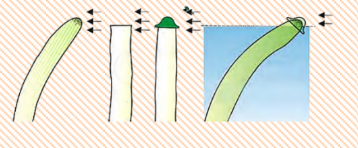
Sol. (a) In plant shoots, the role of auxin is to cause a positive phototropism, i.e. to grow the plant towards the light. When light is incident on a plant from one direction, it causes the auxins to redistribute towards the shaded side of the plant. One function of auxin is to cause cell elongation. The redistribution causes the cells on the shaded side to elongate more, making the shoot bend towards the light than those on the side with the light shining on them. This causes the shoot to bend towards the light.
(b) The objective of the experiment is to show the phototropic movement of the plant.
32. Name any three endocrine glands in human body and briefly write the function of each of them.
Sol. Three endocrine glands with their function in human body are as follows:
-
Thyroid gland: It secretes a hormone called thyroxine. Thyroid hormones play an important role in the regulation of the basal metabolic rate. These hormones also support the process of red blood cell formation. Thyroid hormones control the metabolism of carbohydrates, proteins and fats.
-
Adrenal gland: It secretes two hormones – adrenaline (epinephrine) and nor-adrenaline (nor-epinephrine). These hormones are secreted in response to any kind of stress and emergency situations. Thus, they are called as "fight or flight hormones" or "emergency hormones".
-
Pancreas: It secretes two hormones — insulin and glucagon. Insulin hormone lowers the blood glucose level. Glucagon hormone increases the blood glucose level.
33. What is ‘chemotropism’? Give one example. Name any two plant hormones and mention their functions.
Sol. Chemotropism is the movement of a part of the plant in response to a chemical stimulus. It can be positive chemotropism or negative chemotropism.
Example: The growth of pollen tube towards a chemical which is produced by an ovule during the process of fertilisation in a flower.
Two plant hormones with their functions are as follows:
-
Auxins promote cell elongation, root formation, cell division, respiration and other physiological processes like protein synthesis, etc.
-
Gibberellins stimulate stem elongation, seed germination and flowering.
34. State the functions of any three parts of the structural and functional unit of nervous system.
Sol. The structural and functional unit of the nervous system is the neuron. Here are the functions of three key parts of a neuron:
-
Cell body: Contains the nucleus and cytoplasm; responsible for maintaining metabolic activities of the neuron. It processes incoming signals and integrates information before transmitting it to the axon
-
Dendrites: Branched extensions that receive signals (or stimuli) from other neurons or sensory receptors. They transmit these signals toward the cell body.
-
Axon: A long, slender projection that transmits electrical impulses away from the cell body to other neurons, muscles, or glands.
35. What is ‘hydrotropism’? Describe an experiment to demonstrate ‘hydrotropism’.
Sol. Hydrotropism is the directional growth of a plant part in response to water. For example, roots show hydrotropism as they grow towards water in the soil and are positively hydrotropic.
Experiment to demonstrate hydrotropism:
-
A porous pot filled with water is taken and inserted in a tub filled with dry sand.
-
A freshly germinated pea seedling is sowed in the sand.
-
As water is not available in sand, the root will bend towards the porous pot filled with water.
-
A hydrotropic curvature of the root is observed as it grows towards water.
-
This bending of root shows the movement in response towards water.
36. What are ‘hormones’? State one function of each of the following hormones: (i) Thyroxine (ii) Insulin
Sol. Hormones are the chemical substances that coordinate and control the activities of living organisms and also their growth. The term hormone was introduced by Bayliss and Starling.
(i) Function of Thyroxine: Thyroid hormones play an important role in the regulation of the basal metabolic rate. They also support red blood cell formation and control the metabolism of carbohydrates, proteins and fats.
(ii) Function of Insulin: Insulin plays a major role in the regulation of glucose homeostasis. It enhances cellular glucose uptake and utilisation, leading to decreased blood glucose levels (hypoglycemia).
37. What is the function of receptors in our body? Think of a situation where receptors do not work properly. What problems are likely to arise?
Sol. Receptors are present in all parts of the body, for example, in the skin, eye, nose, tongue etc. They detect the signals and then send them to the brain in the form of electrical signals. If these receptors are damaged, they will not detect the input, which leads to harm to our bodies in dangerous situations.
38. State the functions of plant hormones. Name five different types of plant hormones.
Sol. Plant hormones help to coordinate growth, development and responses in the environment.
Five different types of plant hormones are – Auxins, Gibberellins, Cytokinins, Ethylene and Abscisic acid.
A. Auxins control the tropic (growth-related) movements of the plants in response to light, gravity, touch etc. by increasing the size of cells. Under the influence of auxins, the plant stem bends towards unidirectional light whereas the roots bend away from it.
B. Gibberellins stimulate stem elongation and leaf expansion. Its application causes stem elongation in small plants such as cabbage. Spraying gibberellins on sugarcane plants increases the stem size and hence the yield.
C. Cytokinins are produced in regions of the plant body where rapid cell division occurs, such as root tips, developing shoot buds, young fruits and seeds. Cytokinins promote growth by stimulating cell division. They also help in production of new leaves and chloroplasts in leaves.
D. Ethylene causes ripening of the fruits.
E. Abscisic acid inhibits (i.e., slows down) the growth in different parts of the plant body. It also inhibits germination of seeds. It increases the tolerance of plants to different kinds of stresses such as temperature changes. So, it is also called the stress hormone in plants.
39. Smita’s father has been advised by a doctor to reduce his sugar intake.
(i) Which disease is he likely suffering from, and which hormone is deficient in this condition?
(ii) Identify the gland that secretes it and mention the function of this hormone.
(iii) Explain how the time and amount of secretion of this hormone is regulated in human system.
Sol.
(i) He is suffering from diabetes mellitus. A deficiency of insulin causes diabetes.
(ii) The pancreas secretes insulin. Insulin helps in regulating blood sugar as it enhances cellular glucose uptake and utilisation. As a result, there is a rapid movement of glucose from blood to hepatocytes and adipocytes, resulting in decreased blood glucose levels (hypoglycemia).
(iii) When the sugar level in blood increases, it is detected by the β-cells of the pancreas, which respond by producing more insulin. As the blood sugar level falls, insulin secretion is reduced.
40. State the function of the different parts of the brain.
Sol. The major parts of the brain are the forebrain, midbrain and hindbrain.
The forebrain includes the cerebrum and olfactory lobes. The hindbrain includes the cerebellum, pons and the medulla oblongata.
• Forebrain
The forebrain contains various regions responsible for processing stimuli and generating responses. It includes the cerebrum, which is divided into lobes:
-
Occipital lobe: Responsible for visual perception and processing visual information.
-
Temporal lobe: Processes auditory information; involved in hearing, language comprehension and memory.
-
Frontal lobe: Controls speech (Broca’s area), voluntary movements, decision-making, problem-solving and emotional regulation.
-
Parietal lobe: Processes sensory information related to touch and temperature.
Olfactory system: The sensation of smell is received by the olfactory receptors in the nasal cavity, and signals are sent to the olfactory bulb, which is part of the forebrain (limbic system).
• Midbrain
The midbrain (part of the brainstem) is involved in reflex movements related to visual and auditory stimuli.
-
Reflexive eye movements (such as tracking moving objects).
-
Head and neck movements in response to sudden sounds or bright light.
• Hindbrain
The hindbrain has the cerebellum, pons and the medulla oblongata.
-
Cerebellum: Controls coordination of body movements and posture
-
Pons: Involved in regulation of respiration.
-
Medulla: Controls respiration, cardiovascular reflexes and gastric secretions.
41. "Reflex arcs continue to be more efficient for quick responses". Justify this statement giving reason.
Sol. Reflex arcs continue to be more efficient for quick responses because they allow the body to respond to harmful stimuli almost instantaneously, without involving higher brain centers.
-
Direct pathway via the spinal cord:
Reflex arcs bypass the brain by sending signals directly to the spinal cord, where a quick decision is made. This reduces the time taken for the response. -
Faster reaction time:
In harmful situations (e.g., touching a hot object), reflex arcs ensure a response within milliseconds, preventing injury. -
Automatic, involuntary response:
Reflex arcs control involuntary actions like blinking or withdrawing a hand without conscious thought.
Example:
When you touch a hot surface, sensory nerves send the signal to the spinal cord which immediately sends a motor signal to withdraw the hand—faster than brain processing.
Thus, reflex arcs provide rapid protection against harmful stimuli.
42. (a) Name the hormone which is released into the blood when its sugar level rises. Also mention the digestive enzymes secreted by this organ with one function of each.
(b) Explain the need of chemical communication in multicellular organisms.
Sol.
(a) Hormone and Digestive Enzymes
-
The hormone released when blood sugar level rises is insulin, produced by the β-cells of the pancreas.
Insulin regulates blood glucose levels by promoting uptake of glucose by cells.
Digestive enzymes secreted by the pancreas:
-
Amylase: Breaks down starches into simple sugars.
-
Lipase: Breaks down fats into fatty acids and glycerol.
-
Trypsin: Breaks down proteins into peptides and amino acids.
(b) Need for Chemical Communication in Multicellular Organisms
-
Coordination and Regulation: Specialised cells need to work together; hormones and neurotransmitters regulate body functions.
-
Homeostasis: Helps maintain stable internal conditions (e.g., blood sugar, metabolism, temperature).
-
Response to Stimuli: Enables quick and efficient responses to external stimuli (e.g., stress → adrenaline release).
-
Growth and Development: Hormones regulate proper development of tissues and organs.
43. Draw a well-labeled diagram of a neuron and explain the following terms:
(A) Axon
(B) Dendrites
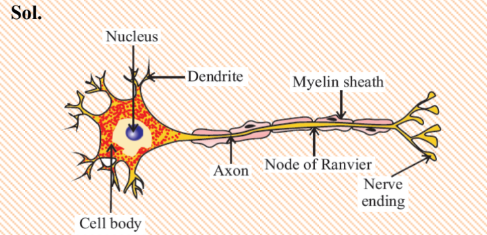
(A) Axon:
The elongated nerve fiber that conducts electrical impulses away from the neuron’s cell body.
(B) Dendrites:
Branch-like extensions of a neuron that receive signals from other neurons.
Case Study Questions:
1. The diagram given below represents an endocrine gland in the human body.
Study the diagram and answer the following questions.
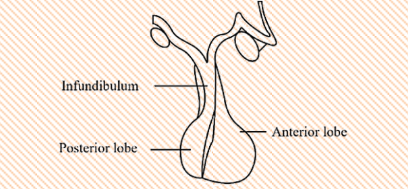
(i) Identify the endocrine gland. Where is it located?
Sol. The given gland is pituitary and it is located at the base of hypothalamus in the brain.
(ii) Why is the above gland referred to as the ‘Master gland’?
Sol. It is called the master gland as it controls secretions of various other endocrine glands by its own hormones, e.g., TSH (Thyroid Stimulating Hormone) released by pituitary controls the secretion of thyroid gland.
(iii) In the given diagram, identify the hormone released by posterior lobe which causes diabetes insipidus and how does this differ from diabetes mellitus?
Sol. The deficiency of ADH (Anti-diuretic hormone). ADH means less absorption of water from filtrate in kidneys and hence, voluminous urine discharge.
(iv) Which lobe of the above gland secretes:
(A) Oxytocin
(B) ACTH
(C) Growth hormone
Sol.
(A) Posterior
(B) Anterior
(C) Anterior
2. Study the following diagram and answer the following questions.
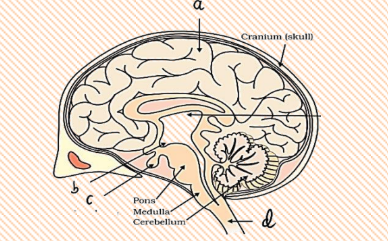
(i) What are the major parts of the brain? (1 mark)
Sol. The major parts of brain are as follows: Forebrain, Midbrain, and Hindbrain.
(ii) Label part ‘a’ and mention its functions. (1 mark)
Sol. ‘a’ is cerebrum. Its functions are as follows:
(i) The cerebrum controls the voluntary motor actions.
(ii) It is the site of sensory perceptions; like tactile and auditory perceptions.
(iii) It is the seat of learning and memory.
(iii) Name one hormone secreted by labelled part ‘c’ and mention its name. (1 mark)
Sol. ‘c’ is pituitary gland. It secretes growth hormone.
(iv) State the function of medulla. (1 mark)
Sol. Medulla forms the brain stem, along with the pons. It lies at the base of the brain and continues into the spinal cord. Medulla controls various involuntary functions; like heart beat, respiration, etc.
3. Given below is an experimental setup to demonstrate a particular tropic movement in germinating seeds. Study the diagram and answer the following questions:
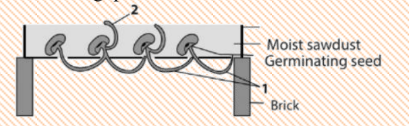
(i) Label the parts 1 and 2
Sol. 1 – Radicle, 2 – Plumule
(ii) Name the tropic movement shown by part I.
Sol. Hydrotropism and geotropism
(iii) Part I is affected by two stimuli. Name them. Which one of the two is stronger?
Sol. Part I is affected by water and gravity; water is stronger.
(iv) What is thigmotropism? Give one example.
Sol. Thigmotropism is movement towards touch, e.g., tendrils of pea plant grow towards support.
PW Class 10 Science Chapter 6 Control and Coordination PDF
PW provides a downloadable PDF featuring important questions and their solutions for CBSE Class 10 Science Chapter 6: Control and Coordination is attached below. You can use this resource for offline study, quick revision, and exam preparation
Science Chapter 6 Control and Coordination PDF Download
Explore New Chapters:
CBSE Important Questions for Class 10 Science Chapter 6 FAQs
What topics are covered in Control and Coordination Class 10?
How can I prepare for Control and Coordination questions?
Are plant hormones important for exams?
Why are reflex arcs important?