The Central Board of Secondary Education Class 12 Physics board exam will be held on 20 February. At this stage, revising important and scoring chapters like Nuclei is essential for better performance. This topic includes key concepts such as radioactive decay, binding energy, and nuclear reactions. NCERT Solutions for Class 12 Physics Chapter 13 help students understand concepts clearly and practice exam-focused questions effectively.
NCERT Solutions for Class 12 Physics Chapter 13 Nuclei
NCERT Solutions for Class 12 Physics Chapter 13 Nuclei help students revise this important Modern Physics chapter efficiently as the CBSE board exams approach.
Nuclei Class 12 Solutions provide clear, step-by-step explanations for all textbook questions. It covers key topics such as radioactive decay, mass defect, binding energy, half-life, and nuclear reactions.
Class 12 Nuclei NCERT Exercise-wise Solutions
Exercise-wise NCERT Solutions for Class 12 Nuclei are arranged exactly according to the NCERT textbook. Below are the Class 12 Physics Nuclei NCERT Solutions are Explained step by step:
Question 1. Obtain the binding energy (in MeV) of a nitrogen nucleus , given=14.00307 u
Solution : Atomic mass of nitrogen,
m = 14.00307 u
A nucleus of nitrogencontains 7 protons and 7 neutrons. Hence, the mass defect of this nucleus, Δm = 7mH + 7mn − m
Where, Mass of a proton, mH = 1.007825 u Mass of a neutron, mn= 1.008665 u
∴Δm = 7 × 1.007825 + 7 × 1.008665 − 14.00307 = 7.054775 + 7.06055 − 14.00307 = 0.11236 u But 1 u = 931.5 MeV/c2
∴Δm = 0.11236 × 931.5 MeV/c2
Hence, the binding energy of the nucleus is given as: Eb = Δmc2 Where, c = Speed of light
∴Eb = 0.11236 × 931.5 (MeV/c2) = 104.66334 MeV
Hence, the binding energy of a nitrogen nucleus is 104.66334 MeV.
Question 2. Obtain the binding energy of the nuclei and
and in units of MeV from the following data:
m= 55.934939 u
m= 208.980388 u
Solution : Atomic mass of, m1 = 55.934939 unucleus has 26 protons and (56 − 26) = 30 neutrons
Hence, the mass defect of the nucleus, Δm = 26 × mH + 30 × mn − m1 Where, Mass of a proton, mH = 1.007825 u Mass of a neutron, mn = 1.008665 u
∴Δm = 26 × 1.007825 + 30 × 1.008665 − 55.934939 = 26.20345 + 30.25995 − 55.934939 = 0.528461 u But 1 u = 931.5 MeV/c2
∴Δm = 0.528461 × 931.5 MeV/c2 The binding energy of this nucleus is given as: Eb1 = Δmc2 Where, c = Speed of light
∴Eb1 = 0.528461 × 931.5 (MeV/c2) = 492.26 MeV Average binding energy per nucleon 492.26/56 = 8.79 MeV Atomic mass of, m2 = 208.980388 unucleus has 83 protons and (209 − 83) 126 neutrons.
Hence, the mass defect of this nucleus is given as: Δm' = 83 × mH + 126 × mn − m2 Where, Mass of a proton, mH = 1.007825 u
Mass of a neutron, mn = 1.008665 u
∴Δm' = 83 × 1.007825 + 126 × 1.008665 − 208.980388 = 83.649475 + 127.091790 − 208.980388 = 1.760877 u
But 1 u = 931.5 MeV/c2 ∴Δm' = 1.760877 × 931.5 MeV/c2 Hence, the binding energy of this nucleus is given as: Eb2 = Δm'c2 = 1.760877 × 931.5(MeV/c2) = 1640.26 MeV Average binding energy per nucleon = 1640.26/209 = 7.848 MeV
Question 3. A given coin has a mass of 3.0 g. Calculate the nuclear energy that would be required to separate all the neutrons and protons from each other. For simplicity assume that the coin is entirely made of atoms (of mass 62.92960 u).
Solution : Mass of a copper coin, m’ = 3 g
Atomic mass ofatom,
m = 62.92960 u
The total number ofatoms in the coin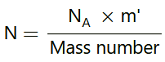
Where, NA = Avogadro’s number = 6.023 × 10²³ atoms /g Mass number = 63 g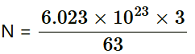 nucleus has 29 protons and (63 − 29) 34 neutrons
∴Mass defect of this nucleus, Δm' = 29 × mH + 34 × mn − m Where, Mass of a proton, mH = 1.007825 u Mass of a neutron, mn = 1.008665 u
∴Δm' = 29 × 1.007825 + 34 × 1.008665 − 62.9296 = 0.591935 u
Mass defect of all the atoms present in the coin, Δm = 0.591935 × 2.868 × 1022 = 1.69766958 × 10²² u But 1 u = 931.5 MeV/c2
∴Δm = 1.69766958 × 1022 × 931.5 MeV/c2
Hence, the binding energy of the nuclei of the coin is given as: Eb= Δmc2 = 1.69766958 × 1022 × 931.5 (MeV/c2) = 1.581 × 1025 MeV But 1 MeV = 1.6 × 10⁻¹³ J Eb = 1.581 × 1025 × 1.6 × 10−13 = 2.5296 × 10¹² J
This much energy is required to separate all the neutrons and protons from the given coin.
Question 4. Obtain approximately the ratio of the nuclear radii of the gold isotope and the silver isotope
 .
.
Solution : Nuclear radius of the gold isotope Nuclear radius of the silver isotope
 Mass number of gold, AAu = 197 Mass number of silver, AAg = 107 The ratio of the radii of the two nuclei is related with their mass numbers as:
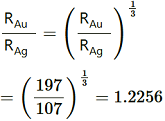
Hence, the ratio of the nuclear radii of the gold and silver isotopes is about 1.23.
Question 5. The Q value of a nuclear reaction A + b → C + d is defined by Q = [ mA+ mb− mC− md]c2 where the masses refer to the respective nuclei. Determine from the given data the Q-value of the following reactions and state whether the reactions are exothermic or endothermic. (i) (ii)
(ii) Atomic masses are given to be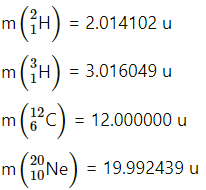
Solution : (i) The given nuclear reaction is: It is given that: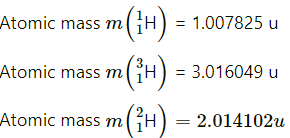
According to the question, the Q-value of the reaction can be written as: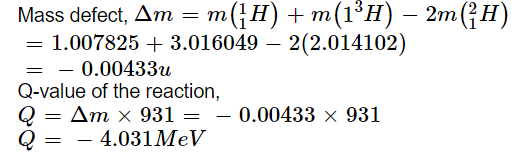
The negativeQ-value of the reaction shows that the reaction is endothermic. (ii) The given nuclear reaction is:It is given that:The Q-value of this reaction is given as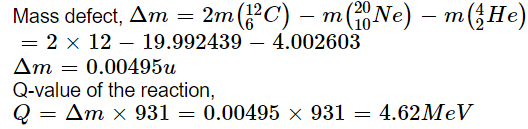 The positive Q-value of the reaction shows that the reaction is exothermic.
Question 6: Solution : The fission of
 can be given as:
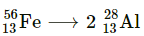 It is given that: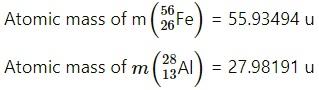
The Q-value of this nuclear reaction is given as: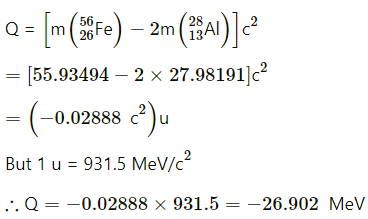
The Q-value of the fission is negative. Therefore, the fission is not possible energetically. For an energetically-possible fission reaction, the Q-value must be positive.
Question 7. The fission properties of 239 94 Pu are very similar to those of 235 92 U . The average energy released per fission is 180 MeV. How much energy, in MeV, is released if all the atoms in 1 kg of pure 239 94 Pu undergo fission?
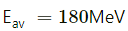
Solution : Average energy released per fission of ,
,
Amount of pure, m = 1 kg = 1000 g NA= Avogadro number = 6.023 × 10²³ Mass number of= 239 g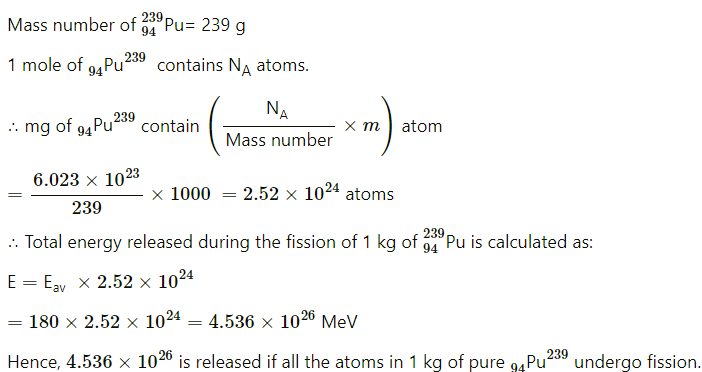
Question 8. How long can an electric lamp of 100W be kept glowing by fusion of 2.0 kg of deuterium? Take the fusion reaction as
Solution : The given fusion reaction is:Amount of deuterium, m = 2 kg 1 mole, i.e., 2 g of deuterium contains 6.023 × 10²³ atoms.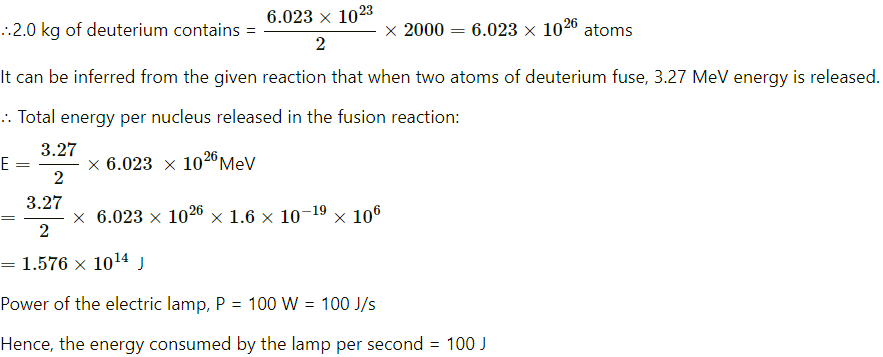 It can be inferred from the given reaction that when two atoms of deuterium fuse, 3.27 MeV energy is released. ∴Total energy per nucleus released in the fusion reaction: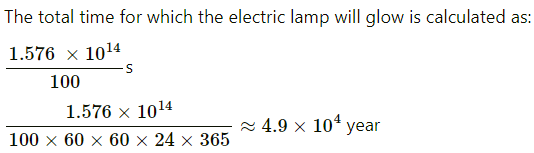
Question 9. Calculate the height of the potential barrier for a head on collision of two deuterons. (Hint: The height of the potential barrier is given by the Coulomb repulsion between the two deuterons when they just touch each other. Assume that they can be taken as hard spheres of radius 2.0 fm.)
Solution : When two deuterons collide head-on, the distance between their centres, d is given as: Radius of 1st deuteron + Radius of 2nd deuteron Radius of a deuteron nucleus = 2 fm = 2 × 10⁻¹⁵ m ∴d = 2 × 10⁻¹⁵ + 2 × 10−15 = 4 × 10⁻¹⁵ m Charge on a deuteron nucleus = Charge on an electron = e = 1.6 × 10⁻¹⁹ C Potential energy of the two-deuteron system: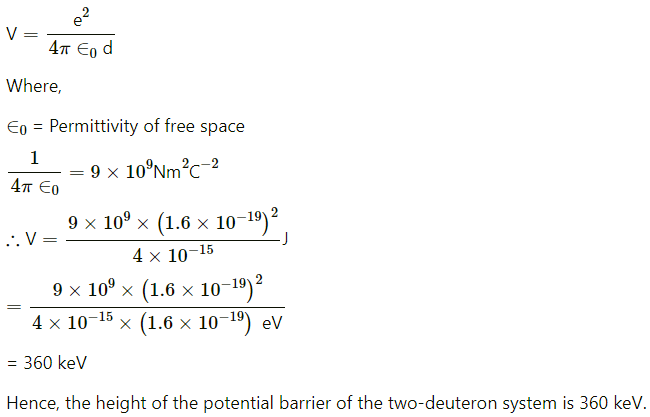 Question 10. From the relation R = R0A1/3, where R0 is a constant and A is the mass number of a nucleus, show that the nuclear matter density is nearly constant (i.e. independent of A).
Solution : We have the expression for nuclear radius as: R = R0A1/3 Where, R0 = Constant. A = Mass number of the nucleus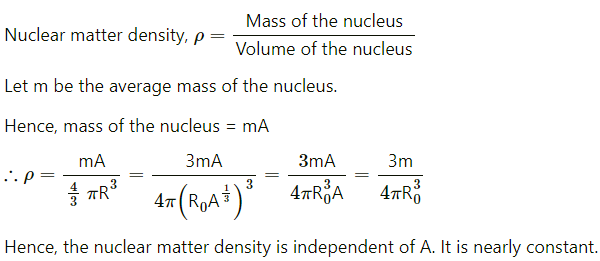
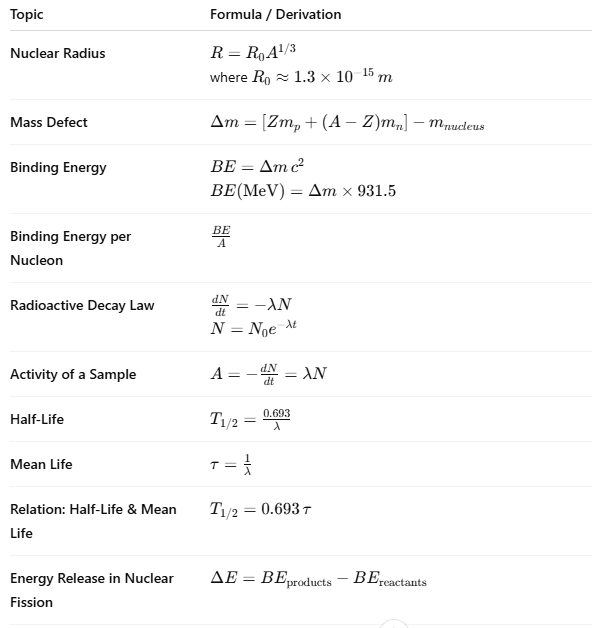
NCERT Solutions Nuclei Class 12 (Important Formulas & Derivations)
The Nuclei chapter heavily relies on formulas and standard derivations, which often carry direct marks in the board exam. NCERT Solutions Nuclei Class 12 highlight all important formulas, decay equations, binding energy relations, and key derivations in a simple and exam-friendly manner.