







With the CBSE Class 12 Physics board exam scheduled for February 20, 2026, this is the right time to revise theory-based and scoring chapters like Electromagnetic Waves. Questions from the electromagnetic spectrum, properties of EM waves, and their applications are frequently asked in CBSE Class 12th board exams.
At this stage, missing out on direct theory questions can lead to avoidable loss of marks. NCERT Solutions for Class 12 Physics Chapter 8 Electromagnetic Waves help students revise quickly, understand key concepts clearly, and prepare precise, exam-oriented answers as per the CBSE marking scheme.
Electromagnetic Waves NCERT Solutions for Class 12 Physics
Electromagnetic Waves NCERT Solutions provide clear and concise explanations of all important topics, including the nature of electromagnetic waves, Maxwell’s contribution, and the electromagnetic spectrum.
These solutions are especially useful for last-minute revision, as they simplify theoretical concepts and help students remember key points and applications that are commonly tested in board exams.
NCERT Solutions for Class 12 Physics Chapter 8 Electromagnetic Waves
NCERT Solutions for Chapter 8 Electromagnetic Waves cover all textbook questions with accurate, CBSE-aligned answers.
The solutions focus on explaining concepts like radio waves, microwaves, infrared, visible light, ultraviolet, X-rays, and gamma rays, along with their uses. Class 12 Electromagnetic Waves NCERT Solutions (All Exercises) are given here:
Question 1. Figure 8.5 shows a capacitor made of two circular plates each of radius 12 cm, and separated by 5.0 cm. The capacitor is being charged by an external source (not shown in the figure). The charging current is constant and equal to 0.15A.
(a) Calculate the capacitance and the rate of change of potential difference between the plates.
(b) Obtain the displacement current across the plates.
(c) Is Kirchhoff’s first rule (junction rule) valid at each plate of the capacitor? Explain. 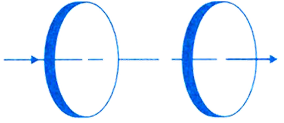
Solution : Radius of each circular plate, r = 12 cm = 0.12 m Distance between the plates, d = 5 cm = 0.05 m Charging current, I = 0.15 A Permittivity of free space, = 8.85 × 10⁻¹² C2 N−1 m−2
(a) Capacitance between the two plates is given by the relation,
C
Where, A = Area of each plate
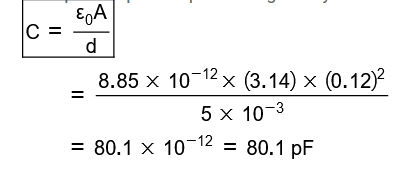
Charge on each plate, q = CV Where, V = Potential difference across the plates Differentiation on both sides with respect to time (t) gives: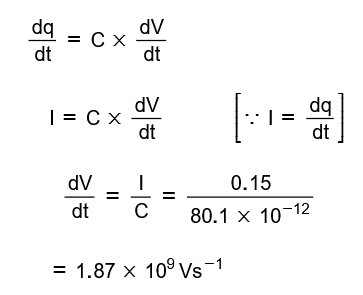
Therefore, the change in potential difference between the plates is 1.87 ×10⁹ V/s.
(b) The displacement current across the plates is the same as the conduction current. Hence, the displacement current, id is 0.15 A.
(c) Yes Kirchhoff’s first rule is valid at each plate of the capacitor provided that we take the sum of conduction and displacement for current.
Question 2. A parallel plate capacitor (Fig. 8.7) made of circular plates each of radius R = 6.0 cm has a capacitance C = 100 pF. The capacitor is connected to a 230 V ac supply with a (angular) frequency of 300 rad s−1.
(a) What is the rms value of the conduction current?
(b) Is the conduction current equal to the displacement current?
(c) Determine the amplitude of B at a point 3.0 cm from the axis between the plates.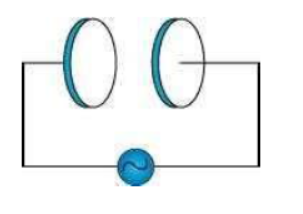
Solution : Radius of each circular plate, R = 6.0 cm = 0.06 m Capacitance of a parallel plate capacitor, C = 100 pF = 100 × 10−12 F Supply voltage, V = 230 V Angular frequency, ω = 300 rad s−1
(a) Rms value of conduction current, I Where, XC = Capacitive reactance
∴ I = V × ωC = 230 × 300 × 100 × 10−12 = 6.9 × 10⁻⁶ A = 6.9 μA Hence, the rms value of conduction current is 6.9 μA.
(b) Yes, conduction current is equal to displacement current.
(c) Magnetic field is given as:
B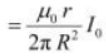 Where, μ0 = Free space permeability
I0 = Maximum value of current =
r = Distance between the plates from the axis = 3.0 cm = 0.03 m
∴B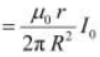 = 1.63 × 10⁻¹¹ T Hence, the magnetic field at that point is 1.63 × 10⁻¹¹ T.
Question 3. What physical quantity is the same for X-rays of wavelength 10−10 m, red light of wavelength 6800 Å and radiowaves of wavelength 500 m?
Solution : The speed of light (3 × 10⁸ m/s) in a vacuum is the same for all wavelengths. It is independent of the wavelength in the vacuum.
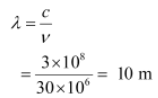
Question 4. A plane electromagnetic wave travels in vacuum along z-direction. What can you say about the directions of its electric and magnetic field vectors? If the frequency of the wave is 30 MHz, what is its wavelength?
Solution : The electromagnetic wave travels in a vacuum along the z-direction. The electric field (E) and the magnetic field (H) are in the x-y plane. They are mutually perpendicular. Frequency of the wave, ν = 30 MHz = 30 × 106 s−1 Speed of light in a vacuum, c = 3 × 10⁸ m/s Wavelength of a wave is given as:
Question 5. A radio can tune in to any station in the 7.5 MHz to 12 MHz band. What is the corresponding wavelength band ?
Solution : A radio can tune to minimum frequency, ν1 = 7.5 MHz= 7.5 × 10⁶ Hz Maximum frequency, ν2 = 12 MHz = 12 × 106 Hz Speed of light, c = 3 × 10⁸ m/s Corresponding wavelength for ν1 can be calculated as:
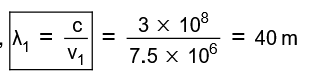
Corresponding wavelength for ν2 can be calculated as: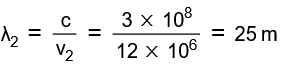
Thus, the wavelength band of the radio is 40 m to 25 m.
Question 6. A charged particle oscillates about its mean equilibrium position with a frequency of 109 Hz. What is the frequency of the electromagnetic waves produced by the oscillator?
Solution : The frequency of an electromagnetic wave produced by the oscillator is the same as that of a charged particle oscillating about its mean position i.e., 109 Hz.
Question 7. The amplitude of the magnetic field part of a harmonic electromagnetic wave in vacuum is B0 = 510 nT. What is the amplitude of the electric field part of the wave?
Solution : Amplitude of magnetic field of an electromagnetic wave in a vacuum, B 0 =51 0 nT=510×10 −9 T Speed of light in vacuum, c = 3×10 8 m/s Amplitude of electric field of an electromagnetic wave is given by the relation, E=cB 0 =3×10 8 ×51 0 ×10 −9 =153N/C Therefore, the electric field part of the wave is 153 N/C.
Question 8. Suppose that the electric field amplitude of an electromagnetic wave is E0 = 120 N/C and that its frequency is ν = 50.0 MHz. (a) Determine, B0, ω, k, and λ. (b) Find expressions for E and B.
Solution : Electric field amplitude, E0 = 120 N/C Frequency of source, ν = 50.0 MHz = 50 × 106 Hz Speed of light, c = 3 × 10⁸ m/s (a) Magnitude of magnetic field strength is given as: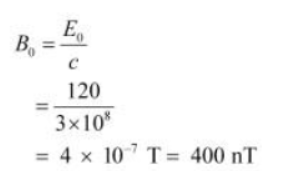
Angular frequency of source is given as: ω = 2πν = 2π × 50 × 106 = 3.14 × 10⁸ rad/s Propagation constant is given as: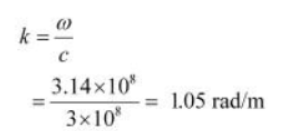
Wavelength of wave is given as: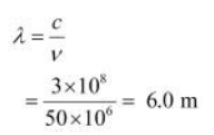
(b) Suppose the wave is propagating in the positive x direction. Then, the electric field vector will be in the positive y direction and the magnetic field vector will be in the positive z direction. This is because all three vectors are mutually perpendicular. Equation of electric field vector is given as: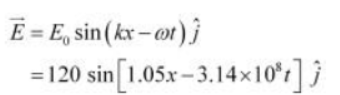
And, magnetic field vector is given as: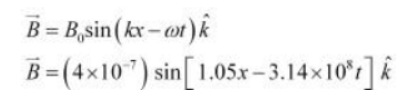
Question 9. The terminology of different parts of the electromagnetic spectrum is given in the text. Use the formula E = hν (for energy of a quantum of radiation: photon) and obtain the photon energy in units of eV for different parts of the electromagnetic spectrum. In what way are the different scales of photon energies that you obtain related to the sources of electromagnetic radiation?
Solution : Energy of a photon is given as: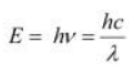
Where, h = Planck’s constant = 6.6 × 10⁻³⁴ Js c = Speed of light = 3 × 10⁸ m/s λ = Wavelength of radiation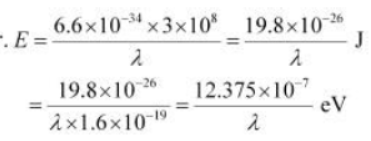
The given table lists the photon energies for different parts of an electromagnetic spectrum for differentλ.
|
λ (m) |
103 |
1 |
10−3 |
10−6 |
10−8 |
10−10 |
10−12 |
|
E (eV) |
12.375 × 10⁻¹⁰ |
12.375 × 10⁻⁷ |
12.375 × 10⁻⁴ |
12.375 × 10⁻¹ |
12.375 × 101 |
12.375 × 10³ |
12.375 × 10⁵ |
The photon energies for the different parts of the spectrum of a source indicate the spacing of the relevant energy levels of the source.
Question 10. In a plane electromagnetic wave, the electric field oscillates sinusoidally at a frequency of 2.0 × 10¹⁰ Hz and amplitude 48 V m−1.
(a) What is the wavelength of the wave?
(b) What is the amplitude of the oscillating magnetic field?
(c) Show that the average energy density of the E field equals the average energy density of the B field. [c = 3 × 10⁸ m s−1.]
Solution : Frequency of the electromagnetic wave, ν = 2.0 × 10¹⁰ Hz Electric field amplitude, E0 = 48 V m−1 Speed of light, c = 3 × 10⁸ m/s
(a) Wavelength of a wave is given as: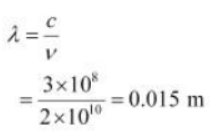
(b) Magnetic field strength is given as: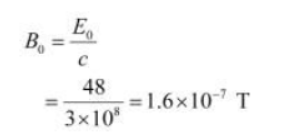
(c) Energy density of the electric field is given as: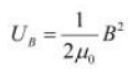
And, energy density of the magnetic field is given as: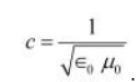
Where, ∈0 = Permittivity of free space μ0 = Permeability of free space We have the relation connecting E and B as: E = cB … (1) Where,… (2) Putting equation (2) in equation (1), we get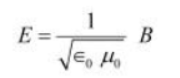
Squaring both sides, we get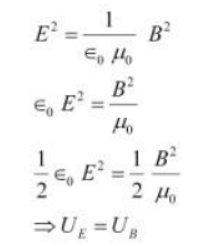
Electromagnetic Waves Class 12 Theory Explained
Here are some important theoretical concepts Class 12th student must know:
-
What are Electromagnetic Waves?
Electromagnetic waves are waves formed due to oscillating electric and magnetic fields that propagate through space without the need for a material medium. The electric field and magnetic field are mutually perpendicular and also perpendicular to the direction of propagation.
-
What is the Speed of Electromagnetic Waves?
All electromagnetic waves travel in vacuum with the same speed, equal to the speed of light, which is approximately 3 × 10⁸ m/s. This speed depends on the electric and magnetic properties of the medium.
-
What is Electromagnetic Spectrum?
The electromagnetic spectrum consists of different types of electromagnetic waves arranged according to increasing wavelength or decreasing frequency, including radio waves, microwaves, infrared rays, visible light, ultraviolet rays, X-rays, and gamma rays.
Last Minute Tips for NCERT Solutions for Class 12 Physics Chapter 8
Here are some Last-Minute Tips for NCERT Solutions for Class 12 Physics Chapter 8 Electromagnetic Waves (especially important before the 20 February 2026 board exam):
-
Revise the electromagnetic spectrum order carefully (Radio → Gamma) along with wavelength and frequency trends.
-
Memorise key properties of EM waves and their common characteristics.
-
Focus on applications of each type of wave — these are often asked in 2–3 mark questions.
-
Go through all NCERT in-text and back exercise questions once.
-
Practise short theoretical answers clearly and write keywords to match the CBSE marking scheme.