






With the CBSE Class 12 Physics Board Exam scheduled on 20 February 2026, students should now focus on revising chapters like Magnetism and Matter, where conceptual clarity and numerical accuracy are essential for answering exam questions effectively.
Important topics such as magnetic field intensity, magnetization, magnetic susceptibility, and hysteresis can often create confusion during last-stage revision if not practised properly. Revisiting these concepts at this time is important because questions based on definitions, relations, and application of formulas are commonly asked in the board examination.
NCERT Solutions for Class 12 Physics Chapter 5 Magnetism and Matter help students overcome these difficulties by providing clear explanations and step-by-step solutions based on the NCERT textbook and the CBSE marking scheme. Focusing on this chapter now supports better understanding of theory-based questions, improves accuracy in numerical problems, and helps students avoid common mistakes in the upcoming board exam.
Class 12 Magnetism and Matter NCERT Solutions
These solutions are structured for last-minute revision. They cover all conceptual questions and numerical problems, ensuring students can quickly recall important points, formulas, and problem-solving techniques.
Following NCERT Solutions for Class 12 Physics allows you to practice efficiently and gain confidence in the final days before the exam.
NCERT Solutions for Class 12 Physics Chapter 5 Magnetism and Matter
NCERT Solutions for Class 12 Physics Chapter 5 Magnetism and Matter cover all the numerical problems. Students can rely on these detailed explanations to clarify doubts and solidify their conceptual knowledge.
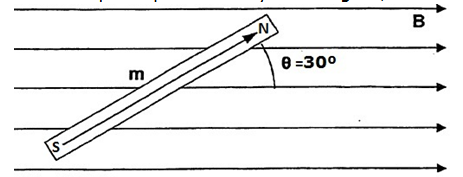
Question 1. A short bar magnet placed with its axis at 30º with a uniform external magnetic field of 0.25 T experiences a torque of magnitude equal to 4.5 × 10⁻² J. What is the magnitude of magnetic moment of the magnet?
Solution : Given: Angle between axis of bar magnet and external magnetic field, θ = 30° Strength of external magnetic field, B = 0.25 T Torque experienced by bar magnet, Τ = 4.5 × 10 -2 J We know that, when a Bar magnet is placed in a uniform magnetic field it experiences a Net torque given by,
T = M × B … (1)
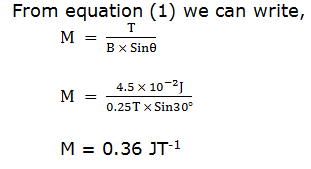
T = M × B × Sinθ Where, M = magnetic moment T = Torque on bar magnet θ = angle between magnetic field and magnetic moment .
Question 2. A short bar magnet of magnetic moment m = 0.32 J T−1 is placed in a uniform magnetic field of 0.15 T. If the bar is free to rotate in the plane of the field, which orientation would correspond to its (a) stable, and (b) unstable equilibrium? What is the potential energy of the magnet in each case?
Solution : Given: Magnetic moment of magnet, M = 0.32JT -1 Strength of external magnetic field, B = 0.15T
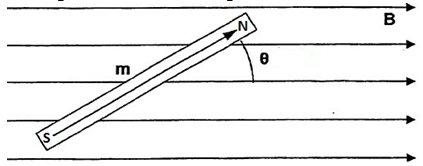
(a) When the magnetic moment is aligned (0°) with the magnetic field then we consider this as stable equilibrium, if the magnet is rotated, then it will have the tendency to come back in this position. θ = 0° We know that, U = - M . B U = -M × B × Cos θ …(1) Where, U = potential energy M = magnetic moment B = magnetic field θ = Angle between filed and magnetic moment
By putting the given values in the equation (1), we have, U = -0.32 × 0.15 × Cos 0° U = -0.048 J Potential energy of the system in stable equilibrium is -0.048 J.
(b) Whereas, in case of unstable equilibrium the moment is at 180° with the magnetic field. If the magnet is rotated then it will never come back in the initial position. θ = 180° Now, by putting values in equation (1), we get, U = -0.32 × 0.15 × Cos 180° U = 0.048 J Potential energy of the system in unstable equilibrium is 0.048J. Note: The direction of the magnetic moment is from south pole to north pole inside the magnet.
Question 3. A closely wound solenoid of 800 turns and area of cross section 2.5 × 10⁻⁴ m2 carries a current of 3.0 A. Explain the sense in which the solenoid acts like a bar magnet. What is its associated magnetic moment?
Solution : Number of turns in the solenoid, n = 800 Area of cross-section, A = 2.5 × 10⁻⁴ m2 Current in the solenoid, I = 3.0 A A current-carrying solenoid behaves as a bar magnet because a magnetic field develops along its axis, i.e., along its length. The magnetic moment associated with the given current-carrying solenoid is calculated as: M = n I A = 800 × 3 × 2.5 × 10−4 = 0.6 J T−1
Question 4. If the solenoid in Exercise 5.5 is free to turn about the vertical direction and a uniform horizontal magnetic field of 0.25 T is applied, what is the magnitude of torque on the solenoid when its axis makes an angle of 30° with the direction of applied field?
Solution : Magnetic field strength, B = 0.5 T Magnetic moment, M = 3.12 T−1 The angle θ, between the axis of the solenoid and the direction of the applied field is 60°. Therefore, the torque acting on the solenoid is given as: τ=MBsin θ = 3.12× 0.5sin60 ° = 13.5×10⁻² J
Question 5. A bar magnet of magnetic moment 1.5 J T−1 lies aligned with the direction of a uniform magnetic field of 0.22 T.
(a) What is the amount of work required by an external torque to turn the magnet so as to align its magnetic moment: (i) normal to the field direction, (ii) opposite to the field direction?
(b) What is the torque on the magnet in cases (i) and (ii)?
Solution : (a) Magnetic moment, M = 1.5JT −1 Magnetic field strength, B = 0.22 T
(i) Initial angle between the axis and the magnetic field, θ1=0 ° Final angle between the axis and the magnetic field, θ2=90 ° The work required to make the magnetic moment normal to the direction of magnetic field is given as: W = −MB(cos θ2 – cos θ1) = −1.5 × 0.22 (cos90 ° – cos0 ° = – 0.33 (0 – 1) = 0.33 J
(ii) Initial angle between the axis and the magnetic field, θ1=0° Final angle between the axis and the magnetic field, θ2 =180 ° The work required to make the magnetic moment opposite to the direction of magnetic field is given as: W = −MB (cosθ2 – cos θ1) = −1.5 × 0.22 (cos180 ° – cos0 °) = – 0.33 (– 1 – 1) = 0.66 J (b) For case (i): θ= θ2=90° ∴ Torque, τ=MBsinθ = MBsin90° = 0.33 J For case (ii): θ= θ2=180 ° ∴ Torque, τ=MBsinθ = MBsin180° = 0 J
Question 6. A closely wound solenoid of 2000 turns and area of cross-section 1.6 × 10⁻⁴ m2, carrying a current of 4.0 A, is suspended through its centre allowing it to turn in a horizontal plane.
(a) What is the magnetic moment associated with the solenoid?
(b) What is the force and torque on the solenoid if a uniform horizontal magnetic field of 7.5 × 10⁻² T is set up at an angle of 30º with the axis of the solenoid?
Solution : Number of turns on the solenoid, n = 1000 Area of cross-section of the solenoid, A = 2×10 −4 m 2 Current in the solenoid, I = 3.0 A
(a) The magnetic moment along the axis of the solenoid is calculated as: M = nAI = 1000 × 2 × 10 −4 ×3 = 0.6 Am2
(b) Magnetic field, B = 5.5 × 10 −2 T Angle between the magnetic field and the axis of the solenoid, θ=30° Torque, τ=MB sinθ = 0.6 × 5.5 ×10 − 2 sin30° = 1.65 × 10 −2 Nm Since the magnetic field is uniform, the force on the solenoid is zero. The torque on the solenoid is 1.65×10 −2 Nm.
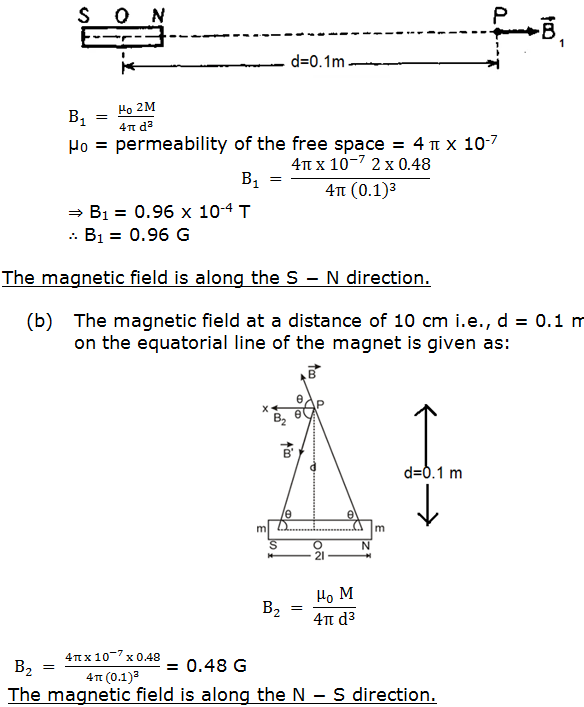
Question 7. A short bar magnet has a magnetic moment of 0.48 J T−1. Give the direction and magnitude of the magnetic field produced by the magnet at a distance of 10 cm from the centre of the magnet on (a) the axis, (b) the equatorial lines (normal bisector) of the magnet.
Solution : Magnetic moment of the bar magnet, M = 0.48 J T −1 (a) Distance, d = 10 cm = 0.1 m The magnetic field at distance d, from the centre of the magnet on the axis is given by the relation:
How Chapter 5 Physics Class 12 NCERT Exercise-Wise Solutions useful?
Chapter 5 Physics Class 12 NCERT exercise-wise solutions are useful because they provide clear and systematic answers to every question given in the textbook.
These solutions help students understand the correct method of solving numerical problems, improve conceptual clarity, and enable effective revision by practicing each exercise thoroughly as per the NCERT Class 12 exam pattern.
-
Help students practice each exercise in a structured and systematic way.
-
Provide accurate, step-by-step solutions as per NCERT guidelines.
-
Improve understanding of both numerical and theoretical questions.
-
Support effective revision before board and competitive exams.
-
Boost confidence by covering all textbook questions thoroughly.